Global views on the treatment of ethnic minorities
Our annual Ipsos Equalities Index, which runs for the second time this year, includes a question designed to discover which groups people believe suffer the most from unfair and unequal treatment in their country.
To mark the International Day for the Elimination of Racial Discrimination, we are publishing some of our findings from this question – specifically how many people identified “ethnic minorities” as one of their answers to it.
- On average across the 30 countries in our study, 1 in 5 (21%) agree that ethnic minorities experience unequal or unfair treatment in their country.
- Younger people tend to be the most sensitive to this form of discrimination, with 1 in 4 (24%; global country average) of Gen Z agreeing that ethnic minorities are unfairly treated where they are.
- Countries with a higher degree of ethnic diversity (such as Indonesia), and those where discrimination on ethnic grounds was legal in relatively recent history (such as the United States and South Africa) typically report higher levels of concern about the issue. It is also possible to see the lingering effects of more distant history in parts of the world where indigenous peoples were displaced and/or there was chattel slavery along racial lines.
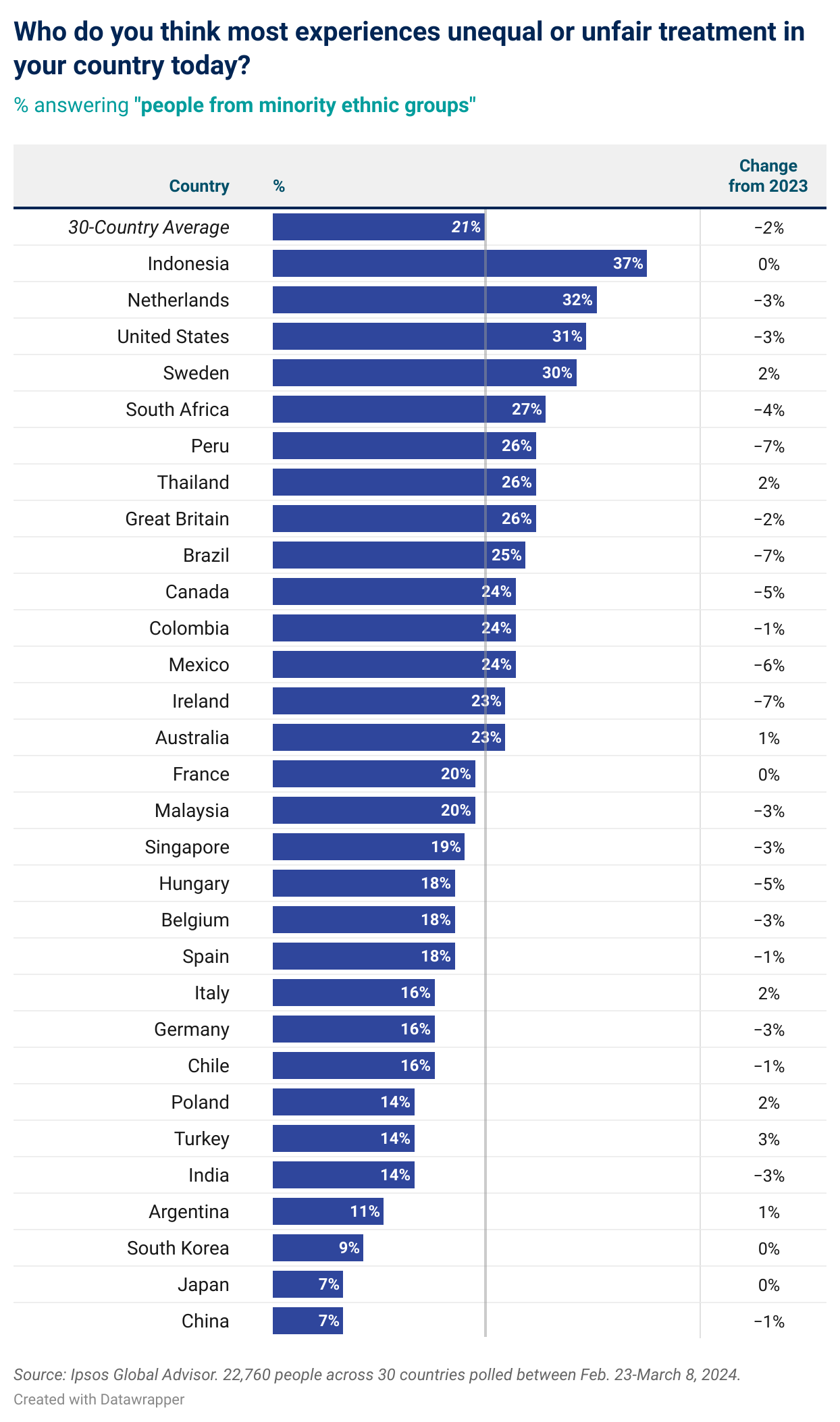
- Conversely, countries that are more ethnically homogeneous and have lower levels of immigration (eg China, Japan and South Korea) are least likely to consider it to be an issue[AT1]
- Money matters: people living in a higher income household are somewhat more likely to be concerned about this form of discrimination than those from lower income households (22% v 18%)
- Education matters: the more educated someone is, the more likely they are to see this type of discrimination in their country: 16% of those defined as having lower levels of education agree that it is an issue vs 20% of those with medium levels of education, and 23% of those with high levels of education.
- Agency matters: those who either own their own business (24% vs 20% of those that don’t), or who are senior execs/decision makers in a business (23% vs 20% of those who aren’t) are also somewhat more likely to agree that ethnic minority groups suffer from unfair discrimination.
About this study
These are the results of a 30-country survey conducted by Ipsos on its Global Advisor online survey platform and, in India, on its IndiaBus platform, between February 23 and March 8, 2024. For this survey, Ipsos interviewed a total of 22,760 adults aged 18 years and older in India, 18-74 in Canada, Republic of Ireland, Malaysia, South Africa, Turkey, and the United States, 20-74 in Thailand, 21-74 in Indonesia and Singapore, and 16-74 in all other countries.