
What we agree on in America’s path forward
Do Republicans and Democrats agree on anything these days?
Against the backdrop of a presidential election that has been described as “a battle for the soul of the nation” and a global pandemic where masks have become a political fault line, it’s understandable to wonder if democracy can survive in our hyper-partisan society.
For the past few years, Ipsos has studied the underlying trends contributing to this uncertainty, including the role of increased tribalism. More recently, however, we have begun to look for areas of agreement among the American public.
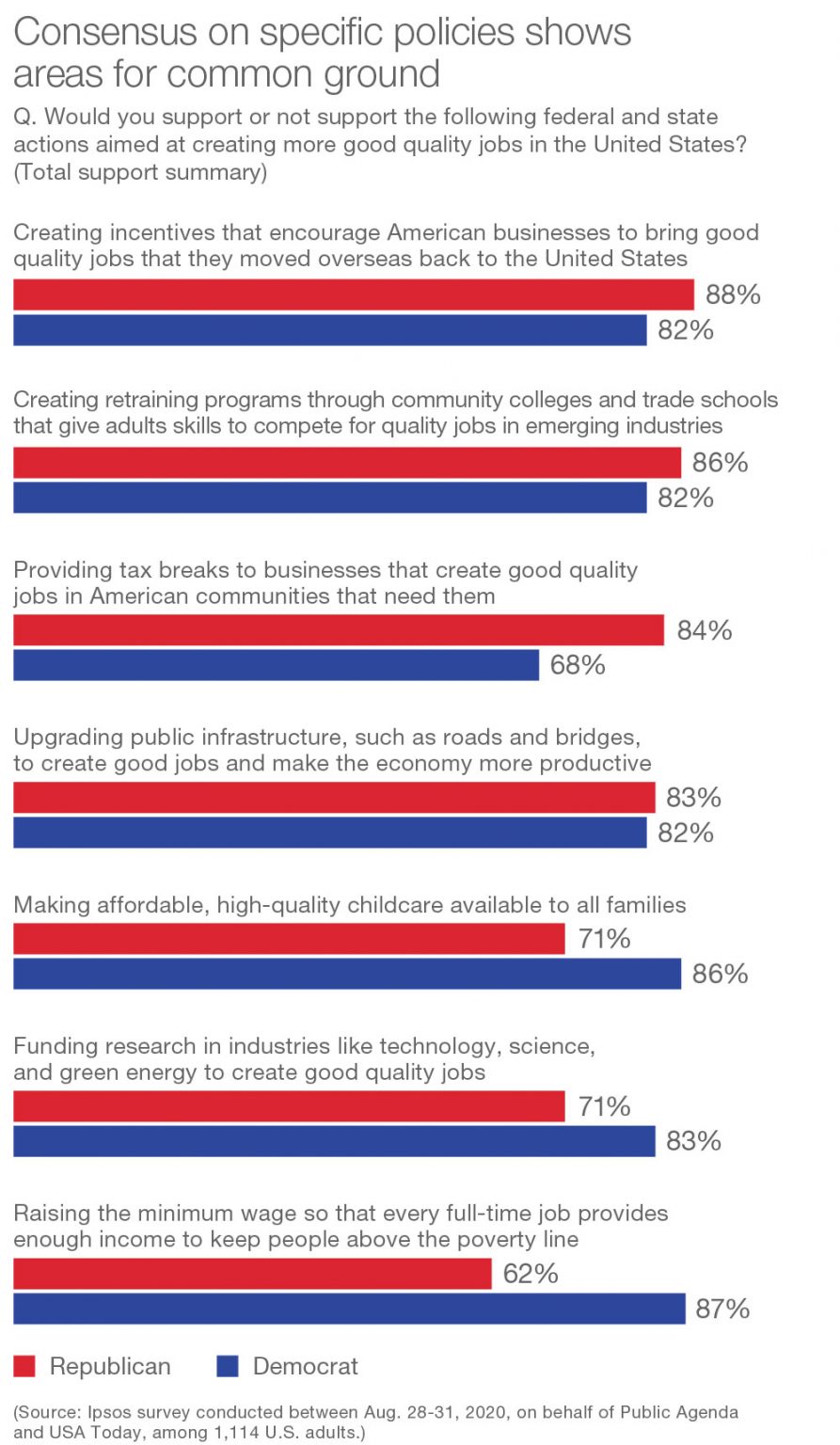
Our inaugural Public Agenda/USA Today/Ipsos Hidden Common Ground survey found that nearly three-quarters of Americans believe there is more common ground among the American people than the news media and political leaders portray. While the desire for common ground is there in theory, are there concrete policies where Americans align?
In a word, yes. Subsequent Hidden Common Ground surveys have found that when it comes to policy proposals on everything from economic opportunity to healthcare to climate change, there is significant cross-partisan support. As the example in the chart shows, we see common ground when policies are stripped of partisan rhetoric or messengers.
Take messaging around healthcare. Asking about “Medicare for All” elicits a highly partisan response; most Democrats support it, while a majority of Republicans oppose it. The same thing is true—in reverse—for calls to “repeal and replace” the Affordable Care Act. Yet, when asked about the principles behind healthcare reform—making sure all Americans have coverage, that people with pre-existing conditions can get affordable insurance and that lower-income people have the same quality of basic care—a strong majority of Democrats and Republicans view these concepts as important. While there are often partisan differences in the solutions, we can’t solve important issues if we get derailed on the highly charged rhetoric.
Therefore, for those looking to build lasting social cohesion, there is a clear path forward: Focus on the principles or policies themselves, not the buzzwords.
For more on our special focus on Democracy, please visit What the Future.
![[WEBINAR] AI in Higher Education: How AI Is Reshaping Teaching and Learning](/sites/default/files/styles/list_item_image/public/ct/event/2026-10/How%20AI%20Is%20Reshaping%20Teaching%20and%20Learning.png?itok=XYdLaI-4)

![[WEBINAR] Winning B2B Buyers: AI Gets You Considered; Trust Gets You Selected](/sites/default/files/styles/list_item_image/public/ct/event/2026-10/Winning%20B2B%20Buyers%20AI%20Gets%20You%20Considered%20Trust%20Gets%20You%20Selected.png?itok=Q4kElwY2)