Cliff’s Take: Our National Dissonance

Peak cherry blossom bloom has come and gone. Traffic has been very heavy here in DC. People are venturing out into the world. It is still scary but less so today.
This is a snapshot of my corner of America, awakening into optimism after a long, dark winter. But it applies to the larger whole.
All this activity reminds me that we are a nation of contradictions. On the one hand is our belief in a better tomorrow and pragmatic exuberance in problem solving. We are outperforming most other nations on vaccine distributions. Think about it. How far we have come!
On the other hand, darker undercurrents are also at play. As a nation, we are prone to distrusting the system. Fundamentally, challenging authority is an American virtue. But it is healthiest in small doses.
When taken to the extreme, fighting back against the system can have destructive consequences—the riot at the US Capitol being just one of the more disturbing recent examples.
In short, as a nation, we contain multitudes. Where these crosscurrents take us is anyone’s guess.
Below, I detail the most relevant polling data points of the week.
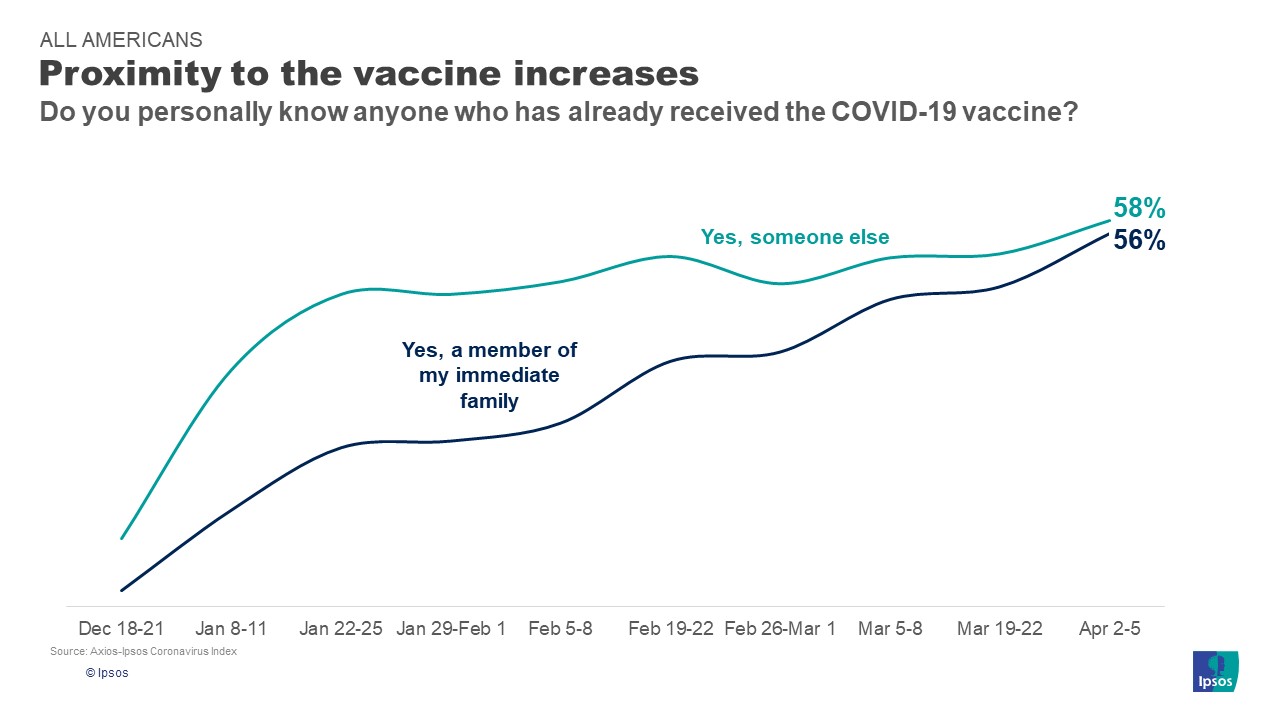
- Vaccine proximity. Per the CDC, we are at 53% of Americans with at least one dose. Our Axios-Ipsos Coronavirus Index tracker, which went to field about a week ago, comes to a similar conclusion - finding that more than half know someone else who has gotten the shot. What does this mean? Americans are less than one degree of separation from the vaccine. We are almost there. The vaccine conditions our optimism.
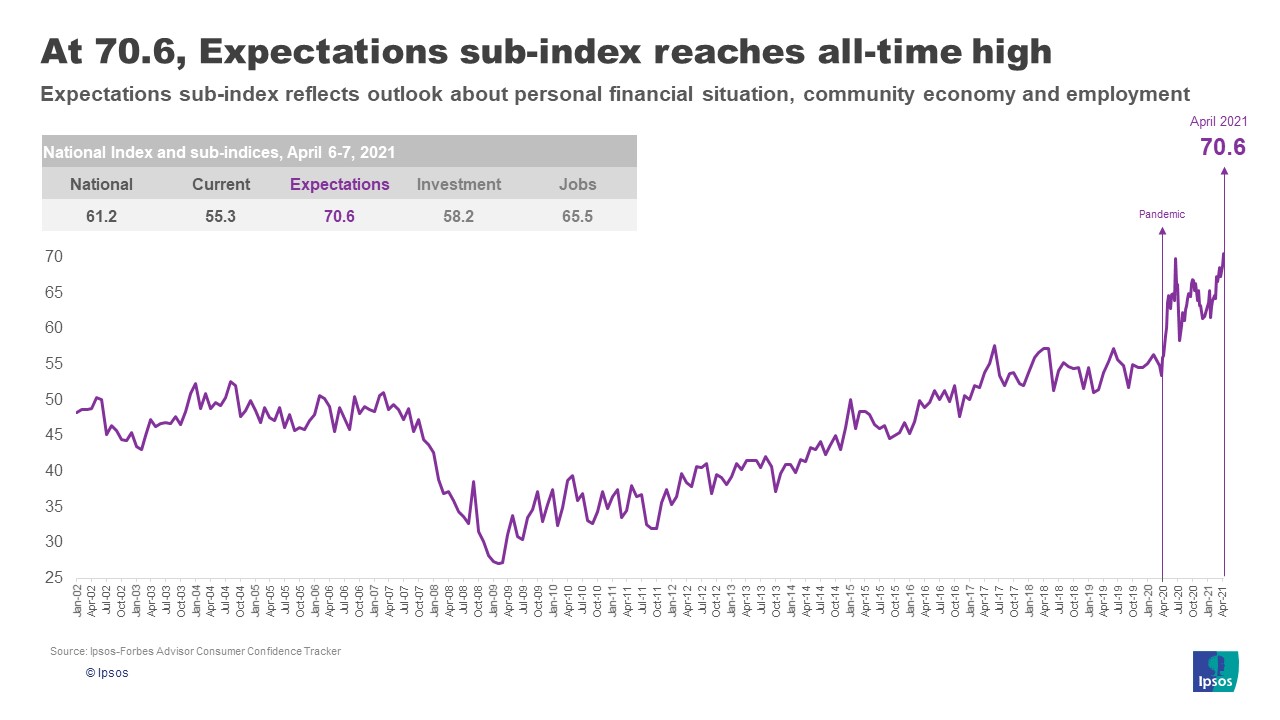
- Breaking records. Americans believe they will be much better off tomorrow than they are today. Look at the data! Expectations (a measure of future outlook around the economy, jobs and personal finances) are at their highest level in our 19-year trendline. Will America deliver? I think so. But we will see.
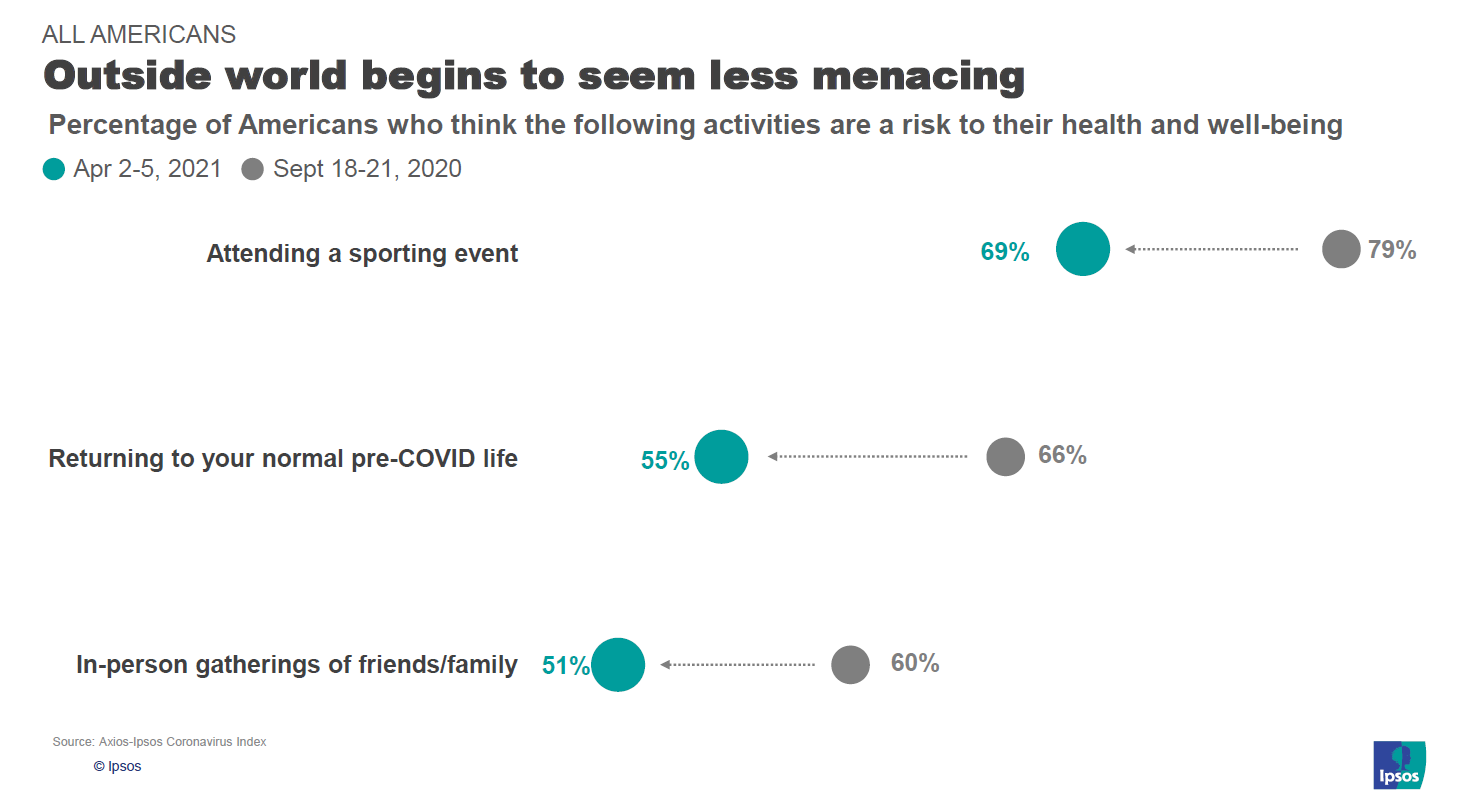
- Emergence. Look at the data. We are venturing out into the world. Of course, thanks to the vaccine: a little bit of liquid courage in the form of a jab.
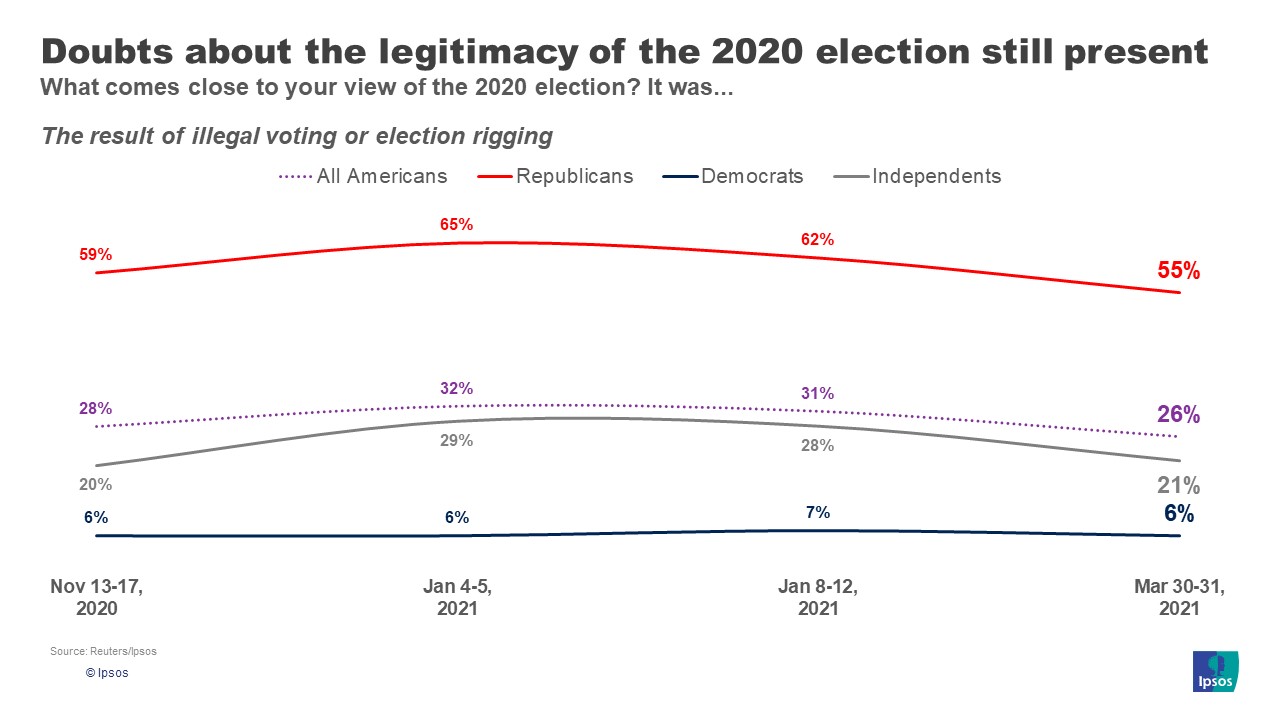
- Doubts persist. Back to politics. One of the most important outcomes of an election is not who wins but whether the losing side recognizes the legitimacy of the results. In the case of Republicans after the 2020 election, it’s clear that most do not. Look at the data. Don’t they say that time heals all wounds? Not here; not now.
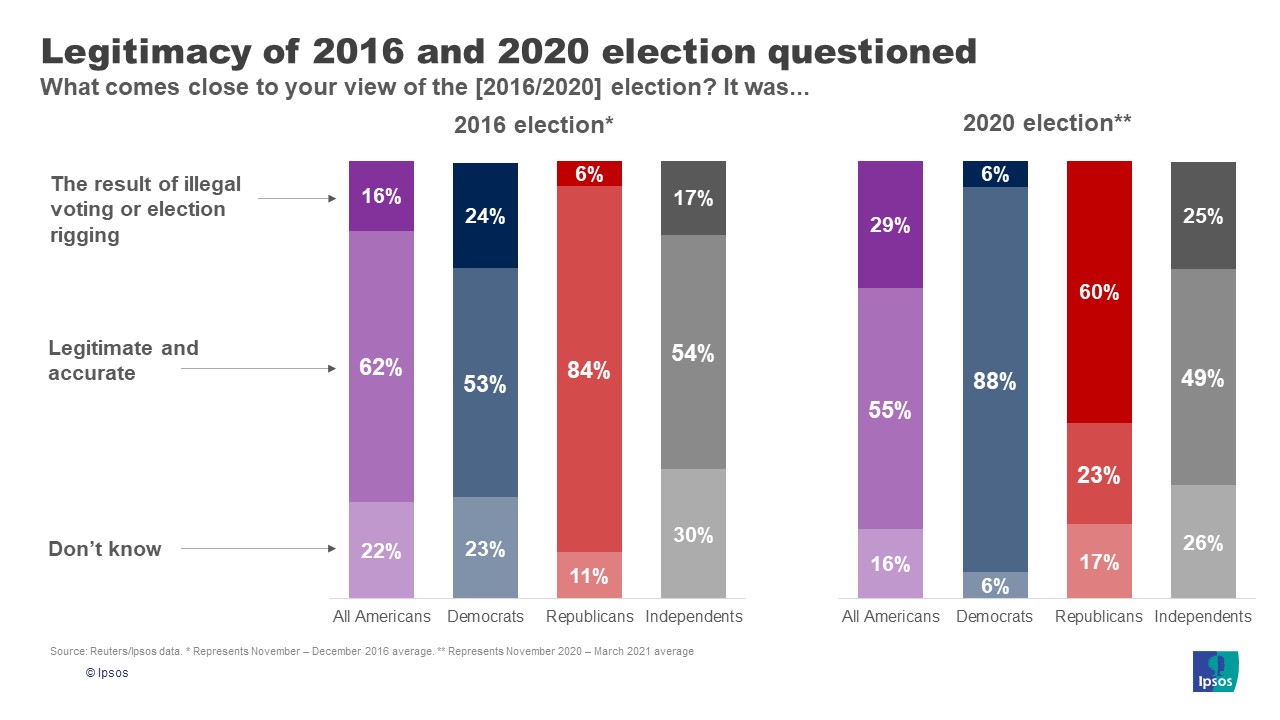
- Mirror image? But wait, weren’t there the same doubts in 2016, just from the other side? Not exactly. The data is clear. Republicans are much more concerned about 2020 than Democrats were about 2016. Fantasy or reality? It doesn’t really matter. Perceptions condition our view on the world. Look at Georgia.
Progress can be choppy—one step backward for every two steps forward. The pandemic may have temporarily thrown us for a loop and underscored just how fractured a nation we have become. But, at least for now, we seem to be moving in the right direction. Optimism, a fundamental American trait.
Be safe and be sane.
For more information, please contact:
Clifford Young
President, U.S.
Public Affairs
+1 202 420-2016
[email protected]
For more information on COVID-19 please click here
About Ipsos
Ipsos is the world’s third largest Insights and Analytics company, present in 90 markets and employing more than 18,000 people.
Our research professionals, analysts and scientists have built unique multi-specialist capabilities that provide powerful insights into the actions, opinions and motivations of citizens, consumers, patients, customers or employees. Our 75 business solutions are based on primary data coming from our surveys, social media monitoring, and qualitative or observational techniques.
“Game Changers” — our tagline — summarizes our ambition to help our 5,000 clients to navigate more easily our deeply changing world.
Founded in France in 1975, Ipsos is listed on the Euronext Paris since July 1st, 1999. The company is part of the SBF 120 and the Mid-60 index and is eligible for the Deferred Settlement Service (SRD).
ISIN code FR0000073298, Reuters ISOS.PA, Bloomberg IPS:FP