
Global Consumer Confidence Index - June 2019
Visit our interactive portal, Ipsos Consolidated Economic Indicators (IpsosGlobalIndicators.com) for graphic comparisons and trended data pertaining to the Ipsos Global Consumer Confidence Index and sub-indices -- and all the questions on which they are based.
Washington, DC, June 21, 2019 – June 2019 sees the Ipsos Global Consumer Confidence Index at 49.6, up 0.3 against last month, at the same level it was three months ago, but down 0.8 of a point over the past year.
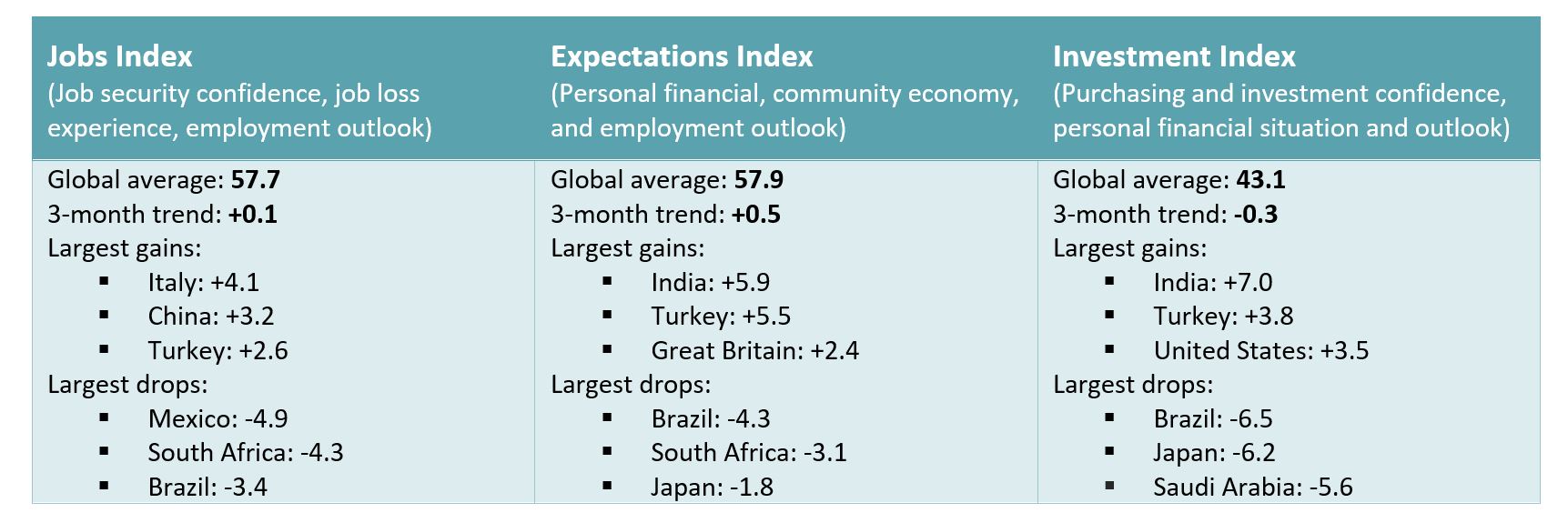
Eight of the 24 countries surveyed see significant three-month gains in their National Index: India (+4.9), Turkey (+3.6), the United States (+2.2), Poland (+2.0), Spain (+1.9), Belgium (+1.9), Sweden (+1.9). and Hungary (+1.8).
Consumer confidence in Japan, Saudi Arabia and Australia show signs of slowing down at varying rates with National Index results declining over the past three months, ranging from 3.2 points in Japan, to 2.7 points in Saudi Arabia, and 1.8 points in Australia. Consumer confidence continues to decline sharply across all three Latin American markets surveyed with three-months drops of 5.0 points in Brazil, 4.1 points in Mexico, and 2.2 points in Argentina. South Africa shows a similar pattern with a three-month decline of 4.3 points.
The Consumer Confidence Index, also called the “National Index,” reflects consumer attitudes on the current and future state of their local economy, their personal finance situations, their savings and their confidence to make large investments.
China continues to enjoy the highest National Index with a score of 69.9; India (65.4), the United States (61.4), Saudi Arabia (61.4), and Sweden (60.4) round off the top-5 markets. At the other end of the spectrum, the countries with the weakest level of consumer confidence are Argentina (34.0), Turkey (35.4), and South Africa (39.2).
About the Study
These findings are based on data from Refinitiv/Ipsos’ Primary Consumer Sentiment Index (PCSI) collected in a monthly survey of consumers from 24 countries via Ipsos’ Global Advisor online survey platform. For this survey, Ipsos interviews a total of 17,500+ adults aged 18-74 in the United States, Canada, China*, Israel, South Africa and Turkey, aged 19-74 in South Korea, and aged 16-74 in the other 17 countries, each month. The monthly sample consists of 1,000+ individuals in each of Australia, Brazil, Canada, China*, France, Germany, Italy, Japan, Spain, Great Britain and the United States, and 500+ individuals in each of Argentina, Belgium, Hungary, India, Israel, Mexico, Poland, Russia, Saudi Arabia, South Africa, South Korea, Sweden and Turkey.
Data collected each month are weighted so that each country’s sample composition best reflects the demographic profile of the adult population according to the country’s most recent census data. Data collected each month are also weighted to give each country an equal weight in the total “global” sample. Online surveys can be taken as representative of the general working age population in Argentina, Australia, Belgium, Canada, France, Germany, Great Britain, Hungary, Italy, Japan, Poland, South Korea, Spain, Sweden, and the United States. Online samples in Brazil, China*, India, Israel, Mexico, Russia, Saudi Arabia, South Africa and Turkey are more urban, more educated and/or more affluent than the general population and the results should be viewed as reflecting the views of a more “connected” population.
Sample surveys and polls may be subject to other sources of error, including, but not limited to coverage error, and measurement error. The precision of the Refinitiv/Ipsos online surveys is measured using a Bayesian Credibility Interval. Here, the poll has a credibility interval of +/- 2.0 points for countries where the 3-month sample is 3,000+ and +/- 2.9 points for countries where the 3-month sample is 1,500+. Please click on this link for more information on credibility intervals.


