Don’t make a mountain out of sample noise
There has been a constant barrage of headlines warning of tightening polls in the lead up to Election Day.
But is the narrowing of the polls real or is it just noise? A closer look at the FiveThirtyEight/Ipsos election tracking program suggests that tightening on the national level may just be the messiness of sample noise and not real, true change.
The Ipsos midterm election series with FiveThirtyEight has gone back to the same 2,000 people since May 2022. Interviewing the same Americans every month and assessing how their views have morphed throughout the election provides a window into how certain events may shape the public’s views on the election.
In other words, going back to the same group of people every month has also allowed us to control for some of the noise that other polls pick up on. Differences this series picks up on over time are actually the same exact people revising their views on who they will vote for, whether they will vote and what they care about.
Ultimately, this tracker found that there has been a slight change in people choosing to turnout as Election Day draws near. However, a widescale tightening or fundamental shift in the race is unlikely.
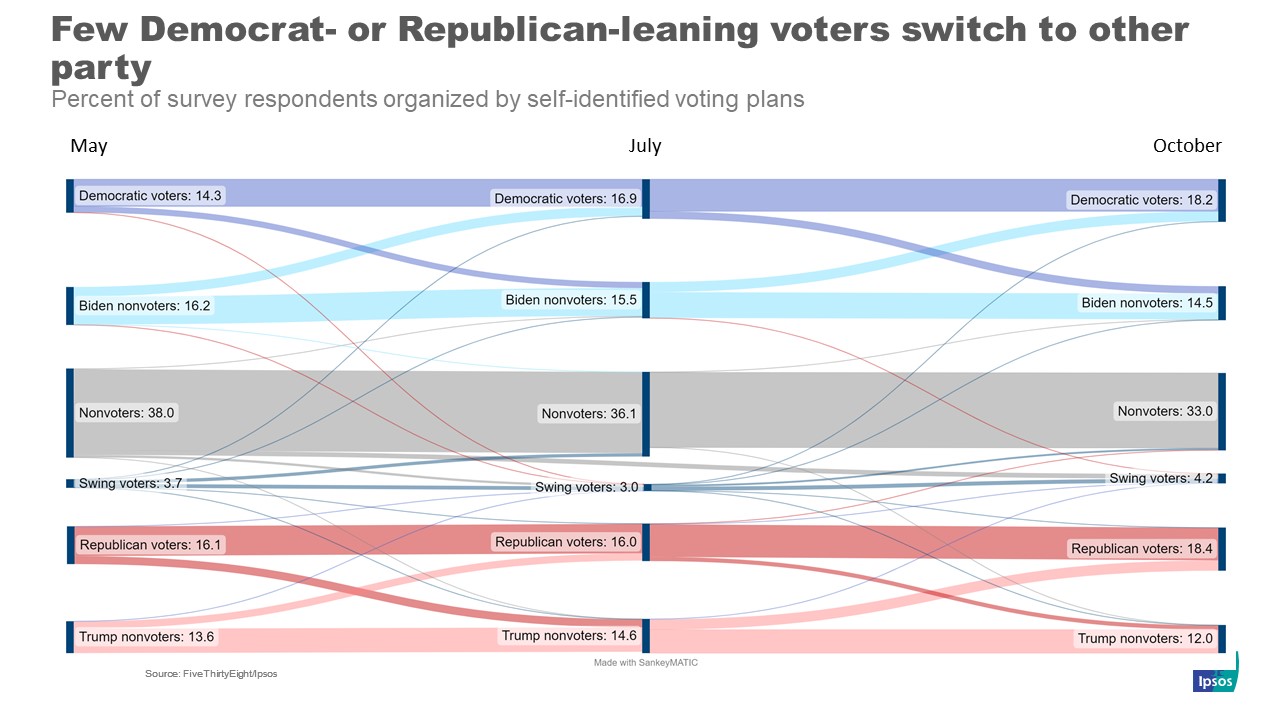
Most of the change over time has come from people who had voted in 2020 but were on the fence about whether they would turnout for their party in the midterms. By comparison, there are very few swing voters. There are roughly three times as many Trump 2020 voters who don't plan on voting in the midterms as there are swing voters. Despite the attention swing voters get, there are more partisans who sit out of elections than switch sides.
Democrats appear to have made greater gains in encouraging Biden’s 2020 base to turnout than Republicans, catching up to Republican’s initial enthusiasm advantage. In May, 14.3% of Democrats who voted for Biden in 2020 said they were certain to vote for a Democrat in 2022. During that same time, 16.1% of Republicans who voted for Trump in 2020 said they would vote for Republicans in the midterms, giving Republicans an edge.
Compared to May, now more of Biden’s 2020 base plan on turning out to vote. In October, 18.2% of Democrats who voted for Biden in 2020 say they’d be certain to turnout to vote in 2022 for Democrats. Between May and October, that represents a 3.9-point swing for Democrats who were Biden voters in 2020 now saying they will turn out to cast a ballot for Democrats in 2022 as well. On the other hand, enthusiasm from Trump’s 2020 base for Republicans (18.2%) has grown but by roughly two-points.
The uptick in stated turnout intention for Democrats may have to do with the overturn of Roe v. Wade in the Dobbs decision. During the summer, following the overturn of the federal right to abortion, more of Biden’s 2020 base started reporting that they would turn out to vote for Democrats this cycle.
Separately, swing voters and their mythic hold over midterms are few and far between. Only a very small percentage of voters are backtracking on how they voted in 2020. From May to July, for example, only about three to four percent of respondents planned on voting differently than they had in 2020, something that remains largely unchanged.
Upon a closer look at the data, theories that independent voters are flocking to Republicans seem to be overplayed. How people voted in 2020 is largely informing how they plan to vote in 2022, and the past few months has done little to change that.
Still, that doesn’t mean that voters or potential voters on the margin are unimportant. Midterm elections are typically decided by a small number of voters that hold firm, passionate beliefs on relatively niche topics.
These elections will end up coming down to how each party is able to mobilize their own base by focusing on key topics that their voters care a lot about, for example women’s rights for Democrats and immigration for Republicans.
What does this mean for the 2022 elections? Well, it at least implicates a media that is quick to assume the oncoming of a complete political realignment after each new fiery headline from the 24/7 news cycle; the reality is that political views, especially political views for partisans, are mostly baked in. It also tells the cautionary tale: polls are noisy, and the appearance of a tightening race almost always deserves a closer examination.
Media experts have long cautioned against the dangers of horserace coverage for political races. Covering political contests like a horserace leaves voters less informed, and more distrustful of both politicians and the media. These results serve as further proof that horserace coverage often makes a mountain of sample noise, something that is not only harmful to the electorate, but inaccurate.