Unpacking our crisis of faith in elections
As we enter the homestretch of 2021, there is much to distract – omicron, inflation, and partisan squabbling on the Hill. On a more positive note, holiday celebrations are about to get into full swing.
But this week, we’re going to step back and take a closer look at perceptions of election integrity, a perennially important issue. With the 2022 midterms soon afoot, this will become increasingly relevant.
A recent Ipsos survey on election fairness, conducted with Axios, shows that a majority believe that the midterm election will accurately reflect the will of the public. Yet fewer – just over half – believe that the next presidential election will be open and fair, putting the country at a 13-point deficit from 64% in 2016.
What’s driving that erosion in confidence in the presidential election? In part, it comes down to vacillating partisan sentiment. But look closer, and the imprint of the 2020 election is clear. Elections have become part of the tribal cage match. Trust in them as a result has suffered.
Some of the findings below.
- Eye of the beholder. Average confidence in the integrity of our presidential elections masks wild swings in partisan sentiment, tracking with whichever party holds the White House. We see partisan opinion flip-flop across other measures – such as views on the direction of the country, and consumer confidence – every time the balance of power shifts. Beauty without doubt is in the eye of the beholder!

- Dirty politics. Yet to attribute the shift in confidence to partisan fickleness alone is to miss the elephant in the room. A substantial minority (25% across the general public) and a majority of Republicans (58%) say that fraudulent voting altered the outcome in 2020. These numbers have held steady for a full year now. Electoral mistrust is engrained in our political DNA.

- Variable validity. Unpack confidence in the outcome of 2022 and 2024, and we see the toxic imprint of the charges of fraud in 2020. People who believe the 2020 election outcome was based on fraud unsurprisingly have very little faith in the integrity of future elections. The effect of the Trump years lingers still.

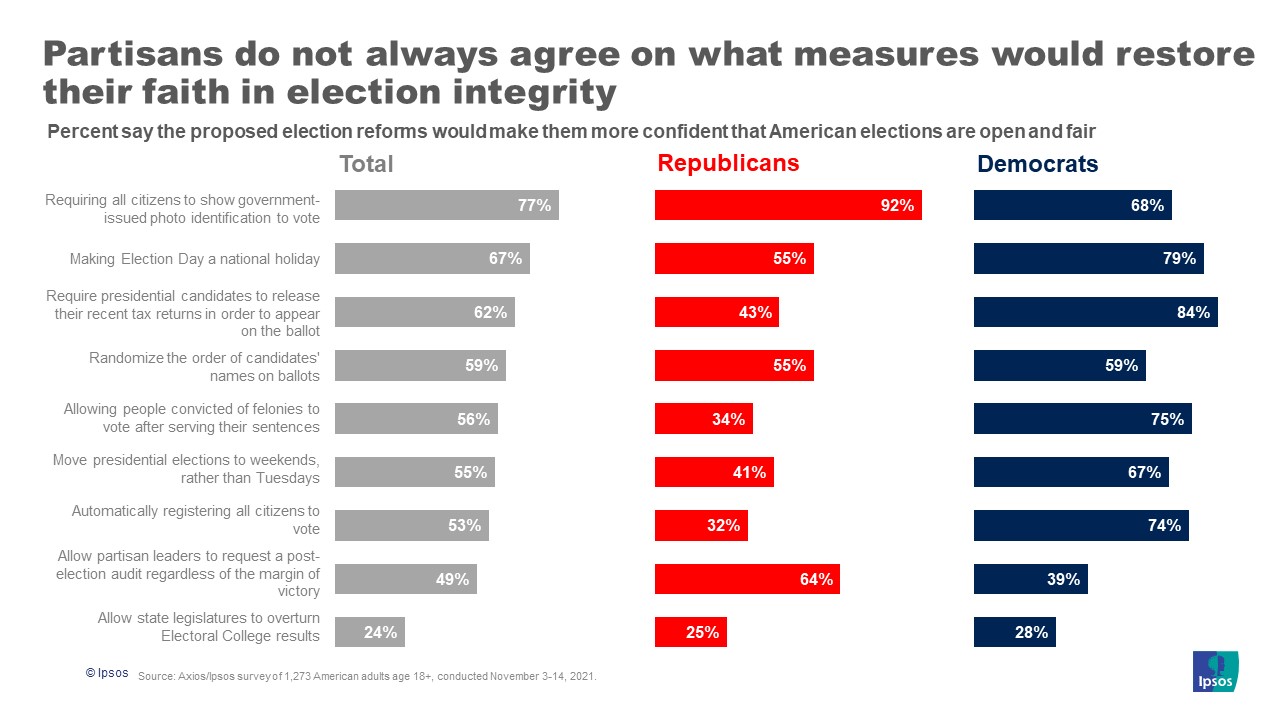
- Restoring faith. So, what measures would help repair this broken trust? We ran a few proposed electoral reforms by the public and found a few areas of common ground. Partisans agree on requiring proof of identification to vote and making Election Day a holiday. But opinion falls apart elsewhere, underlining that the two parties are approaching this central problem from very different places. The tale of two Americas—one blue; the other red.
- Checking out. Remember that despite the general furor around elections, tens of millions of Americans regularly choose not to vote. Indeed, extraordinary turnout was one of the elements that made the 2020 election so unusual. Apathy and disillusionment are primary reasons why people choose to opt out. Below is a profile in disillusionment. Is this our future? Is this the result of our tribal times? We will see.

Doubts about the integrity of our presidential election did not appear out of nowhere. They were present we last ran these questions with CSPAN in 2019. And, as we wrote in 2019, the data then suggested that whatever the outcome was in 2020, a large block of the population was primed to reject the outcome as illegitimate, driven by concerns about the structural integrity of our electoral process and foreign interference.
We’ve since seen those fears come to fruition, as evidenced by the 25% who still believe the election was fraudulent, a year after the fact.
What are the remedies? Our polling points to some reforms that would satisfy both the left and right. But fully restoring faith in the electoral process will likely take a de-escalation of today’s political polarization, an even more elusive goal. Election legitimacy will be central part of politics well into the future.