Veterans are more satisfied with their healthcare than the civilian population
Washington DC, November 07, 2022 – Ipsos polling ahead of Veterans Day finds that most Veterans are more satisfied with their healthcare than general population. Despite this high level of satisfaction, there are many other benefits that Veterans may be eligible for, like career or housing services, but know little about. At the same time, Veterans also know very little about the Promise to Address Comprehensive Toxics Act, legislation signed into law earlier this year to make it easier for Veterans who have been exposed to burn pits to access care. Majorities of Veterans who may be eligible for these expanded benefits reported knowing little about them.
- Veterans are more satisfied with their healthcare than the civilian population.
- Four in five Veterans (80%) are satisfied with their healthcare. By comparison, 70% of all Americans are satisfied with their healthcare.
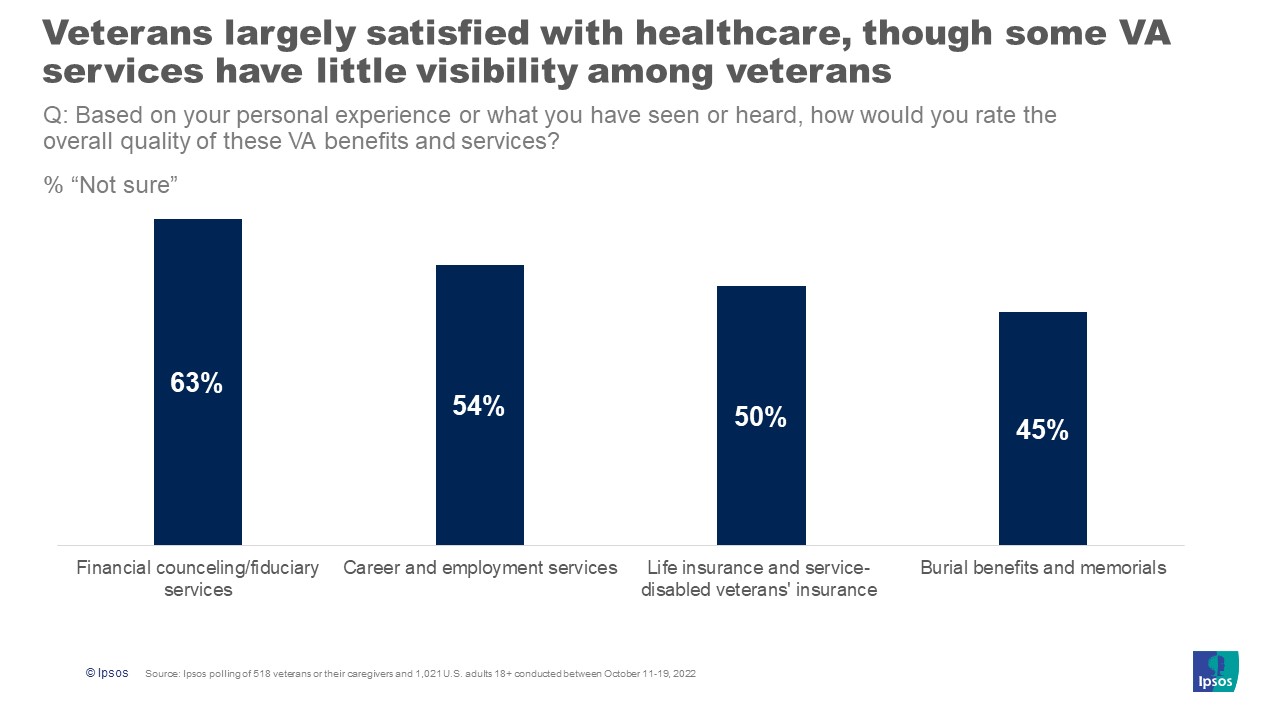
- Many non-healthcare VA services have little familiarity among Veterans.
- When asked how they felt about specific non-healthcare VA services, veterans were by and large unsure how to rate some VA services, indicating an overall lack of familiarity. Most Veterans are unsure on how to rate the VA’s financial services or fiduciary services (63%) and career and employment services (54%), while nearly half of all Veterans are also unsure how to rate the VA’s life insurance and service-disabled Veterans’ insurance (50%), and burial and memorial benefits (45%).
- Most Veterans know little about the PACT Act or the benefits it provides, even Veterans who may qualify for expanded benefits.
- Over three in four Veterans that receive all or some VA benefits (83%) say they know little to nothing about the PACT act. High numbers of veterans that say they were likely exposed to environmental hazards while in the military (75%) also little to nothing about the legislation.
- Familiarity about the PACT Act is highest among veterans who experienced health problems caused by exposure to burn pits, with around half saying they know at least a fair deal about the act (49%).
About the Study
This Ipsos Study was conducted October 13 – October 17, 2022 by Ipsos using our KnowledgePanel®. This poll is based on a nationally representative probability sample of 1,021 adults age 18 or older, including 518 veterans who received all or some benefits from Veterans Affairs and 503 adults from the general population.
The survey was conducted using KnowledgePanel, the largest and most well-established online probability-based panel that is representative of the adult US population. Our recruitment process employs a scientifically developed addressed-based sampling methodology using the latest Delivery Sequence File of the USPS – a database with full coverage of all delivery points in the US. Households invited to join the panel are randomly selected from all available households in the U.S. Persons in the sampled households are invited to join and participate in the panel. Those selected who do not already have internet access are provided a tablet and internet connection at no cost to the panel member. Those who join the panel and who are selected to participate in a survey are sent a unique password-protected log-in used to complete surveys online. As a result of our recruitment and sampling methodologies, samples from KnowledgePanel cover all households regardless of their phone or internet status and findings can be reported with a margin of sampling error and projected to the general population.
The study was conducted in English.
The data for the veteran sample (included those who received and did not receive benefits from Veterans Affairs) were weighted to adjust for gender, age, race/ethnicity, education, Census region, metropolitan status, and household income. The demographic benchmarks of the veteran population came from the 2022 March Supplement of the Current Population Survey (CPS). The sub-set of veterans who received all or some benefits from Veterans Affairs were separated out using their corresponding veteran weights for analyses.
The data for the general population sample were weighted to adjust for gender by age, race/ethnicity, education, Census region, metropolitan status, and household income. The demographic benchmarks of the general population came from the 2022 March Supplement of the Current Population Survey (CPS).
- Gender (Male, Female) by Age (18–29, 30–44, 45–59, and 60+) for the general population sample. For the veteran sample, gender and age were weighted separately and age grouping were slightly different (18-44, 45-54, 55-64, 65-74 and 75+).
- Race/Hispanic Ethnicity (White Non-Hispanic, Black Non-Hispanic, Other or 2+ Races Non-Hispanic, Hispanic)
- Education (Less than High School, High School, Some College, Bachelor and beyond) for the general population sample. For the veteran sample, less than High School and High School were collapsed into a single category for weighting.
- Census Region (Northeast, Midwest, South, West)
- Metropolitan Status (Metro, non-Metro)
- Household Income (Under $25,000, $25,000-$49,999, $50,000-$74,999, $75,000-$99,999, $100,000-$149,999, $150,000+)
Veteran weights:
The margin of sampling error is plus or minus 5.1 percentage points at the 95% confidence level, for results based on the sample of veterans. The margin of sampling error takes into account the design effect, which was 1.40. In our reporting of the findings, percentage points are rounded off to the nearest whole number. As a result, percentages in a given table column may total slightly higher or lower than 100%. In questions that permit multiple responses, columns may total substantially more than 100%, depending on the number of different responses offered by each respondent.
General population weights:
The margin of sampling error is plus or minus 4.6 percentage points at the 95% confidence level, for results based on the sample of veterans. The margin of sampling error takes into account the design effect, which was 1.12. In our reporting of the findings, percentage points are rounded off to the nearest whole number. As a result, percentages in a given table column may total slightly higher or lower than 100%. In questions that permit multiple responses, columns may total substantially more than 100%, depending on the number of different responses offered by each respondent.
For more information on this news release, please contact:
Chris Jackson
Senior Vice President, US
Public Affairs
+1 202 420-2025
About Ipsos
Ipsos is one of the largest market research and polling companies globally, operating in 90 markets and employing over 18,000 people.
Our passionately curious research professionals, analysts and scientists have built unique multi-specialist capabilities that provide true understanding and powerful insights into the actions, opinions and motivations of citizens, consumers, patients, customers or employees. Our 75 solutions are based on primary data from our surveys, social media monitoring, and qualitative or observational techniques.
Our tagline "Game Changers" sums up our ambition to help our 5,000 customers move confidently through a rapidly changing world.
Founded in France in 1975, Ipsos has been listed on the Euronext Paris since July 1, 1999. The company is part of the SBF 120 and Mid-60 indices and is eligible for the Deferred Settlement Service (SRD).ISIN code FR0000073298, Reuters ISOS.PA, Bloomberg IPS:FP www.ipsos.com