
2020 Was a Big Year for Online Sales – But at What Cost?
While marketing managers will tout omnichannel as the ultimate shopping solution, a deeper examination might reveal that not all products and not all categories need an omnichannel approach. So how do you steer shoppers to the proper channel?
Taking a look back at what worked, and what did not in 2020, Ipsos Strategy3 brand experts breakdown insights from shoppers to provide a guide forward in 2021.
2020 WAS A BIG YEAR FOR ONLINE SALES – BUT AT WHAT COST?
Something is missing from the online buying experience. Here’s what brick-and-mortar stores can learn from unhappy shoppers. Online retail sales skyrocketed this past holiday season as many Americans stayed home, avoiding crowded or closed shopping centers and clicking away on Amazon for holiday presents. To some retail analysts, these huge sales numbers might imply that a new world order has been established, and we’d better get used to it. Online shopping is the wave of the future. Not so fast. Signals are coming in that many shoppers are unhappy with how this past holiday season unfolded. The Federal Trade Commission reported that online shopping topped the national list of COVID-19 related consumer complaints, even adjusted for the increase in online shopping year over year. Begrudged online shoppers also take to social media with their complaints which can have a snowball effect on a brand. While an omnichannel strategy is often needed, not every channel will perform equally for all products. Here’s how marketing managers can guide their consumers about where to go for what.
Online shopping stats
According to Adobe Analytics, online retail sales rose 32.2% from 2019, totaling $188.2 billion. Online retailers are touting their successes —Target’s online sales surged 102% between November and December. Meanwhile, brick and mortar businesses facing safety concerns and pandemic restrictions released dismal statistics. Black Friday foot traffic was down more than 52%. Black Friday gave way to Cyber Monday as the biggest online shopping day in the U.S. despite early discounts from retailers.
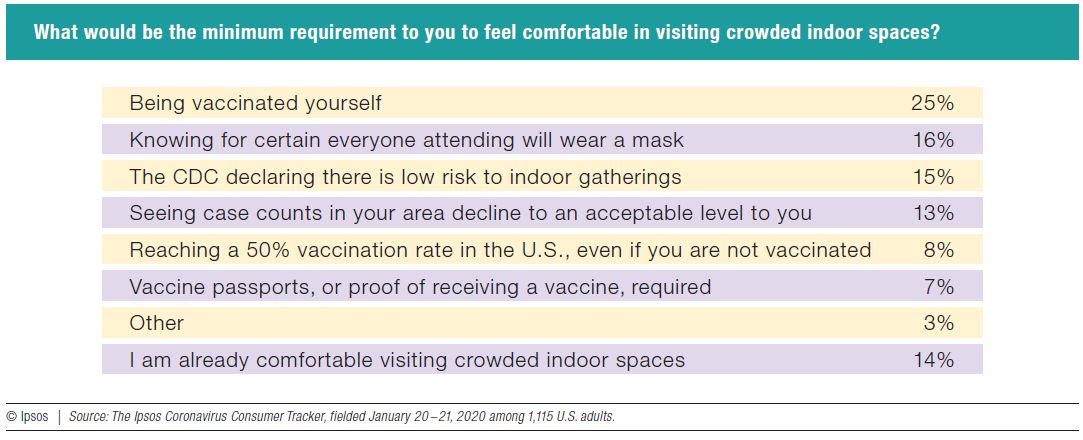
Despite these numbers, something appears to be missing from the online experience. An Ipsos study found that more than one-third of shoppers who ordered products online to be picked up in store (BOPIS: Buy Online, Pickup In Store) then took their orders, and still went into the store to continue shopping. This begs the question: what was missing from having the products in hand?
This, in turn, begs the bigger questions: Where does online shopping fall short? What is missing for consumers when they shop online? What can brick-and-mortar retail learn from
this experience when they can safely reopen again, to draw shoppers back into stores?
The right approach
While marketing managers will tout omnichannel as the ultimate shopping solution, a deeper examination might reveal that not all products and not all categories need an omnichannel approach. So how do you steer shoppers to the proper channel? Consider what the airlines have done. Customers know that to change a seat assignment, they use an app. To look at an alternate routing after a delay, they often speak to a human agent to work quickly through a complicated set of options. Why, because airlines have thought about the best approach for each flyer’s needs. By the same token, retailers should think about how to funnel customers to the right channel, depending on the need. Some examples: A grocery retailer could have all branded, shelf-stable foods promoted through online and delivery, while reserving physical locations for produce, prepared foods, and to showcase new brands/SKUs? This is one thing those BOPIS shoppers who picked up their groceries and then went into the store were trying to tell us? Those 24-pack sparkling water cases don’t need to be lugged from the market. But going inside to hand- select fresh tomatoes is preferred over the Instacart employee that might not have the same discerning eye.
Returning to stores
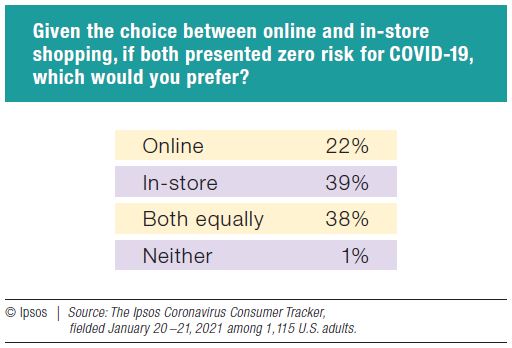
Ensuring the linkage between online and offline in one seamless experience will address some of the dissatisfaction we’ve seen this past holiday. While most (55%) anticipate doing more online shopping in 2021, shoppers are now keenly aware of what online is good for, and what in-person retail is good for. More than a third of consumers explicitly want to use both online and in-store shopping equally once COVID-19 is no longer a risk, according to the Ipsos Coronavirus Consumer Tracker. Three-in-four want to shop both in-store and online.
Window of opportunity
Maybe we’ve been trying too hard to replicate the in-person shopping experience online, only to disappoint. Guaranteeing two-day shipping is not the same as rushing home from the store to slip on the new shoes you’re wearing that night. Technology-driven gimmicks are fun, but don’t fully satisfy. Scrolling through seven pages of Amazon search results is not the same as gawking at an entire wall of colors, sizes and options. There’s no question that online shopping is here to stay, and will continue to grow, especially as the pandemic continues to rage. But 2021 presents a unique window of opportunity for retailers, online, offline and omnichannel, to optimize and improve their experiences. What do we do better in-person? What do we do better online? And how do we do each of those better?

![[WEBINAR] Cracking the Nutritional Supplement Market](/sites/default/files/styles/list_item_image/public/ct/event/2026-05/thumbnail-cracking-nutritional-supplement.png?itok=Cts0kD4T)
![[WEBINAR] Dealmaking 2026: What’s Changing, What’s Not, and How to Position for the Next Wave](/sites/default/files/styles/list_item_image/public/ct/event/2026-03/deal.png?itok=NtU1lGCc)