
Looking Forward: Understanding Women Veterans’ Mental Health Needs Post-Pandemic
As the U.S. takes steps toward re-opening on a larger scale, there is an increased sense of optimism and hope among Americans for the first time in a year. There is also a chance that mental health concerns will take a back seat as the masses receive vaccinations, the economy recovers and an increasing number of children return to school.
However, just because the need for mental health resources and research may not feel as immediate as these other concerns does not mean that the need is not present. As the nation reopens, the mental health deterioration that women and women Veterans have faced in the past year will not simply disappear, as the effects of trauma linger if unaddressed.
As we move toward a “new normal,” we have an important opportunity to examine the struggles and needs of women and women Veterans throughout this crisis more closely. As the woman Veteran population continues to grow and evolve, so will the need for strong mental health services to support them. By prioritizing the mental health needs of this vulnerable population during the national recovery process, we can ensure a safer and more hopeful “new normal” for all.
Read more about this topic in our detailed paper.
LOOKING FORWARD: UNDERSTANDING WOMEN VETERANS’ MENTAL HEALTH NEEDS POST-PANDEMIC
With over 3 million recorded deaths inter-nationally, and over half a million and counting in the U.S. alone, the COVID-19 pandemic has brought fear, isolation, and an upheaval of daily life to the world. Although vaccine rollouts are steadily on the rise, and COVID-19 cases and deaths are steadily decreasing across the U.S., the consequences of stringent economic and social restrictions, as well as the collective grief of so many who have lost loved ones to COVID-19, remain serious issues worthy of attention. Whether caused by economic stress from loss of work, social isolation and loneliness, or grief, the mental health impacts of the COVID-19 pandemic may linger for years to come. Lingering mental health concerns will likely disproportionately impact populations already at greater risk for mental illness, such as women, people of color, and Veterans. As the economy reopens this spring and summer, there remains a great need to study and address the mental health concerns of these population subgroups, particularly those at the intersection of these categories, such as Veteran women and Veteran women of color. These populations are traditionally underserved, and it is there-fore imperative to proactively assess their needs and provide them with the attention and care that they deserve.
The National Health Interview Survey (NHIS) reported that between January and June of 2019, 11% of the general U.S. population reported symptoms of anxiety and depressive disorder; by January 2021, that figure rose to 41%, according to the Census Bureau’s weekly Household Pulse — a 270% increase. Furthermore, roughly 11% reported experiencing suicidal ideation.1 While the pandemic has taken a toll on self-reported mental health across the board, research has shown that women have been impacted at a higher rate than men. Women across the globe are facing elevated levels of mental health deterioration, noting physical, mental and social health declines.2 In April 2020, a Kaiser poll showed 16% more women than men reporting a significant impact on their mental health from COVID-19 related stress.3 Axios-Ipsos polling has indicated an approximate 10-point gap in self-reported mental wellness between genders throughout the pandemic.4 While some attention has been given to this gender disparity, there is a gap in research pertaining specifically to women Veterans’ mental health during the pandemic. The total population of women Veterans is approximately 2 million, while the Department of Veterans Affairs (VA) Center for Women Veterans notes the significant gaps in biomedical research needed for this group.5 Veterans were already more likely than civilians to experience mental illnesses prior to the pandemic, and mental illness is more commonly diagnosed among women than men. As such, there is an acute need for research, outreach, and treatment specifically targeting women Veterans, the group of individuals at the intersection of these two vulnerable populations. Women Veterans represent a growing group, as estimates suggest that at least 16% of the Veteran population will be women by 2040.6 We cannot neglect this population as it continues to evolve, in the midst of a critical moment for global and national health. In order to better serve this population, it is important to understand a variety of factors that influence the mental health of women throughout the pandemic, and how these factors impact women Veterans in particular: Pre-Existing Mental Health Conditions, Motherhood, Income / Socio-Economic Standing, and Race.
PRE-EXISTING MENTAL HEALTH CONDITIONS
In addition to a national increase in the number of people reporting symptoms of depression and anxiety, people with pre-existing mental health conditions have reported worsening symptoms throughout the course of the pandemic.7 Furthermore, women are more likely than men to be diagnosed with mood disorders such as depression and anxiety. The National Center for PTSD notes that generally, women are 6% more likely than men to experience and report PTSD at some point in their lives.8 On top of this, Veterans are much more likely to experience trauma-related mental health conditions than the civilian population, and research indicates that women Veterans are especially vulnerable. In addition to the combat trauma experienced by many Veterans, women in the military are significantly more likely than their male counterparts to be exposed to harassment and sexual assault, with nearly 73% of women in one survey reporting experiencing sexual assault or harassment while serving.9 VHA also reports that “about 1 in 3 women seen in VHA respond ‘yes’ when screened for Military Sexual Trauma (MST).”10 Exposure to these traumas leaves them with a higher likelihood of developing PTSD, eating disorders,11 , and other mental health conditions than their civilian and male Veteran counterparts.
MOTHERHOOD
Mothers have traditionally taken on the brunt of childcare responsibilities in families, and recent Axios-Ipsos polling shows that not only has this pattern continued throughout the course of the pandemic, but it has resurged at higher levels than before. The social pressures for women to be the foremost domestic partner are still felt today, despite rising numbers of women pursuing and prioritizing careers, or often being the familial breadwinners.
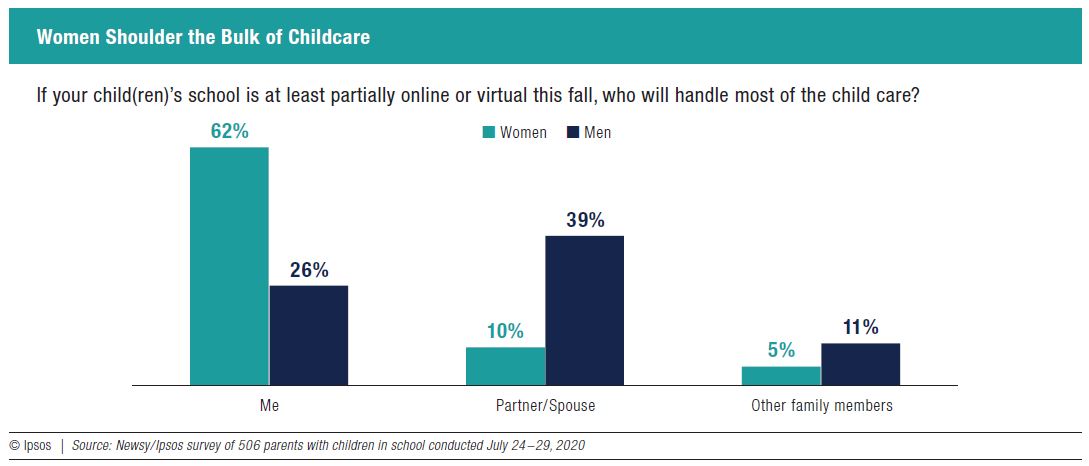
Working mothers face the added stresses of managing their work responsibilities in addition to being the primary caretakers of the home. The Axios-Ipsos Coronavirus Index shows that working mothers have been consistently more likely than fathers to report more difficulty in their ability to do their job throughout the pandemic. In September of 2020 alone, over 865,000 American women left their jobs.
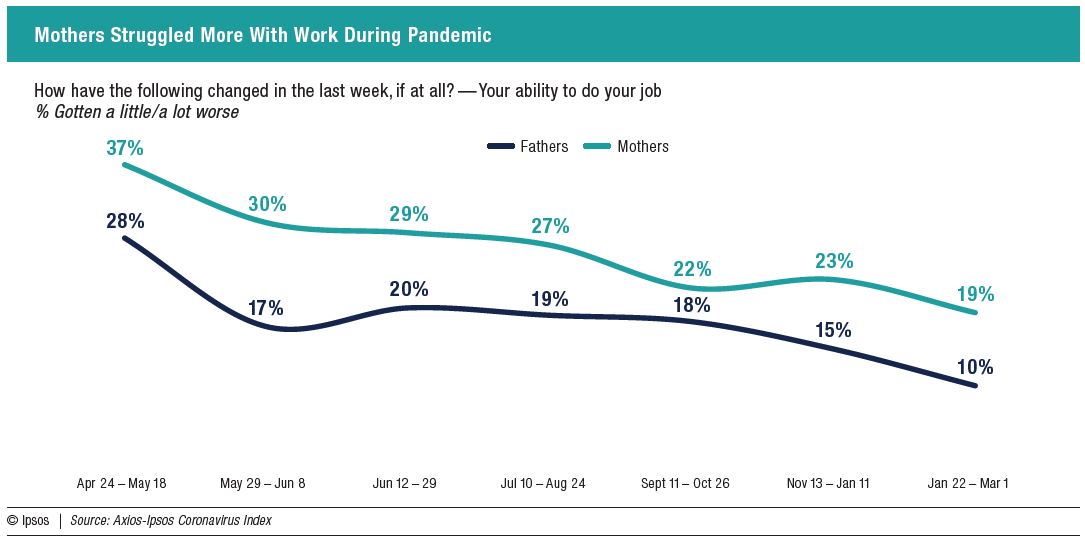
As explained in pieces such as the New York Times’ America’s Mothers are in Crisis or NPR’s Why Women Are Quitting Work: The Pandemic’s Devastating Toll, this imbalance between work and home life is driving many women towards the mental breaking point. For Veteran mothers, these stressors are compounded on top of some additional unique parenting struggles. Veteran mothers are proportionally more likely to be single parents than their male Veteran counterparts.13 Given limited available options for affordable child care, limited availability of financial guidance and assistance, and a lack of a natural larger peer support group, Veteran mothers — especially Veteran mothers struggling with the transition back to civilian life — can find themselves quite isolated in their parenting struggles. The additional mental toll resulting from physical isolation, the pressure of managing family health in the middle of a pandemic and other stresses imposed by COVID-19 can put these mothers in an even more stressful position than their civilian counterparts.
INCOME / SOCIO-ECONOMIC STANDING
COVID-19 has had a significant impact on the world’s economy. As many of the world’s industries were forced to a standstill during periods of lockdown, national economies were thrown into crisis. Working women are more likely than working men to be affected during times of economic crisis, and women in low-income positions are among the most vulnerable. Women in the U.S. have been disproportionately affected by job loss throughout the pandemic, accounting for about 55% of the net 9.8 million jobs lost between February 2020 – December 2020. In December 2020 alone, women accounted for 100% of the reported net 140,000 jobs lost over the course of the month. As of 2015, Veteran women had a slightly higher labor force participation rate than non-Veteran women. Veteran women are also less likely than non-Veteran women to be living in poverty. However, Veteran women are still more likely than Veteran men to be counted among the country’s “working poor” (those who are working, but whose income is at or below poverty level).15 Additional support is needed for these women, especially in times of financial crisis.
RACE
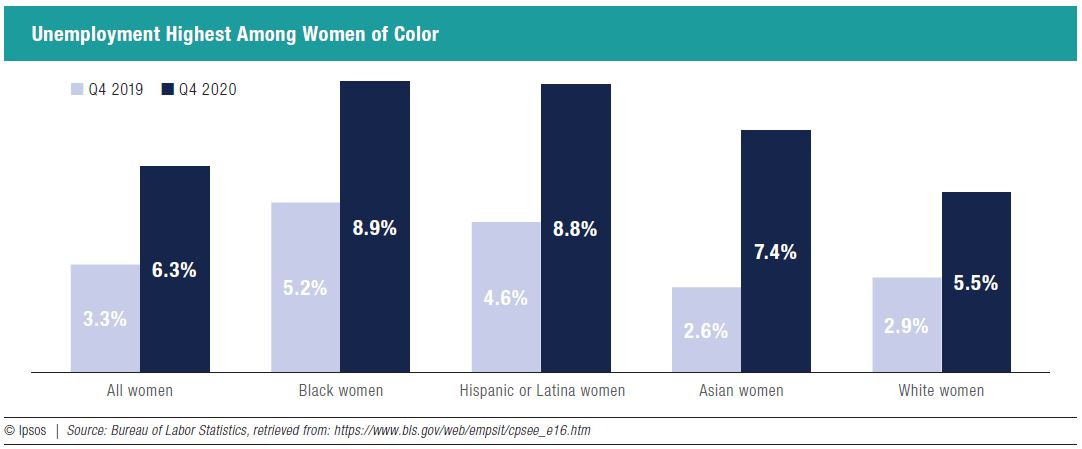
Racial minorities have been disproportionately impacted by the COVID-19 crisis compared to white Americans, both in terms of finances and health. Higher likelihood of being lower-income and having unequal access to healthcare means racial minority groups have been at an increased risk for COVID-19 throughout the pandemic. It has been well-documented that people of color have contracted COVID-19 at higher rates and with worse outcomes than their white counterparts,16 creating the conditions for increased stress both from health anxieties and grieving loved ones. Economically, the Bureau of Labor Statistics reports that women of color have been hit the hardest by unemployment during this time.
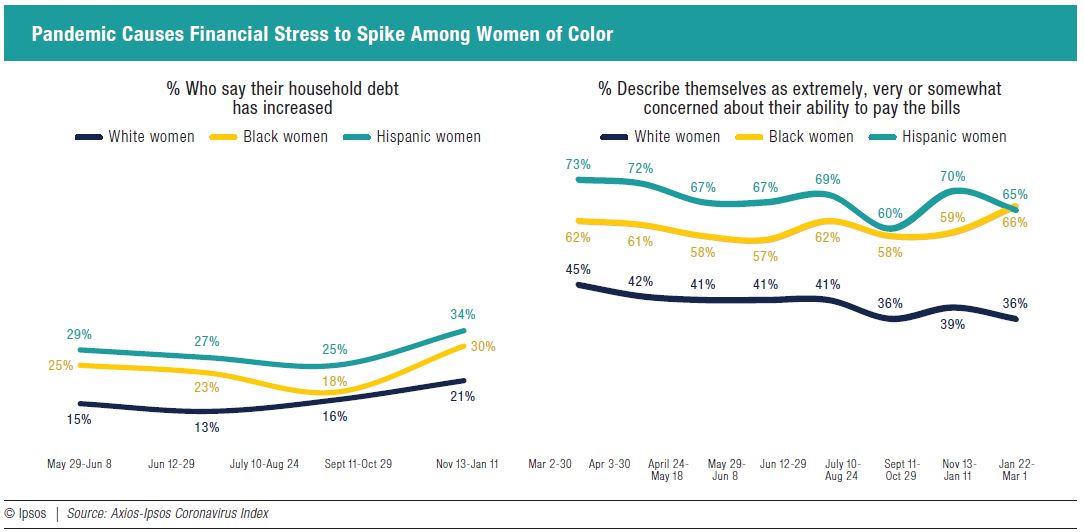
Additionally, research by Axios-Ipsos has found that African-American and Hispanic women in particular have reported higher levels of financial stress than their white counterparts during the pandemic, including increased household debt and higher concerns about their ability to pay household bills.
While most women Veterans are white, ethnic minorities are a sizable percent of the female Veteran population, and this representation is expected to grow. In fact, a 2015 VA study found that African-American women are over-represented in the military, reporting that “19% of women Veterans were African-American, compared with 12% of non-Veteran women.”17 The same study also found that there is higher representation for African-American women vs. African-American men in the military. As the representation of women of color in the military continues to rise, it is necessary to ensure that these women have the resources to protect their finances and health upon their return to civilian life.
MENTAL HEALTH WILL CONTINUE TO BE IMPORTANT EVEN AS THE NATION MOVES TOWARD RECOVERY
As the U.S. takes steps toward re-opening on a larger scale, there is an increased sense of optimism and hope among Americans for the first time in a year.18 There is also a chance that mental health concerns will take a back seat as the masses receive vaccinations, the economy recovers and an increasing number of children return to school. However, just because the need for mental health resources and research may not feel as immediate as these other concerns does not mean that the need is not present. As the nation reopens, the mental health deterioration that women and women Veterans have faced in the past year will not simply disappear, as the effects of trauma linger if unaddressed. As we move toward a “new normal,” we have an important opportunity to examine the struggles and needs of women and women Veterans throughout this crisis more closely. As the woman Veteran population continues to grow and evolve, so will the need for strong mental health services to support them. By prioritizing the mental health needs of this vulnerable population during the national recovery process, we can ensure a safer and more hopeful “new normal” for all.
![[WEBINAR] Know America at 250: Public Opinion Update](/sites/default/files/styles/list_item_image/public/ct/news_and_polls/2026-09/250_0.png?itok=7pwykKmG)
![[WEBINAR] Ipsos Global Trends 2026: The U.S. Edition](/sites/default/files/styles/list_item_image/public/ct/event/2026-09/thumbnail-gt-26.png?itok=AbsiS6xk)
![[WEBINAR] AI in Higher Education: How AI is Reshaping Teaching and Learning](/sites/default/files/styles/list_item_image/public/ct/event/2026-10/How%20AI%20Is%20Reshaping%20Teaching%20and%20Learning.png?itok=XYdLaI-4)