Cliff’s Take: America's Relationship With Work Remains Complicated

Deeply embedded in the traditional conceptualization of what it is to be an American is the Protestant work ethic. That a hard-working, pull yourself up by the bootstrap attitude will take you far. Put differently, a winner vs. loser ethos where self-worth is rooted in achievement – academic, economic or social.
The American that I am never questioned this until my oldest son, at age 8, pushed back on my demand to see higher grades from him. His retort to my guidance - “When am I going to have time for myself?”
That stopped me in my tracks. At one level he was questioning the entire American superstructure without knowing it. An eight-year-old! See, up to that point he had lived in Brazil, a culture and place where self-worth and achievement, while linked, were seriously attenuated relative to the US.
I can’t remember how we resolved our conundrum. But what an interesting insight.
This brings me back to a question I often ask myself. What is America’s relationship with work? Are we as fervent as always? Or does my son —a millennial—represent a changing of the guard?
Below are the key polling points of the week and to answer this question.
- Recalibration. It looks like my son was just one voice among many in his age group. Millennials above all other generations think that America is too focused on the daily grind. Gen X-ers are not far behind. But don’t forget about income and educational attainment either. There is truth in large numbers.
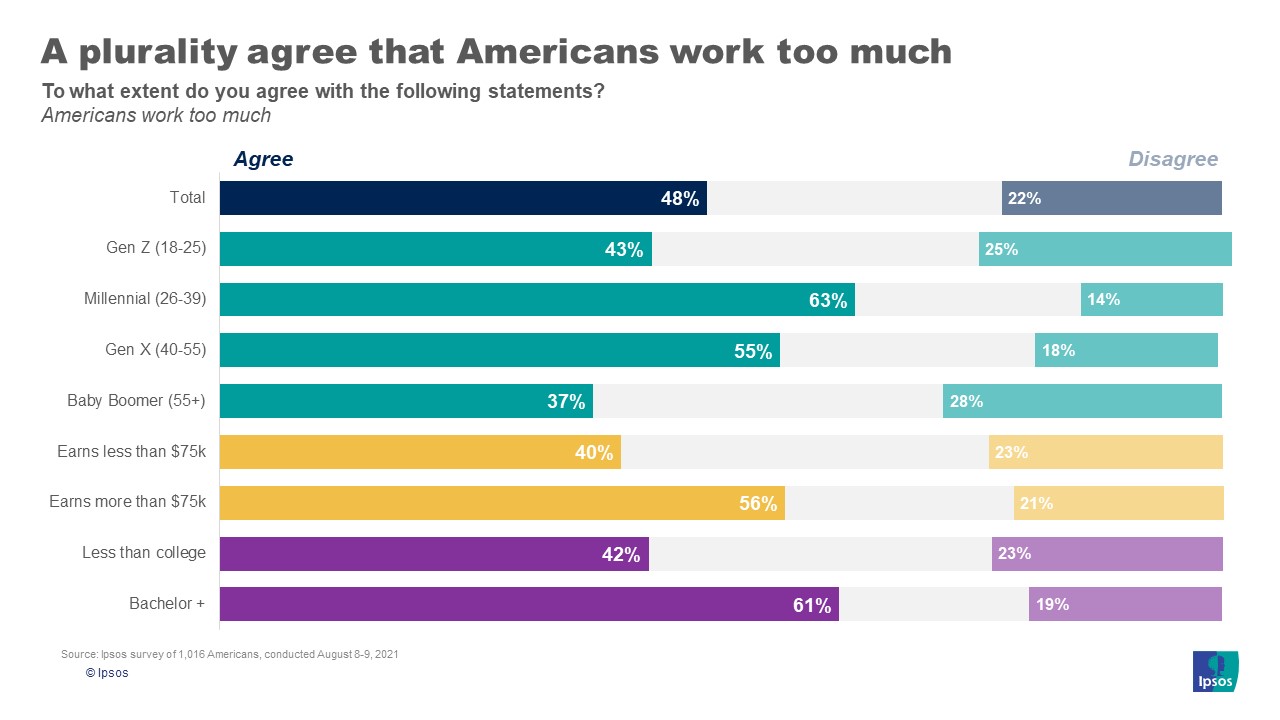
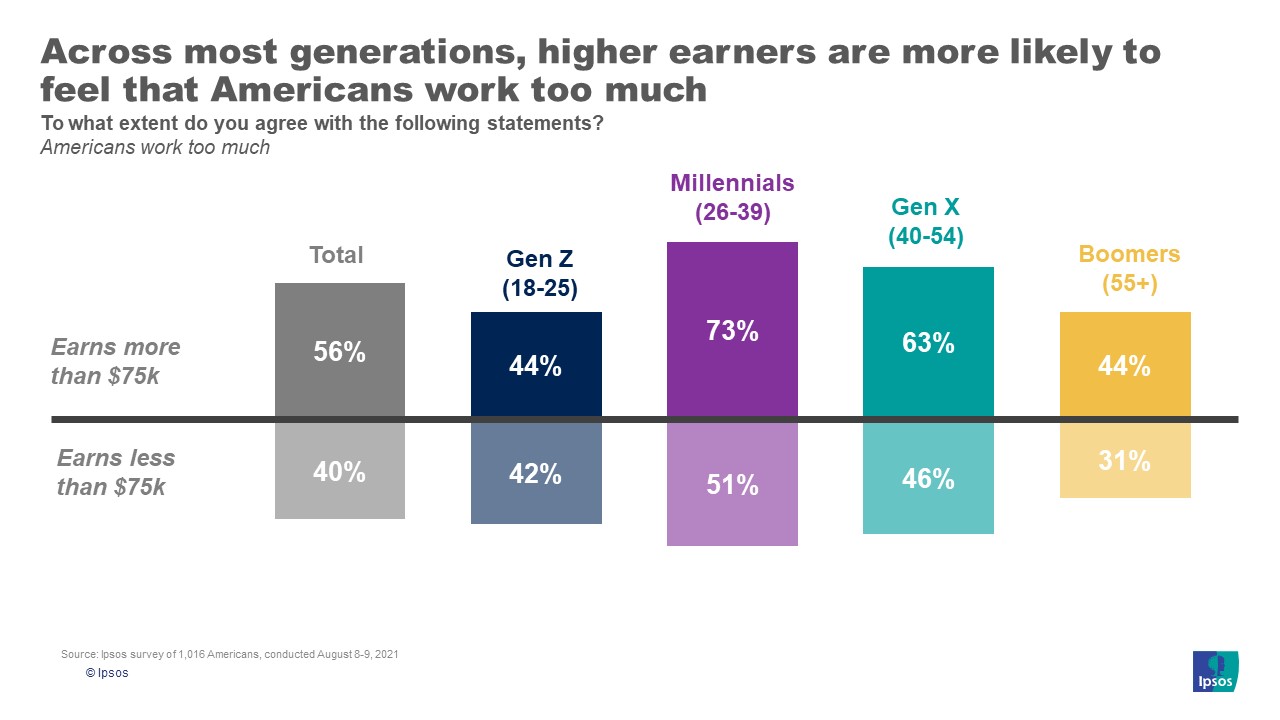
- Silver spoon effect? Let’s unpack that relationship to work at the cross-section of income and generation. Across the board – except among Gen Z – more affluent Americans tend to feel that Americans work too much. Considering how much of our identities get tied up with what we do from 9 to 5, is that sense of being overburdened coming from a position of relative privilege? Or just burn out, pure and simple? Again, look at the data.
- It’s about flexibility, stupid. What Americans appear to really want, more than anything else, is flexibility. Among employed workers, a majority want the option of working from home or the office, as suits them, and flexible hours. There’s also broad support for a four-day work week. But what they don’t want? Their company telling them when they can take time off. Americans want quality not quantity in their "me" time.
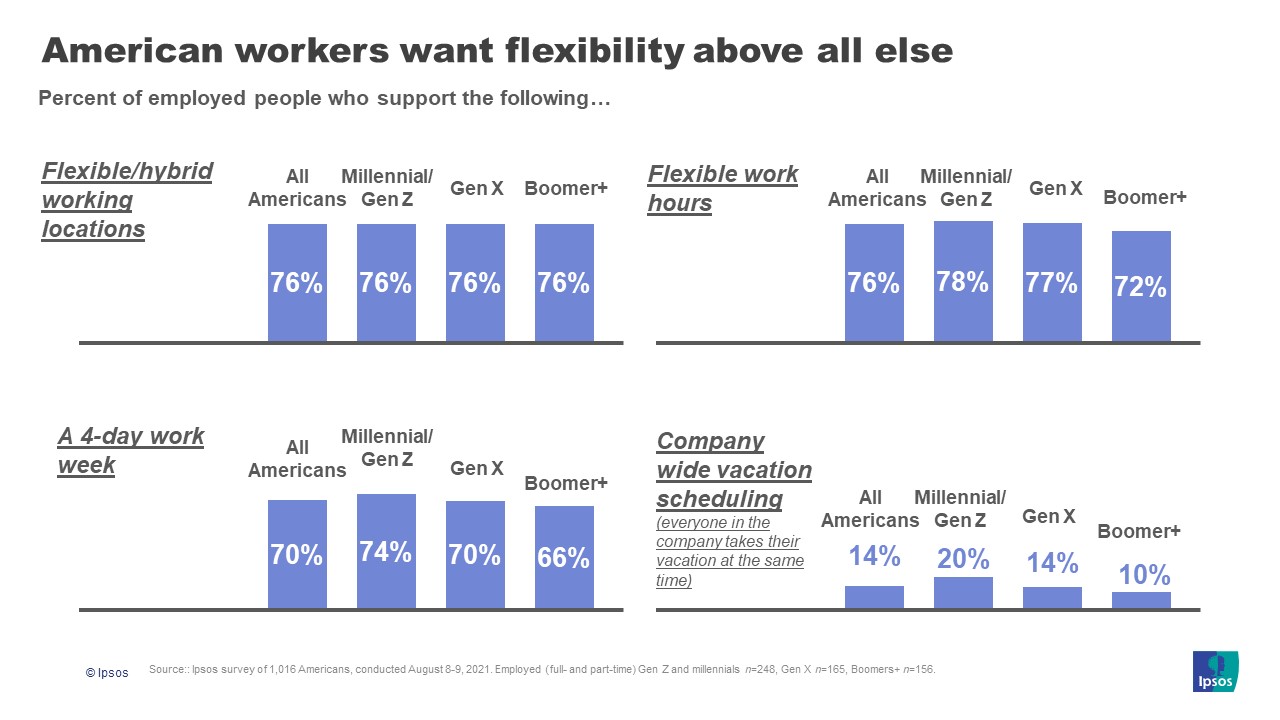
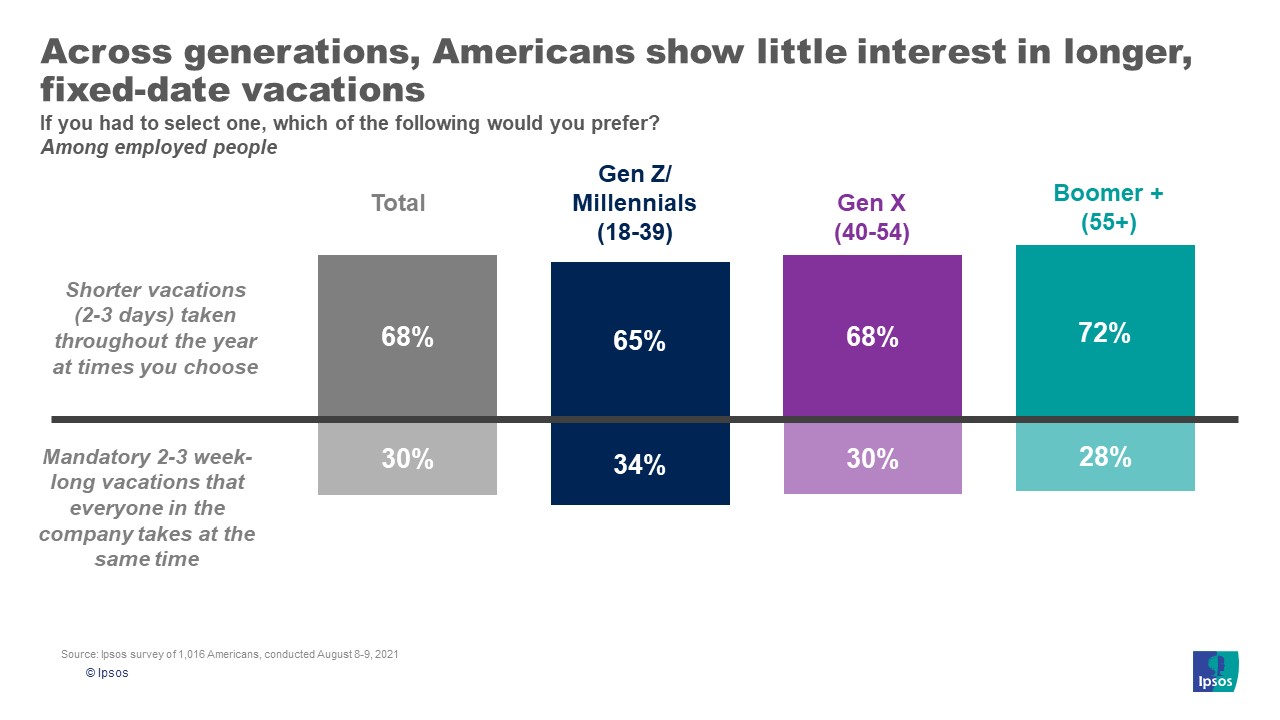
- Flexibility, not vacation. Again, reinforcing the point above, many Americans would forego having weeks off at a time in favor of shorter breaks interspersed across the year at the time of their choosing. I know our European friends currently enjoying their extended August vacations might find this crazed. But such is our way of life. Flexibility, flexibility, flexibility.
- Managing the downside. Taking time off every now and then is essential. But many are anxious about the impact it would have on their careers. Will they be seen as less than dedicated? This is particularly strong among Americans under 40, those still at the outset of their working lives. Flexibility, yes; but career advancement still demands sacrifice.
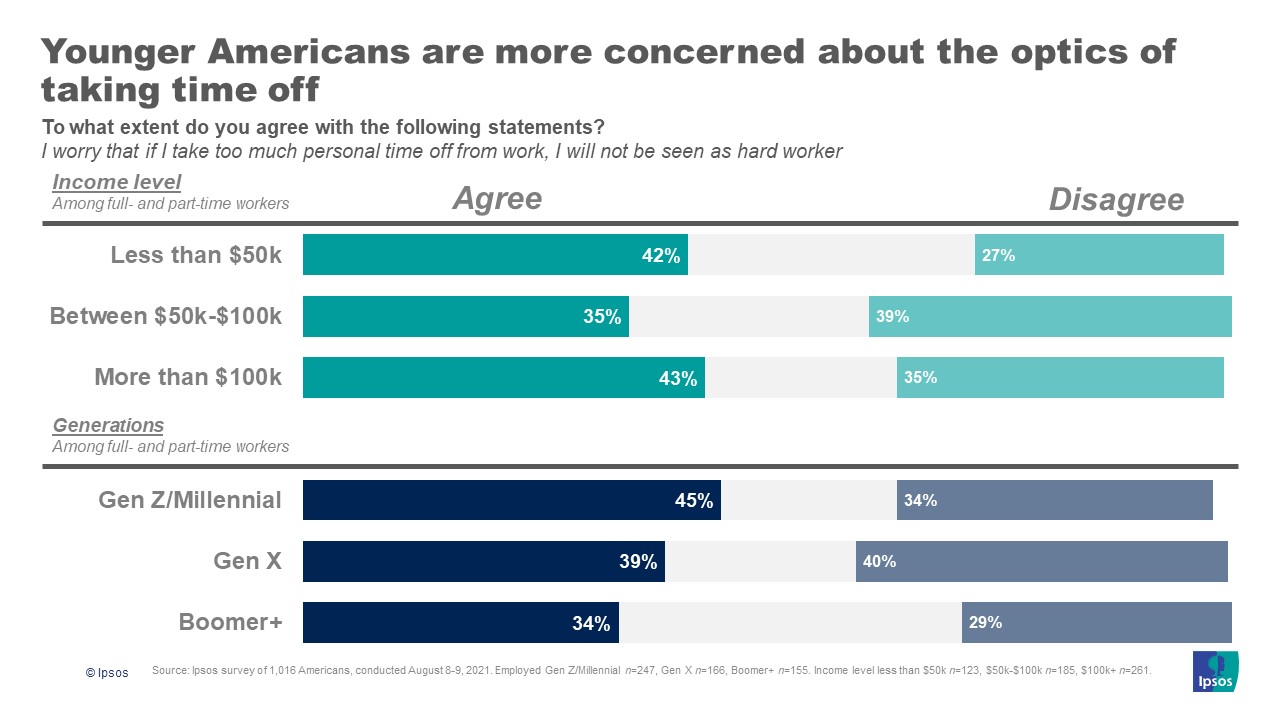
So, the takeaways here. First, few disagree that Americans work too much. Millennials and Gen X are pretty convinced. Gen Z, which has yet to enter the labor market in full, is still a little more tentative on that score. But let’s see where they stand with time.
Yet there seems to be little appetite among the American public to take weeks off at a time to recharge. Instead, we’ll settle for a little more flexibility in when and where we work. A little more "me" time as my son so well put it.
Be safe, be sane, and take a break.