
What do global citizens care about in 2021?
In this paper, we share data from our 2020 Anholt-Ipsos Nation Brands Index (NBI) which show that global citizens prioritize protecting the environment and natural resources (36%) as the top issue they would like addressed. Countries interested in driving improved reputation will recognize the insights in our study offer opportunities to lead by example and address these key issues of concern, demonstrating the ways in which they are working to protect and preserve the environment, provide food security, and promote human rights.
An annual tracker since 2008, NBI has been providing nations with an in-depth understanding of their reputation and provides insights necessary for countries to proactively manage standing in the world. Since 2014, the NBI program has started exploring the issues that global citizens want the world to prioritize. Download our paper to access this data segmented both by top issues, and by regions.
Looking ahead, the upcoming 2021 NBI program will explore whether these issue priorities have shifted, and to what extent countries are recognized for addressing these issues.
The Anholt-Ipsos Nation Brands Index (NBI), run annually since 2008, provides nations with an in-depth understanding of their reputation and provides insights necessary for countries to proactively manage standing in the world. Since 2014, the NBI program has explored the issues that Global Citizens want the world to prioritize.
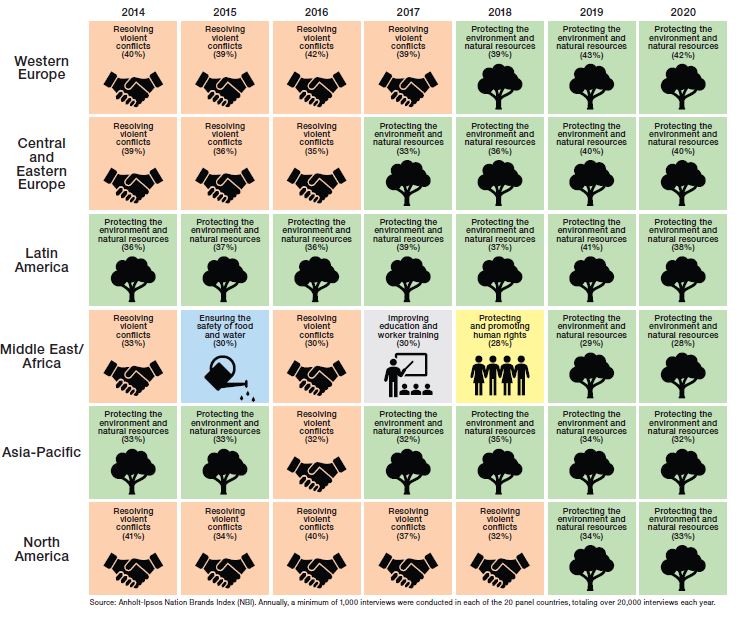
In 2020, NBI research conducted in 20 countries, representing different regions of the world, shows that Global Citizens prioritize protecting the environment and natural resources (36%) as the top issue they would like addressed. This is the fourth consecutive year that protecting the environment and natural resources has topped the issues list, but it has not always been the main concern. From 2014–2016, Global Citizens cited concerns with resolving violent conflicts in the world. Since then, resolving violent conflicts has steadily diminished in priority, coming in fifth (24%) in 2020. During that same period, Global Citizens have indicated an increased desire to see the safety of food and water and human rights issues addressed.
This shift in opinions on global issues highlights that in 2021 the world is looking to heal. Global citizens value a world where the environment, food, water and people are protected. There is an opportunity for countries to lead by example and address these key issues of concern. Demonstrating the ways in which a nation is working to protect and preserve the environment, provide food security, and promote human rights is likely to lead to stronger perceptions and an improved reputation.
Regional Highlights
All regions agree that protecting the environment and natural resources is most important. In 2020, at least a quarter of respondents in each region select protecting and preserving the environment as the main issue. This is a change from 2014 where four of the six regions highlighted violent conflicts as a major issue. Latin America has consistently cited environmental concerns as a top priority, whereas the Middle East/Africa region has seen the most diversity in top issues over the past seven years.
Future Research
The upcoming 2021 Anholt-Ipsos Nation Brands Index (NBI) will explore whether these issue priorities have shifted, and to what extent countries are recognized for addressing these issues. Additional enhancements to the 2021 NBI program include:
- Tripling the number of interviews conducted in each panel country. By increasing the number of inter- views from 1,000 to 3,000, our total sample size now comes in at 60,000 interviews worldwide.
- Growing the list of measured nations by 20%. By increasing the number of measured nations from 50 to 60, the NBI program will now be more inclusive and comprehensive.
These program improvements will augment nations’ ability to manage their brands at this stage of the pandemic. Having an even greater understanding of current perceptions, in the global context and in these turbulent times, can help guide future commu-nications and marketing efforts for greater likelihood of campaign success.
![[WEBINAR] AI in Higher Education: How AI Is Reshaping Teaching and Learning](/sites/default/files/styles/list_item_image/public/ct/event/2026-10/How%20AI%20Is%20Reshaping%20Teaching%20and%20Learning.png?itok=XYdLaI-4)

![[WEBINAR] Winning B2B Buyers: AI Gets You Considered; Trust Gets You Selected](/sites/default/files/styles/list_item_image/public/ct/event/2026-10/Winning%20B2B%20Buyers%20AI%20Gets%20You%20Considered%20Trust%20Gets%20You%20Selected.png?itok=Q4kElwY2)