The Economic Pulse of the World - January 2016
Positive Trends to Start the Year, but Some Seeing Red
The local economic assessment remains stable. With no change since last sounding (and for a third straight month), almost one third (30%) of global citizens say the economy in their local area is “strong”.
As usual, with the New Year come new expectations and hopes that things will change for the better. This might be the reason for a 3 point improvement in the future economy assessment with one quarter (26%) expecting the economy in their local area to be stronger in the next 6 months. This is the biggest point increase for this assessment category since January 2014.
Hit hard by falling oil prices, Saudi Arabia, Canada and Russia each lost points in these assessment categories. China, struggling with the stock market crisis, has experienced a decline across the board as well.
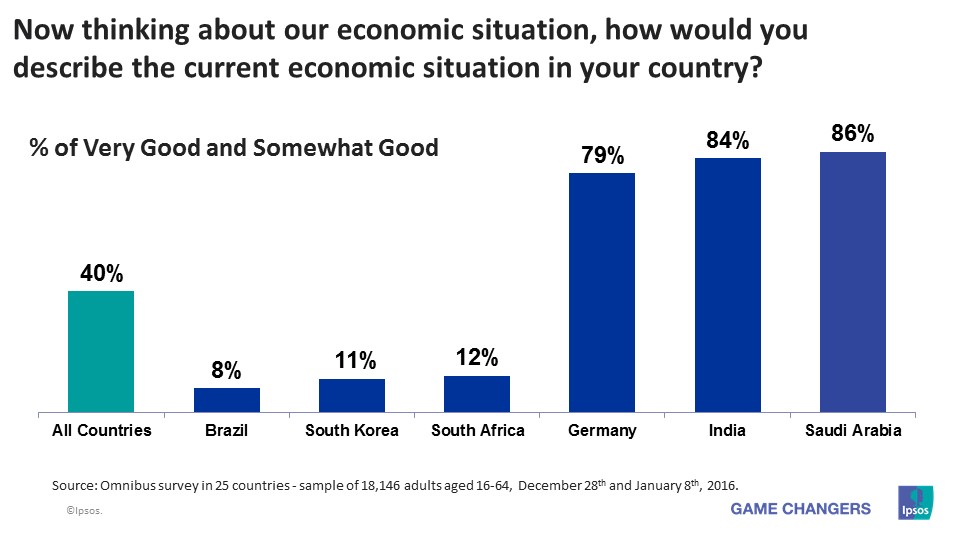
Global Average of National Economic Assessment Up One Point: 40%
Starting the new year on an uptick, the average global economic assessment of national economies surveyed in 24 countries is up one point with 40% of global citizens rating their national economies as ‘good’.
Despite experiencing a four point decline, Saudi Arabia (86%) remains at the top spot in the national economic assessment category, followed by India (84%), Germany (79%), China (66%), Sweden (65%) and Australia (59%). For a fifth month in a row, Brazil (8%) has the lowest assessment score, followed by South Korea (11%), South Africa (12%), Italy (13%), Hungary (16%), France (18%), Spain (18%) and Mexico (24%).
Countries with the greatest improvements in this wave: Sweden (65%, +7 pts.), India (84%, +5 pts.), Germany (79%, +5 pts.), Turkey (45%, +5 pts.), Belgium (40%, +5 pts.), France (18%, +5 pts.), Brazil (8%, +4 pt.), Great Britain (48%, +3 pt.), Australia (59%, +2 pt.) and Japan (29%, +2 pt.).
Countries with the greatest declines: China (66%, -8 pts.), Canada (44%, -7 pts.), Hungary (16%, -7 pts.), Saudi Arabia (86%, -4 pts.), Israel (42%, -4 pts.), Russia (32%, -4 pts.), Italy (13%, -3 pts.), South Korea (11%, -2 pts.) and Poland (35%, -1 pts.).
Global Average of Local Economic Assessment (30%) Unchanged
When asked to assess their local economy, an average of 30% of those surveyed in 24 countries agree that the state of the current economy in their local area is ‘good’. The local economic assessment is unchanged since last month.
With a significant 11 point increase, India (61%) takes the lead in the local assessment category, followed by Saudi Arabia (59%), Sweden (59%), Germany (56%), China (54%), Israel (50%), Turkey (39%) and the United States (36%). South Korea and South Africa (both 10%) share the lowest spot in this assessment, followed by Japan (11%), Italy (13%), Spain (15%) Brazil (16%), Hungary (16%) and Russia (18%).
Countries with the greatest improvements in this wave: Turkey (39%, +12 pts.), India (61%, +11 pts.), Germany (56%, +7 pts.), Sweden (59%, +6 pts.), Great Britain (33%, +4 pts.), Mexico (20%, +4 pts.), France (20%, +3 pts.), Argentina (20%, +2 pts.) and Brazil (16%, +2 pts.).
Countries with the greatest declines in this wave : Australia (32%, -10 pts.), Israel (50%, -9 pts.), Saudi Arabia (59%, -7 pts.), Russia (18%, -6 pts.), China (54%, -4 pts.), Japan (11%, -2 pts.) and South Africa (10%, -2 pts.).
Global Average of Future Outlook for Local Economy (26%) Up Three Points
The future outlook is up three points since last month, with an average of one quarter (26%) of global citizens surveyed in 24 countries expecting their local economy to be stronger six months from now.
India (69%) takes over the the lead in this assessment category, followed by Argentina (65%), Brazil (53%), Saudi Arabia (51%), Peru (49%), China (48%), Turkey (35%), Mexico (32%), the United States (23%) and Spain (23%). South Korea (8%) has the lowest future outlook this month, followed by Sweden (9%), Belgium (10%), France (11%), Hungary (11%), Japan (11%), Poland (13%) and South Africa (13%).
Countries with the greatest improvements in this wave: India (69%, +13 pts.), Turkey (35%, +13 pts.), Mexico (32%, +8 pts.), Argentina (65%, +7 pts.), France (11%, +5pts.), Israel (15%, +4pts.) and South Africa (13%, +2 pts.).
Countries with the greatest declines in this wave: Australia (15%, -4 pts.), Poland (13%, -4 pts.), the United States (23%, -3 pts.), Canada (15%, -3 pts.), Saudi Arabia (51%, -2 pts.), Russia (19%, -2 pts.), Japan (11%, -2 pts.) and South Korea (8%, -2 pts.).
Citizens in 25 countries assess the current state of their country’s economy for a total global perspective.