
Fashion: Opportunities and challenges in 2023
It is also one of the most significant – a sector that is estimated to reach pre-pandemic rates in 2023, exceeding 83 billion euros.
A compendium of reflections and provocations on fashion in relation to the themes of environmental sustainability, technology, omnichannel and body representation help us navigate this world in the immediate future.
Far from stagnating, the fashion industry has experienced internal revolutions in recent years, from the commitment to the environment and society, to debates on authenticity, to the introduction of the concept of inclusion and diversity, to the proliferation of bottom-up styles and, finally, to the resignification of our post-pandemic wardrobe.
Fashion tells the story of societal change; it is an extremely powerful non-verbal communication tool. As author Andrea Batilla states, “dressing is a political act that we perform every day by choosing what to buy and what to wear”.
We can therefore predict that in the course of 2023, fashion industry trends will evolve and challenge the issues that have been at the centre of debate in recent years.
Sustainability
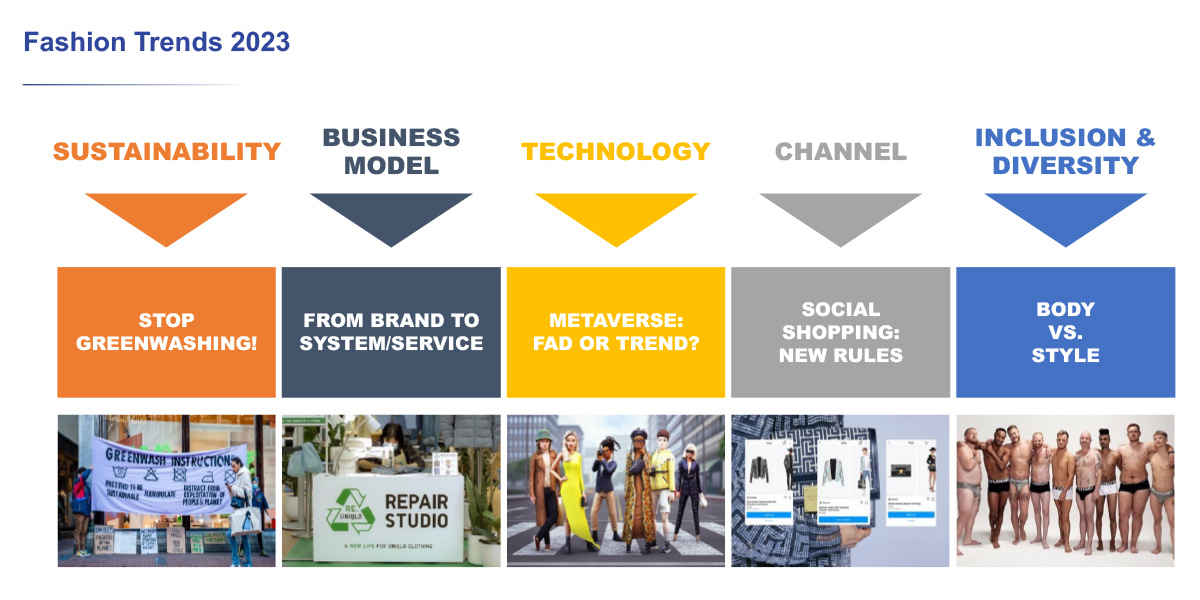
Starting with sustainability, there will be a war on greenwashing. In fact, if one in two declare themselves in favour of paying more for brands that prove to be ethical, the increase in sceptics towards the actions promoted by brands (21% in 2021 vs. 13% in 2018) is a trend set to grow further. This is mainly due to the lack of authenticity and non-differentiation of sustainability messages, often inconsistent with the brand’s positioning and values.
Business model
Consumer scepticism also opens up further reflection on the future of sustainability in fashion, which sees the need for a shift from brands to real services and systems. In fact, the consumer is often lost when faced with the identification of sustainable fashion – not knowing how to find it and unsure about the maintenance of the garments themselves. The activities of recycling, downcycling, upcycling, repair and disposal – proposed not only by the big luxury fashion houses but also by new brands in the sector – are just some of the initiatives to offer added value that helps to engage and educate consumers.
Technology
In the area of technology, we have seen many experiments recently by fashion brands with immersive realities, but at the same time the findings of our studies in collaboration with the Metaverso Observatory (see our latest issue on ChatGPT) show that there are still few consumers able to give a positive and enhancing meaning to their initiatives.
One possible track to rebuild the value chain is to move away from activities where immersive realities and NFTs (digital tokens used to prove ownership of an asset) are devoted to mere entertainment, collecting and even consumerism, and instead focus on problem solving, such as virtual sampling in the supply chain, or ownership certificates to prevent counterfeiting and theft.
Only 35% can mention a brand name active in the metaverse.
Omnichannel
In the context of omnichannel shopping, influencer modelling – responsible for unsustainable, unbridled consumerism – can expect a rewriting of its rules. New modes of peer-to-peer social shopping will be contrasted, where the main factor of success is the more direct and transparent relationship between buyer and buyer.
Diversity and inclusion
Finally, regarding diversity and inclusion, in a world where the body has increasing value – challenging established aesthetics and representing the multifaceted complexity of reality – we will witness the industry leaning towards a growing dichotomy between style and body representation, grown from the body positivity and neutrality movements.
Silvia Andreani
Table of content
- An introduction to Flair Italy 2023: Catenaccio
- ESG investment: From 'ideals' to concreteness
- Food: Recipes for the future
- Fashion: Opportunities and challenges in 2023
- Green mobility: Cities as a laboratory for tomorrow’s mobility
- Tourism: Holidays, inflation and luxury
- Generations - Beauty boom: stereotypes, myths and reality
| Previous | Next |