
Food: Recipes for the future
The good news is that, with reasonable certainty, the directions along which trends will be channelled are already marked out: the factors are in fact themselves the synthesis of universal and personal, natural and artificial.
However, foreseeing their expressions and concretisation requires in-depth focus and analysis, since even within the territories identified below, we witness dichotomies and tensions that are sometimes at odds with each other.
By way of example, globally:
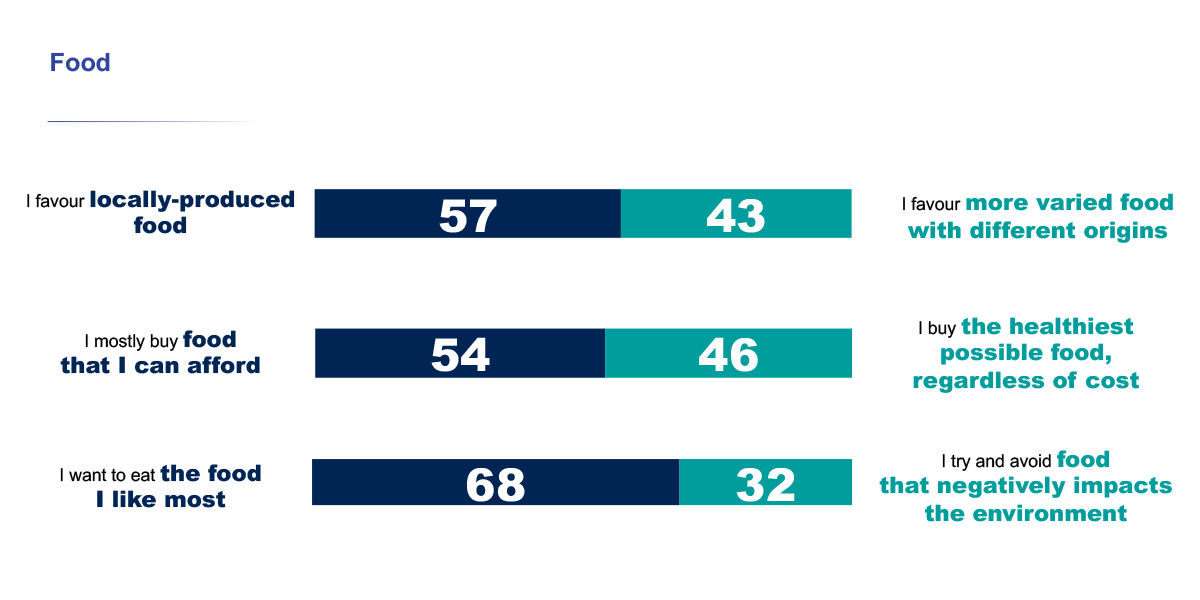
- 57% of the population prefer locally produced food, while 43% prefer varied food of different origins.
- Just over half of consumers (54%) say they buy food that they can afford, while slightly less (46%) say they choose healthier foods, regardless of cost.
- While 32% look for foods with a positive environmental impact, the majority prioritise taste and choose the foods they enjoy most.
With this complexity in mind, we outline the signs that lead us to predict these trends:
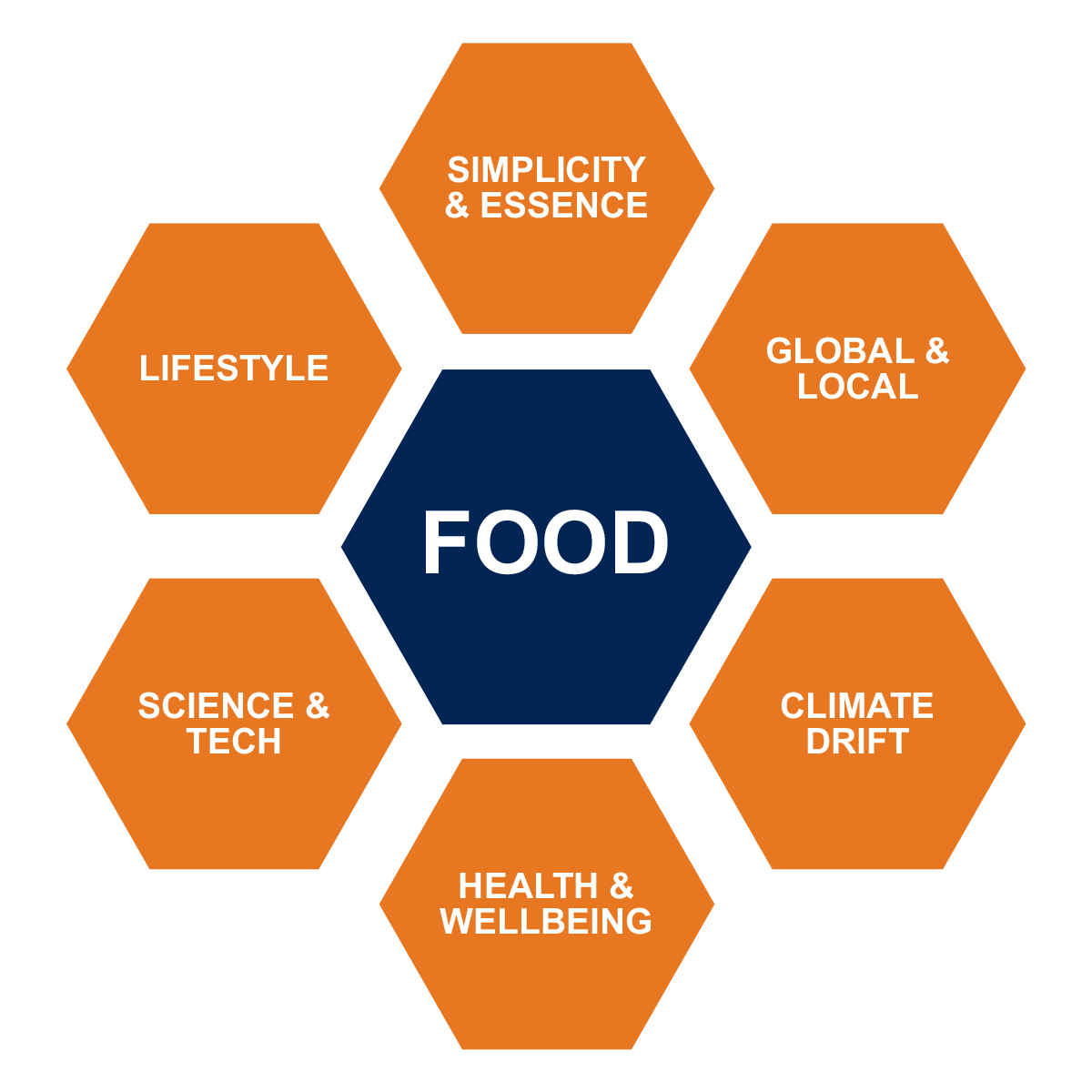
Climate drift
Sustainability is undoubtedly a matrix within which many opportunities exist for food: the reduction of emissions, attention to packaging and its disposal or recycling (first and foremost plastics), and the selection of ingredients and supply chain processes that do not harm the environment. Above all, at this historical moment, is the intense attention on food waste – 94% of Italians say they are paying more attention to the food they throw out.
Health and wellbeing
The pandemic has made mankind aware of its own fragility, boosting the already existing need to be physically and mentally healthier, stronger, and more immune. About two thirds (63%) of Italians consider it increasingly important to follow a healthy lifestyle. This trend goes in two apparently contrasting directions: the first is more collective and ecological (good for my body, good for the planet) whose main signal is the search for varied and balanced foods and diets that protect one's health but also biodiversity and the territory. The second is more individual and intimist (good for my body, good for my soul) that sees a growing search for customised food products and programmes.
Science and technology
It is almost superfluous to emphasise how digitalisation has consolidated in recent years. We witness daily the proliferation of food delivery applications and virtual cooking programmes, as well as the emergence of blockchain to guarantee the traceability of the food supply chain, smart homes and the Internet of Things (IoT), or innovative realities such as vertical farms. Even in this area, there is no shortage of contradictions: where 41% of global consumers are in favour of a laboratory synthesis of products that are difficult or expensive to produce in nature, 77% trust only naturally produced food.
Lifestyle and habits: the new normal
The increasingly large adoption of teleworking, as well as the inflationary grip and expectations for a bleak future, have made Italians accustomed to spending more time at home and devoting more time to cooking, both for individual and group meals. While 66% of those working remotely cook at home, phenomena are rising for things such as home delivery or chef at home. Meanwhile, the reopening of businesses after lockdown has boosted demand for healthy and convenient take-away solutions (food on-the-go and lunch boxes).
The global and the local
Globalisation has exposed Italians to flavours, recipes, and culinary traditions from all over the world, so it is not surprising that 73% wish to continue experimenting with such ingredients to add creativity and enhance meals. But it is also true that 82% seek to consume products made in Italy to support the territory and the Italian economy.
Simplicity and essentiality
70% of the population wants a simpler life: this for food is substantiated in a return to primary values, to the reassuring concept of tradition and closeness, hence phenomena such as zero km, the home vegetable garden, and shopping at the farmers.This translates into the search for pure food products without frills or additions, hence realities such as free-from or original and ancestral diets and styles (paleo diets/keto diets).
Enrica Tiozzo
Table of content
- An introduction to Flair Italy 2023: Catenaccio
- ESG investment: From 'ideals' to concreteness
- Food: Recipes for the future
- Fashion: Opportunities and challenges in 2023
- Green mobility: Cities as a laboratory for tomorrow’s mobility
- Tourism: Holidays, inflation and luxury
- Generations - Beauty boom: stereotypes, myths and reality
| Previous | Next |