
Inflation vs. porfolio: The brand vacuum
 However, in the same context, the outbreak of war in Ukraine in February 2022 (three months before the end of the public health emergency declared by the World Health Organisation) makes the scenario even more complex, with production bottlenecks affecting global supply chains and shortages of raw materials and essential parts in all markets.
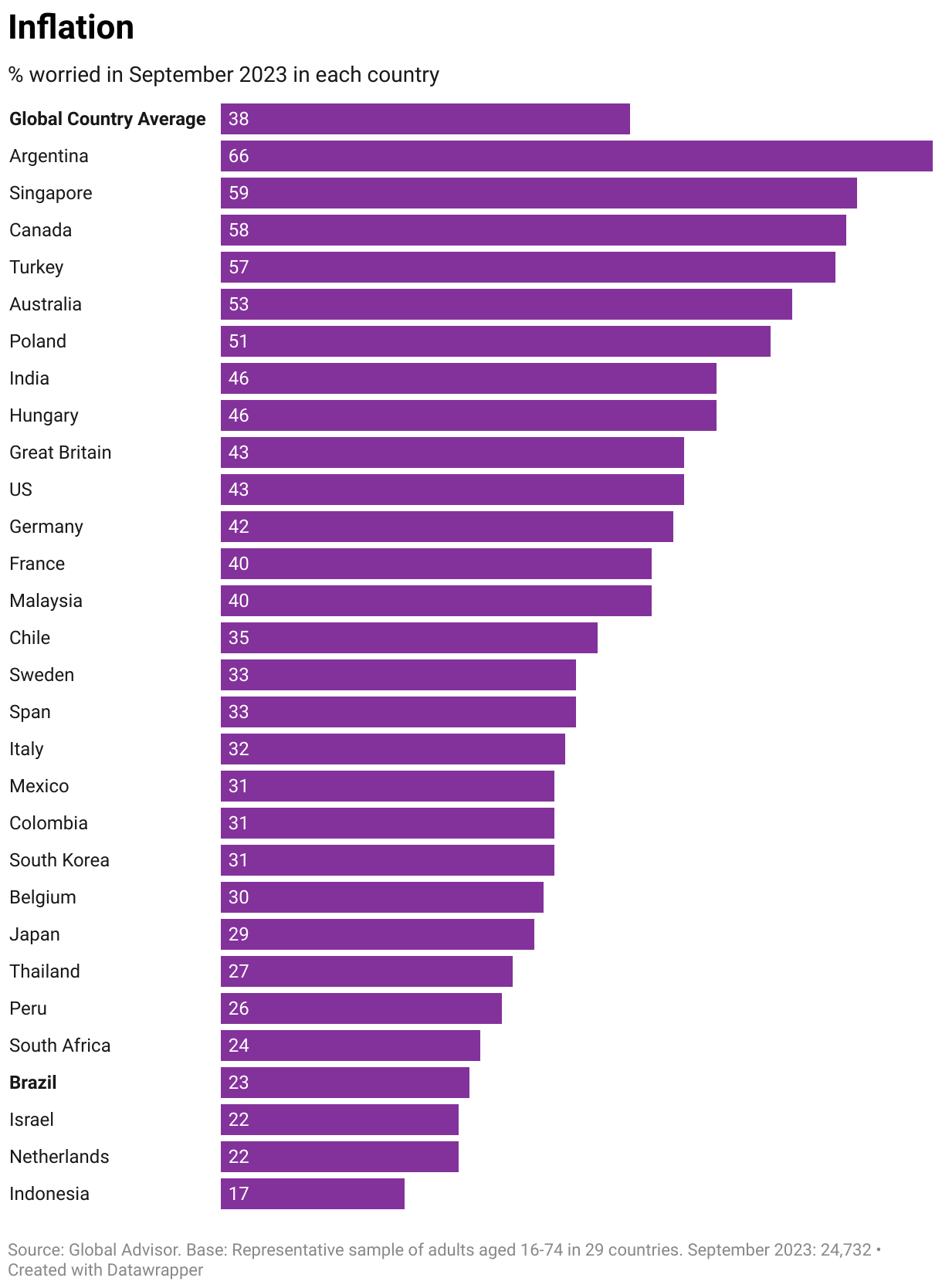
According to the Ipsos Global Advisor 2023 Predictions survey, Brazilians were more optimistic than the global average. Fifty-five per cent of Brazilian consumers believed that product prices would rise faster than their income, compared to 79% globally. More recently, our What Worries the World survey found 23% of Brazilians citing inflation as one of their top concerns, compared to 38% globally. Brazil is a country that has already experienced periods of high inflation and economic instability and has even faced hyperinflation in the past.
The younger generation are now experiencing what it is like to live in this context, and learning to deal with the challenges that inflation brings. They are developing new consumption strategies and are becoming more demanding in their purchasing decisions. This change is driven by the need to cope with rising prices, which have a direct impact on purchasing power.
Inflation: the silent enemy of consumer power
As consumer purchasing power declines, it is essential that brands position themselves in the "commoditised" categories that offer some financial or product advantage, such as greater performance and durability, as they are currently not differentiated by brand status. In this context, it is also important to consider how easily each category is interchangeable and what manufacturers need to do to remain present to consumers.
Inflation and the and the consumer goods market: challenges and opportunities
 Industries face the challenge of increasing production costs, tight margins, and the need to pass these costs on to the consumer. However, it is important to stress that despite these challenges, inflation can also open doors to innovation and efficiency gains, as consumers tend to review their habits and look for more advantageous solutions. In this sense, the adoption of new technologies and standpoints can be an effective response to price sensitivity. By associating the brand with key issues such as the climate crisis or health, the perception of responsibility and timeliness can help guide the consumer's choice (in addition to the price factor). The search for efficiency in the production process, new raw materials, and the implementation of consumer-centred strategies are also valid ways forward.
Basic categories and easily replaceable products suffer more from inflation, while those that offer differentiation and convenience are more resilient, such as skincare, make-up, and alcoholic beverages. Examples include Gillette, which has expanded its portfolio with the development of a technologically advanced razor that claims to "remove impurities", and Corona Cero Sunbrew, a non-alcoholic beer that claims to include a vitamin D substitute. Faced with a more attentive and social consumer, it also seems important to adopt more assertive strategies. We are seeing an increase in WhatsApp groups and social networks where promotions are shared, such as a group of mothers sharing promotions for nappies.
In times of inflation, the strategy behind the product portfolio is of even greater importance. Companies that traditionally operate with premium brands are prioritising "value brands" in their strategies to minimise the migration of consumers affected by the crisis to competitors. Another strategy that is being adopted is to work with price ranges within the value territory (territory brands that offer low prices as an advantage), offering options with some added value but still at affordable prices, creating a product perception that is always "promoted". Another possible strategy is focusing on the "premiumisation" of products where price sensitivity is usually lower. An example is the Nespresso brand, which has managed to transform the home coffee experience, a typical Brazilian habit, by offering a different experience: special flavours and the possibility for consumers to create their own recipes.
New shapes and sizes
 Industries are re-evaluating packaging to reduce waste and offer savings to consumers, either through smaller packaging or more concentrated products. Working with smaller packs also allows them to maintain or increase the price per gram or millilitre. In addition, diversifying pack sizes to meet different consumption occasions is an effective strategy, as exemplified by sugar-free Coca-Cola, which introduced non-conventional packaging to extend its reach and meet new needs and occasions.
Another increasingly popular practice is downsizing, in which companies reduce product portions while maintaining the same price, in order to avoid increasing costs for the consumer. However, we have observed that consumers are becoming increasingly aware and critical of this practice, as they feel that companies are trying to deceive them. Depending on the level of loyalty and repeat business, this can lead to long-term brand abandonment.
In addition to product-related actions, collaboration with retailers is essential. Trade strategies and negotiations with retailers can also be used to respond to changes caused by inflation, including different forms of execution promotions, product adaptation, point-of-sale positioning, and pricing strategies. Diversification of portfolios across channels is key; smaller channels prefer smaller, premium packaging, while supermarkets and hypermarkets demand more variety.
In summary
Faced with a consumer who is more attentive, more rational, and more open to change when they discover more cost-effective options, the companies' strategy portfolio and assortment by channel must be carefully organised to minimise problems and offer the right product at the right time for that consumer. In addition, this is a time for innovation, as consumers are more willing to change their habits. Consumers need relevant and new innovations in their lives, meeting their needs and offering everyday rewards. In short, this is a time of reinvention, where the ability to rethink can be the difference between a brand's success or decline.
Table of content
- An introduction to Flair Brazil 2024: Nostalgia or perspectives
- Inflation vs. porfolio: The brand vacuum
- Brands and social purpose in a politically divided time
- Digital extremism: How algorithms feed the politics polarisation
- The importance of female representation in Brazil
- The role of companies in taking responsibility and action
- Conclusion
| Previous | Next |

![[WEBINAR] KEYS: Dialling Up the S In Sustainability](/sites/default/files/styles/list_item_image/public/ct/event/2026-06/keys-webinar-sustainability.webp?itok=xPunvoGu)
![[Webinar] Real-World Evidence: Empowering the Patient](/sites/default/files/styles/list_item_image/public/ct/event/2026-05/healthcare-real-world-evidence-webinar.jpg?itok=kT0PwLPQ)