

The importance of female representation in Brazil
 The most positive evolution of this issue has been the effort to spread understanding of the importance of the commitment to gender equality in companies. While this is good news, there are still companies yet to set clear targets or develop programmes and policies aimed at reducing gender inequality – especially at senior levels, where the gender gaps are greater.
A very clear example of this problem is the WILL (Women in Leadership in Latin America) survey. When participating companies were asked what practices or policies are in place to combat the culture of prejudice against women and the underestimation of their abilities in the workplace, almost all companies (94%) reported that they have a policy prohibiting discrimination on the basis of gender, and 86% of them conduct internal awareness raising to increase understanding of the importance and value of women. However, only half (50%) of the companies surveyed provide optional training on unconscious bias, for example, and an even smaller proportion (29%) provide mandatory training on unconscious bias in relation to discrimination. Training, talks, and workshops are a fundamental step that companies need to take in order to build knowledge about gender equality among their employees.
It is in these spaces that sensitive issues such as discriminatory acts, unconscious bias and attitudes are addressed. The same pattern of action is found when we measure other axes or components of the research. For example, when asked about “company policies or practices against harassment, moral or sexual abuse of female employees”, 94% of companies say they provide an anonymous reporting channel and complaints against harassment. In addition, eight out of ten companies monitor these complaints. The same proportion train their employees on the types of behaviour that can be considered moral and sexual harassment. However, less than half of companies (47%) include an assessment of gender discrimination and harassment in their strategic risk management and reputation processes. This data highlights the importance of governance in embedding social and environmental practices within companies.
 When it comes to women in senior positions, around two thirds of companies (59%) say they have targets to reduce the gap between men and women in senior positions. Despite the progress that has been made on this issue, we know that the number of women in senior positions still falls short of what can be considered equal. Not only in the private sector, but also in the public sector. And this is not just a Brazilian problem. According to an article published by the American Psychological Association (APA) only 10% of the 500 largest companies listed by Fortune magazine are run by women. The APA article cites several studies conducted in the United States that have shown that the presence of women in leadership positions positively contributes to productivity, improves collaboration between teams, inspires organisational commitment and increases a sense of social justice. An article in Forbes magazine entitled "Why Everyone Wins With More Women In Leadership" confirms that despite the progress made, women are still underrepresented in leadership positions. The article focuses on the link between diversity and innovation, and how women stand out in terms of the soft skills required for corporate leadership.
If there are so many benefits, why is it proving difficult to close the gap in women's representation in business? There are several answers to this question: the prevalence of a patriarchal culture, a lack of understanding of the damage caused by inequality, resistance to change, and a lack of commitment to goals that can have a real positive impact.
In Brazil, the Ipsos 2023 International Women's Day survey revealed less than half of the population (47%) recognise that gender equality is something that benefits both men and women. In comparison, understanding is higher in other Latin American countries included in the survey, reaching 62% in Chile and Peru, 60% in Colombia, 58% in Mexico, and 53% in Argentina.
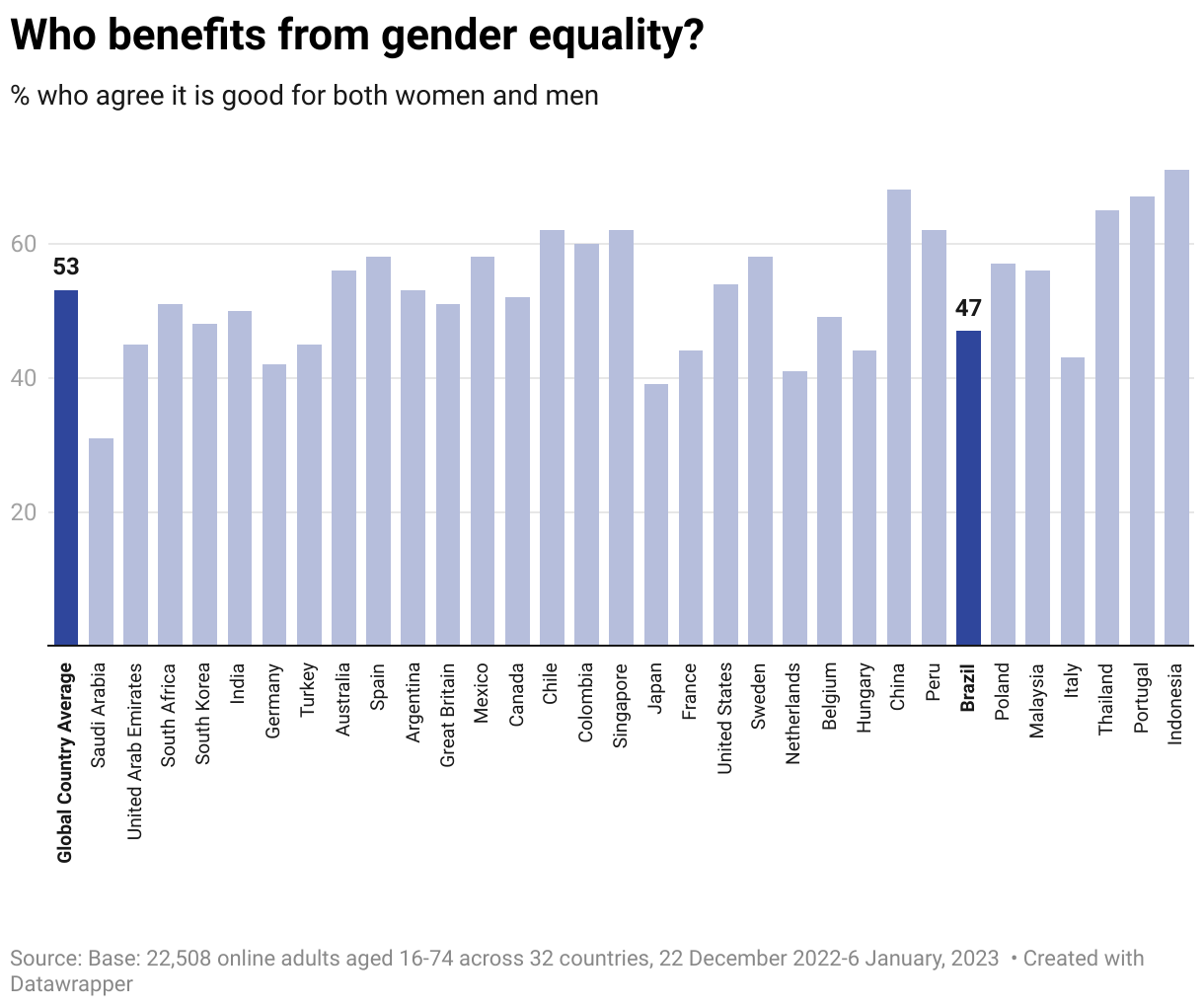
It is clear it is still a challenge to widen the understanding that gender equality is something that benefits everyone and not just one group. Academics and researchers on the subject agree on some ways in which more could be done to achieve a more equal scenario, such as:
- Having programmes to identify potential leaders
- Providing training – especially for men – on discrimination and unconscious bias
- Implementing formal mentoring
- Sponsorship and training programmes for women
- Including clear targets and transparent indicators on gender equality in performance evaluations (both personal and corporate)
Take away
 The use of targets and indicators allows companies to be held accountable – strengthening governance and fostering a culture of transparency. In addition to indicators, it is important to stress the need to broaden the debate to pave the way for positive change. We must consider not only those conversations that revolve around gender equality, but also those that revolve around its intersectionality: black women, trans, 50+, PCD. Programmes to promote women's leadership must be designed according to the specifics of each underrepresented group.
Research can and should be an ally in this journey, providing strategic inputs at the different stages of building a more egalitarian culture. Whatever stage an organisation is at in terms of gender equality, setting clear and evidence-based targets – which can be monitored and assessed – should be the starting point for achieving positive impact.
Table of content
- An introduction to Flair Brazil 2024: Nostalgia or perspectives
- Inflation vs. porfolio: The brand vacuum
- Brands and social purpose in a politically divided time
- Digital extremism: How algorithms feed the politics polarisation
- The importance of female representation in Brazil
- The role of companies in taking responsibility and action
- Conclusion
| Previous | Next |

![[WEBINAR] KEYS: Dialling Up the S In Sustainability](/sites/default/files/styles/list_item_image/public/ct/event/2026-06/keys-webinar-sustainability.webp?itok=xPunvoGu)
![[Webinar] Real-World Evidence: Empowering the Patient](/sites/default/files/styles/list_item_image/public/ct/event/2026-05/healthcare-real-world-evidence-webinar.jpg?itok=kT0PwLPQ)