
The role of companies in taking responsibility and action
 "ESG has become the new et cetera". I thought a lot about this statement made by sustainability expert Denise Hills during a conversation I had with her. Indeed, the number of articles, news stories and discussions about environmental, social and governance issues has increased in quantity, but not necessarily in quality. It is often the case that in-depth discussions fall short of what the subject demands. On the other hand, because it is a growing topic, we see companies moving towards sustainable practices, adopting strategies where environmental and social issues permeate through governance or actions.
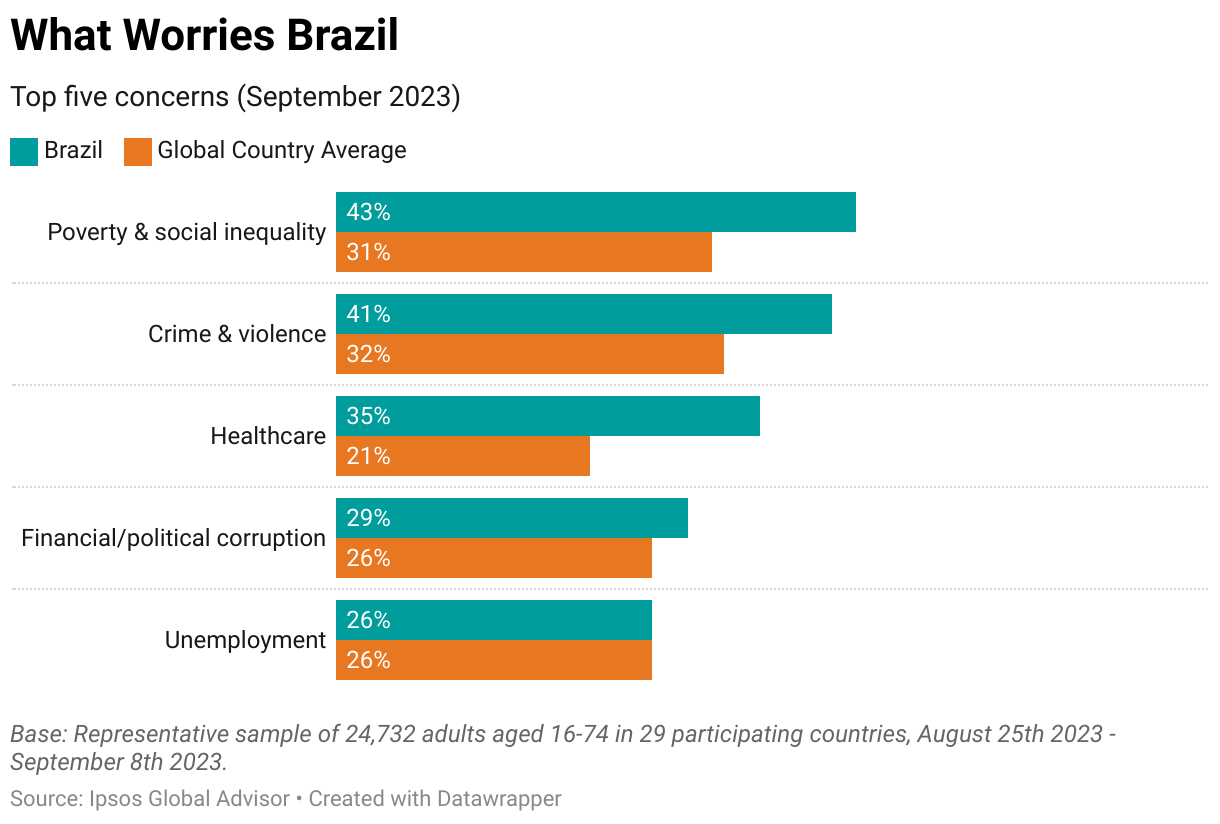
In an attempt to understand the new “et cetera” and why it is so relevant, we should look at the top five concerns listed by Brazilians in the September 2023 What Worries the World Survey: poverty and social inequality (43%), crime and violence (41%), healthcare (35%), corruption (29%) and unemployment (26%). While several of these issues have previously stood at significantly higher levels (e.g., crime and violence reached 55% in April 2018, corruption reached 63% back in June 2017), concern about each of these issues is higher in Brazil than on average globally.
Are such issues the sole responsibility of public authorities?
 Fewer than one in ten Ipsos Reputation Council members – senior corporate communicators based in 16 markets – believe that solving social problems is solely the responsibility of government. On the other hand, Council members are also aware of the risks of entering highly polarised socio-political debates, and there remain additional complexities or "uncomfortable truths" about ESG in the corporate world.
There is a lack of standardisation of objective measures, with the social pillar most affected by subjectivity (because the actions surrounding employees, the community and customers are sometimes less tangible). In some countries the regulatory developments are complex. Finally, companies are highly dependent on supply to meet the environmental commitments that they are making today – and sometimes it's not clear how companies will be able to meet certain commitments.
Given this complex scenario, why do companies really need to act? And how can they act authentically, leaving no room for scepticism? To help companies answer these questions, Ipsos has developed the following framework:
- Orientate (understanding the landscape)
- Focus (identifying where your company should focus its efforts)
- Act (creating or updating offers, products, services, or models that are more sustainable)
- Talk (communicating sustainability efforts, positioning, or repositioning brands, influencing positive behaviour change)
- Evaluate (systematically monitoring what’s working and what’s not)
According to Helio Gastaldi, Head of Public Affairs at Ipsos in Brazil, brands can establish a better communication channel more quickly than corporate communication, gradually solidifying the position of the company. However, it is important to ensure that there is no conflict between the two positions (brand and company). A success story, according to Gastaldi, is Natura, a company that has managed to "guarantee a high degree of consistency between its purpose and its products – a complete symbiosis".
Companies and brands do, in fact, have a place to talk about ESG issues
 Companies and brands have enough credibility and public trust to talk about social and environmental issues. Our Earth Day 2023 research finds that Brazilians believe that there is a shared responsibility among government (70%), businesses (69%) and individuals themselves (73%) to act to tackle climate change.
Renata Bugni, Master in Public Policy, in a conversation with me on the subject, stated that companies "can and should" provide a socio-environmental counterpart in the territory where they are located. "We have to understand society as a fabric in which these exchanges take place, because we are in the same environment". Another point that Bugni mentions is the positive impact of the company's actions: "If an employee can reach the company safely – through a cycle path or with a more intelligent bus route – they arrive happier and are more satisfied working".
How can companies act?
 Gastaldi recommends that the first step for companies wishing to develop a communication agenda based on ESG issues is to identify the company's purpose. In other words, the company must decide where, when and what it wants to speak on, and consult its first stakeholder: the company's employees. "There’s nothing worse than when the company takes action and the employees themselves think it's strange, don't identify with it or listen to the external communication discourse, but themselves have no contact with the published action," he says. When employees identify with the cause, they are the best disseminators because they are the top of the reputation pyramid: advocacy.
Gastaldi also adds that it is vital that the sustainability agenda increasingly permeates strategy and decision making, and that companies adopt a stance of transparency and accountability. "Whatever decision is made – and decisions are being made all the time – the company must be transparent and ready to demonstrate the fairness of its actions, without omitting anything or publicising more than it does. The effect can be overwhelming," says Gastaldi.
Progress is slow, but the world is moving towards greater acceptance of ESG concepts. Companies have a credible role to play in driving such positive change. To support the process of innovating more environmentally friendly products or business models (pillar "E" of ESG), Ipsos carried out an analysis that sought to identify and quantify different groups of people by cross-referencing levels of engagement and concern for environmental issues. In this segmentation, we see almost 20% of people in opposite pillars: Activists (17%) and Disengaged Denialists (19%). We also find another three intermediate groups: Busy Bystanders (16%), Conflicted Contributors (18%) and Pragmatists (29%).
Identifying such groups can help companies assess whether their product may have greater affinity with one or more of them, and thus direct development and communication efforts. Activists, for example, are a group of people for whom packaging is far less important than ensuring a fair production process. Pragmatists want products to retain their current characteristics but be more sustainable. Busy Bystanders are a group with a relatively high level of engagement, but due to lack of time, need facilities to make it easier for them to adopt more sustainable products or services. Conflicted Contributors expect sustainability to be a co-benefit and not to have to pay more for it.
So, to conclude this article, I bring you one more thought from Hills: "there is no sustainability strategy if it is not the strategy itself". The role of brand communication and its alignment with corporate communication is only possible when environmental and social sustainability is incorporated into the company's strategy and reflected in governance.
Table of content
- An introduction to Flair Brazil 2024: Nostalgia or perspectives
- Inflation vs. porfolio: The brand vacuum
- Brands and social purpose in a politically divided time
- Digital extremism: How algorithms feed the politics polarisation
- The importance of female representation in Brazil
- The role of companies in taking responsibility and action
- Conclusion
| Previous | Next |

![[WEBINAR] KEYS: Dialling Up the S In Sustainability](/sites/default/files/styles/list_item_image/public/ct/event/2026-06/keys-webinar-sustainability.webp?itok=xPunvoGu)
![[Webinar] Real-World Evidence: Empowering the Patient](/sites/default/files/styles/list_item_image/public/ct/event/2026-05/healthcare-real-world-evidence-webinar.jpg?itok=kT0PwLPQ)