Know the New America & Beyond: August 2026
What brand doesn’t want its customers to succeed? Put another way, what brand doesn’t succeed when its customers do? In the U.S., as around the world, the metrics of success are changing. For global brands to succeed, they need to understand the new ways their American customers are trying to get by.
Benchmarks on the traditional path to the American dream — graduate, get a job, buy a house and start a family — today are happening on a different timeline, if at all. The result: While a majority of Americans (68%) still believe in the dream, a growing majority (88%) think it’s harder to reach than it used to be. And for Gen Z, there’s been a 22-point jump since last year in their belief that the U.S. economy is rigged to advantage the rich and powerful, according to our latest issue of What the Future: Success.
Meanwhile, many American workers are concerned about the economy as the AI era progresses. Far more American workers (55%) believe that AI will take away opportunities in the job market than create opportunities (11%), Ipsos polling shows. And while only 6% believe AI will personally replace their job, 67% believe it will make the overall worker experience worse. Combined with data centers increasingly becoming a major political issue — an unpopular one, at that — this is becoming a major minefield for brands to be mindful of as they market AI or AI-enabled tech in the U.S. market.
Read on to discover the latest insights on America from Ipsos — please contact us to help you navigate this uncertain environment.

What American workers are saying about AI
Broadly, Americans view AI as destructive to jobs. Although job losses attributed to AI represent a small share of the overall U.S. workforce, Americans of all age groups are more likely to view AI as a force that will take away jobs, not create them.
- More than half of American teens are concerned about AI’s impact on their ability to get a job in the future - Read more
- Bipartisan skepticism: Few Americans support the construction of new data centers in their communities - Read more

How Americans are rethinking the rules of success for the future
How can you, as a brand or policy leader, help people reach success as modern milestones shift? That’s what Ipsos digs into in our latest issue of What the Future. Helping your customers succeed can build relationships that will help you succeed in the future, too. But it all starts with a deeper understanding of today’s American consumer.

Democrats now hold an edge over Republicans on the cost of living, as election draws nearer
The Democratic Party now holds an 8-point lead over the Republican Party as the more trusted party to handle the cost of living, an issue that is poised to play a key role in November’s midterms, according to a new Reuters/Ipsos poll.
Trump’s approval hits all-time low
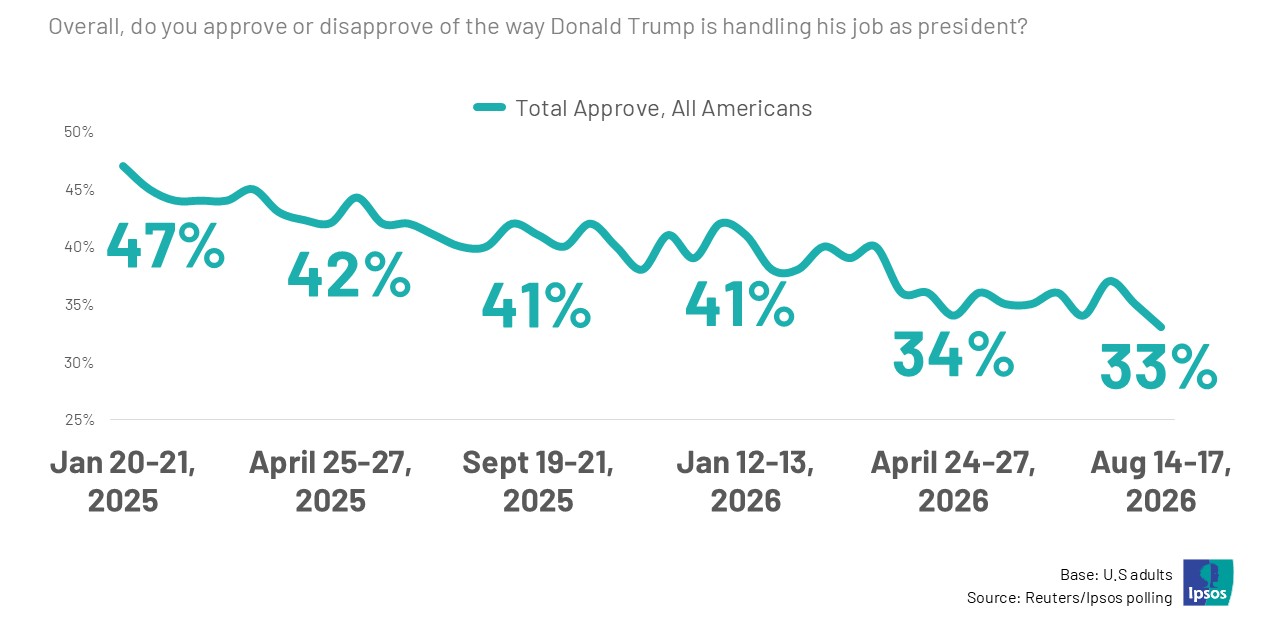
After a brief rebound, President Donald Trump’s approval rating has continued the downward trend that accelerated with the beginning of the Iran war. It now sits at 33% — the lowest reading of either his first or second terms as president.
Consumer confidence falls back to war-driven low
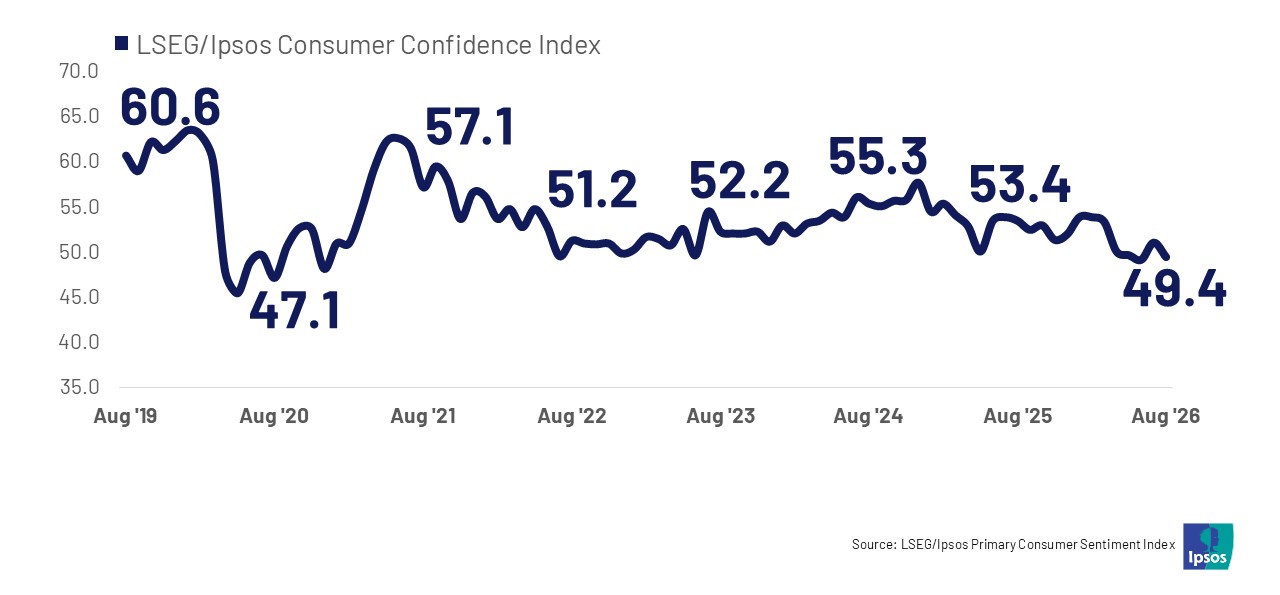
Americans’ confidence in the economy has sunk back to a low point we haven’t seen since COVID. After a brief rebound during the Iran war’s ceasefire earlier this summer, the LSEG/Ipsos Primary Consumer Sentiment Index is back down to 49.4.
That means consumers’ confidence in the economy matches or beats some of the worst moments in recent economic history. The index has been below 50 for three out of the past four months; during the inflation crisis of 2022, it only dipped below 50 twice, rebounding immediately after. The last year with three readings under 50 was 2020, when confidence sat below 50 for six months during the depths of COVID.
What the rest of the world thinks
The view from South America
Across Latin America, the United States remains the region's most influential economic power, key migration destination, and most important external partner. The 2026 FIFA World Cup has enhanced the U.S.’s image in Latin America by showcasing diversity, Latino culture, and organizational capability.
However, perceptions of the U.S. in Latin America have weakened amid growing concerns about political polarization, immigration policies, and policy unpredictability. While 58% of Latin Americans still believe the U.S. will have a positive influence on global affairs, this figure has fallen significantly. Attitudes vary across countries, with Mexico experiencing one of the sharpest declines.
While Chile, Peru, and Colombia have recently experienced political shifts, however, they don’t have much to do with the U.S. or President Trump. They’re driven primarily by domestic concerns such as crime, security, and corruption rather than a stronger alignment with the United States.

Jean-Christophe Salles
CEO, Latin America, Ipsos
And finally, other Ipsos global reports this month
- What Worries the World: Conducted monthly in 30 countries among around 20,000 adults for over a decade, the Ipsos What Worries the World study offers an exceptional snapshot of world opinion on pressing global issues.
- Your next car might drive better than you: The perception of AI in automobiles: There’s a striking paradox around AI in cars: Most people believe modern cars already have too much technology, yet trust in autonomous driving is quietly growing.
- The Life Aspirations Report: A new 30-country Ipsos study explores what people consider a successful life — and who gets to achieve it.
- Ipsos Update: Our regular round-up of research from around the world features a poll digest alongside short summaries of the latest releases. Available in English, French, Spanish and Portuguese.
- Keep in touch with the latest Ipsos research and polling on the Iran conflict from around the world here.