
Attitudes towards same-sex marriage in Northern Ireland
One year on from the overwhelming victory for the Yes campaign in the Referendum on same-sex marriage in the Republic of Ireland, the debate on whether this should be legalised in Northern Ireland continues. But how do people in Northern Ireland feel about the issue 12 months after the Referendum and our May 2015 poll?
A recent Ipsos poll which asked, ‘to what extent do you agree with this statement: homosexual couples should be allowed to marry each other’ has found that over two-thirds (70%) of adults in Northern Ireland believe that homosexual couples should be allowed to marry each other; a figure not dissimilar to the same poll Ipsos ran around the time of the Referendum last year (68%). Meanwhile, 22% disagree with the principle.
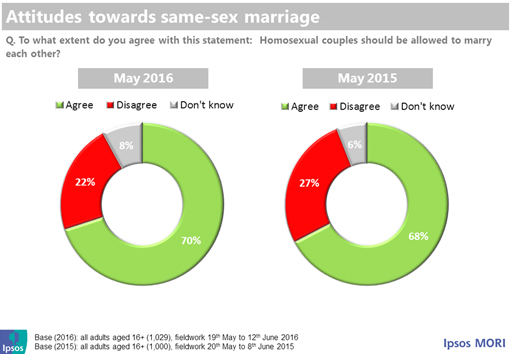
However, there remains a degree of variation among demographic groups when it comes to supporting same-sex marriage. Over three-quarters (77%) of females agree that homosexual couples should be permitted to marry, while fewer males (63%) think the same way.
Over four in five (85%) of 16-34 year olds agree with the principle of same-sex marriage, while those aged 65 and over are less sure (47%).
Four in five (80%) from a Catholic community background agree that homosexual couples should be allowed to marry compared to 60% of those from a Protestant upbringing.
In addition, the data has highlighted differing views on this subject depending on the political party individuals support. As may be expected, agreement that homosexual couples should be permitted to marry is highest among Alliance Party (83%) and Sinn Fein supporters (80%). Three-quarters (76%) of those who favour the SDLP agree that same-sex couples should be allowed to marry, followed by 62% of UUP and 50% of DUP supporters.
Technical note: Ipsos interviewed a representative sample of 1,029 adults aged 16+ across Northern Ireland. Interviews were conducted face-to-face between 19th May and 12th June 2016. Data are weighted to match the profile of the population. Where percentages do not sum to 100, this may due to computer rounding, the exclusion of ‘don’t know’ categories or multiple answers.

