
Economic optimism falls to record low as concern over inflation rises
- Economic optimism has fallen to new historic low in 48 years of Ipsos trends, with 78% expecting a worsening of Britain’s economic condition over the next year.
- The economy is now the equal most mentioned important issue facing the country, at 33%, as immigration falls 5 ppts to 32%.
- Concern about inflation/prices also rises seven points this month to 30%, its highest level for nearly two years.
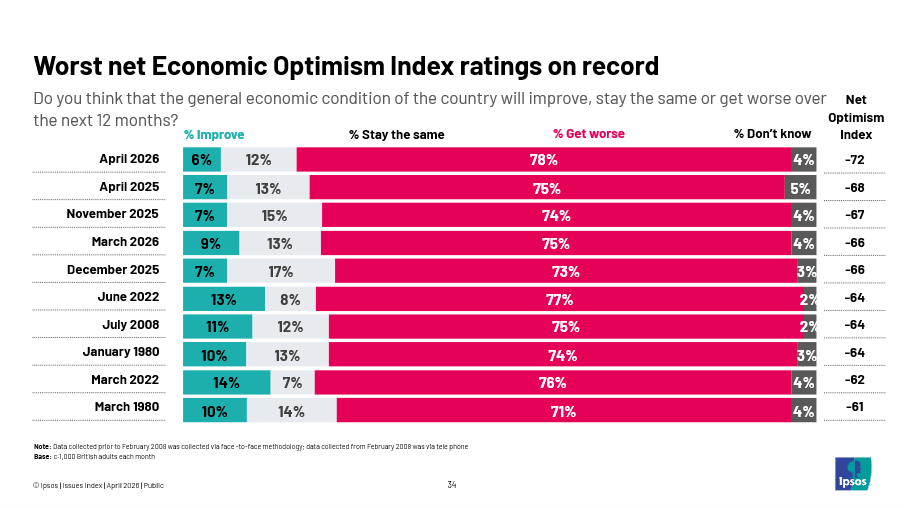
The latest Ipsos Economic Optimism Index (EOI) reveals that net economic optimism in Britain has fallen to the lowest levels ever recorded since Ipsos began collecting this data in 1978. In the latest data, collected 8-14 April 2026, 78% of Britons expect the economy to get worse over the next 12 months (up 3ppts since last month), the highest level recorded since the Index began. 12% (-1) think it will stay the same and just 6% (-3) think it will improve, giving a net Ipsos Economic Optimism Index score of -72.
This current net figure of -72 is four points below the previous historic low of -68 recorded in April 2025 (after the imposition of US tariffs) and is also lower than levels seen during some of the most challenging economic periods in recent history, including the January 1980 recession under Margaret Thatcher, after the winter of discontent (-64), the global financial crisis of July 2008 under Gordon Brown (-64), and the cost-of-living crisis triggered by the COVID-19 pandemic and the invasion of Ukraine in June 2022 (-64).
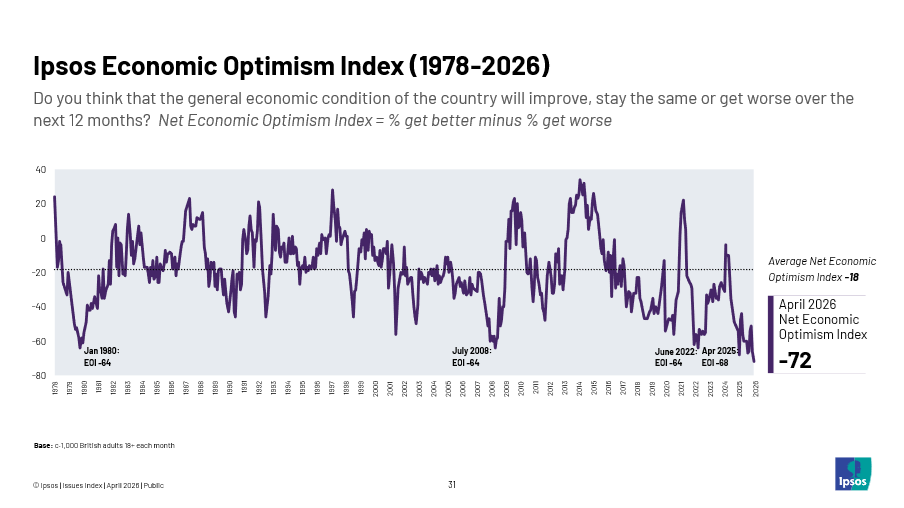
This pessimistic outlook is consistent across all demographics, with only slight variations between groups. The level of net economic optimism this month (twenty-one months into Keir Starmer’s premiership) remains the lowest on record for a Prime Minister at this stage and 5 of the top 10 worst ratings on record have been under the Starmer government.
Issues index
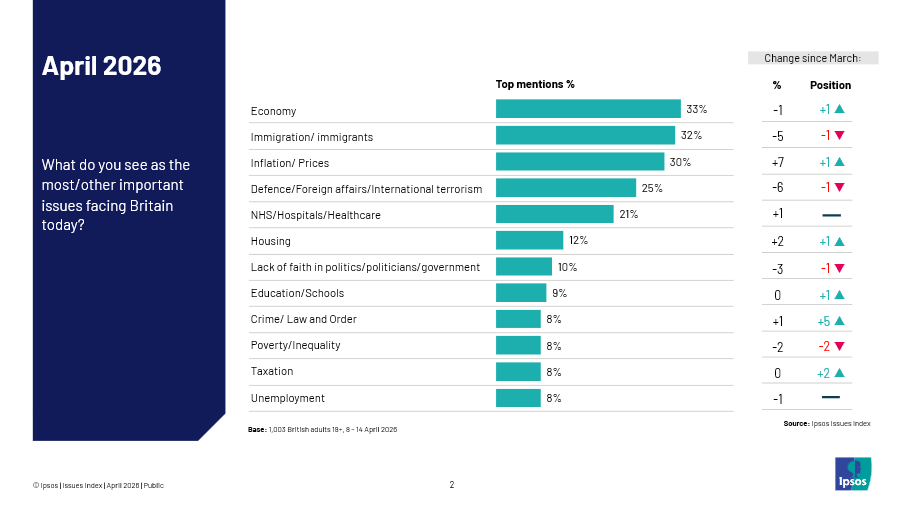
The April 2026 Ipsos Issues Index also reveals that the economy is now equal with immigration as the most mentioned important issue facing Britain this month. Thirty-three per cent of Britons see it as a big issue for the country, similar to the level recorded in March. Concern about the economy is broadly spread across Britain, although those buying their home on a mortgage (42%) are among those particularly likely to mention it as an issue.
Concern about inflation has risen seven points since last month, mentioned by 30% of Britons, making it the third biggest issue for the country and its highest level since June 2024 (when it was mentioned by 29%). Inflation is the top issue for young people (35% of 18-34s) and for women (33%).
The proportion mentioning immigration as a big issue has fallen by five points since March, meaning it is now level with the economy. This is the lowest level for a year, but public concern remains significant, and is still strongly concentrated among Reform UK (70%) supporters, those aged 55+ (40%) and people in social grades C2DE (38%).
Concern about defence has dropped by six points since March. However, it is still the fourth-biggest issue for Britons, mentioned by 25%.
The NHS remains the fifth-biggest issue, with 21% of the public seeing it as a concern, similar to the level recorded last month.
Gideon Skinner, Senior Director of UK Politics at said:
Whilst attention is focused on Westminster, the latest Ipsos Economic Optimism and Issues Index is a reminder that the public are also concerned about issues like the economy and inflation, immigration, defence, and public services, and that dissatisfaction with the state of the country has been entrenched for some time.
This is particularly clear when it comes to attitudes towards the economy, where in the aftermath of the Iran conflict pessimism about the economy has reached record levels in Ipsos’ 48 years of trends, alongside rising concerns about the cost of living. Concern about the state of the economy is widespread among all groups, and is likely to play a key role in the upcoming elections on 7th May as well. Even though Britons recognise the role played by global events on the cost of living, the government is held responsible too, and Labour need to convince the public that they can deliver a more optimistic outlook for the economy if they want to turn their political fortunes around.
Notes to editors
- Ipsos' Issues Index is the longest-running gauge of British public concerns. It is conducted monthly and has provided an overview of the key issues concerning the country for over 50 years. The answers are spontaneous responses, and participants are not prompted.
- Ipsos interviewed a representative sample of 1,003 adults aged 18+ across Great Britain. Ipsos’ telephone omnibus was used for this survey. Interviews were conducted between 8 – 14th April 2026. Data are weighted to match the profile of the population. All polls are subject to a wide range of potential sources of error.


