Andy Burnham and Wes Streeting’s national favourability ratings fall ahead of the Makerfield by-election
- Burnham still the most popular current Labour politician, and leads Starmer as better PM by 25% to 12%, but 50% say there is no difference or want neither.
- Britons would prefer Labour led by either Keir Starmer or Andy Burnham to win the next General Election, instead of Nigel Farage and Reform.
- Kemi Badenoch records her best favourability ratings since becoming leader of the Opposition, while Zack Polanski’s are his worst.
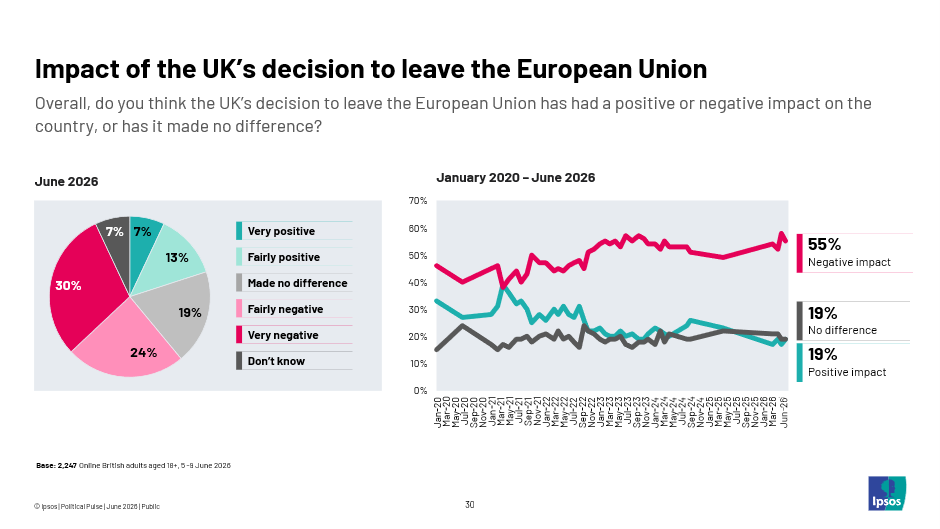
- Ahead of the 10th anniversary of the Brexit vote, 55% of Britons think the decision to leave the EU has had a negative impact on the country.
The future of the Labour Party
In Ipsos’ June favourability tracker, Andy Burnham and Wes Streeting’s ratings have fallen from May.
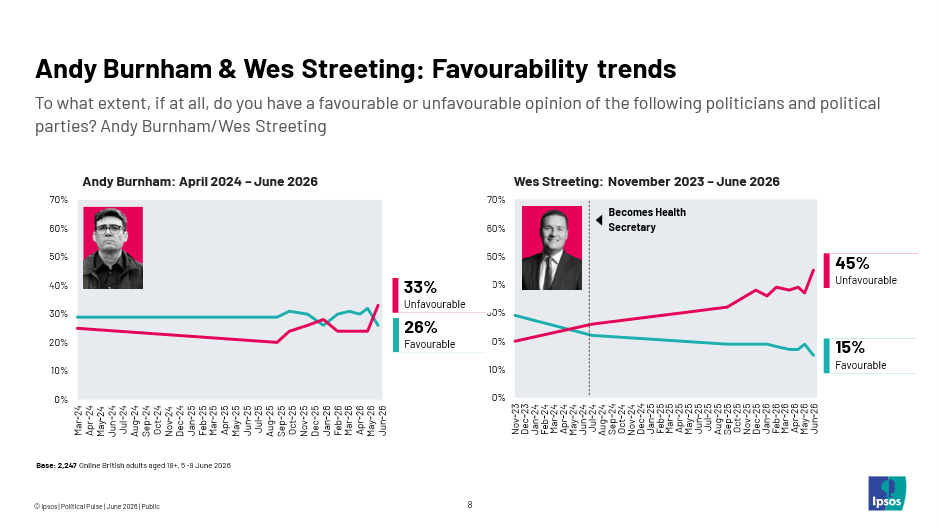
- 26% of Britons have a favourable opinion of Burnham (-6ppts since May), 33% unfavourable (+9), giving him a net favourability rating of -7. While Burnham’s ratings have fallen across the board, the key shifts are among:
- Over 55s: 25% favourable (-12), 41% unfavourable (+11)
- 2024 Conservative voters: 15% favourable (-8), 55% unfavourable (+15)
- Those who think Labour are doing a bad job in government: 12% favourable (-9), 54% unfavourable (+13)
- Scotland: 23% favourable (-15), 32% unfavourable (+11).
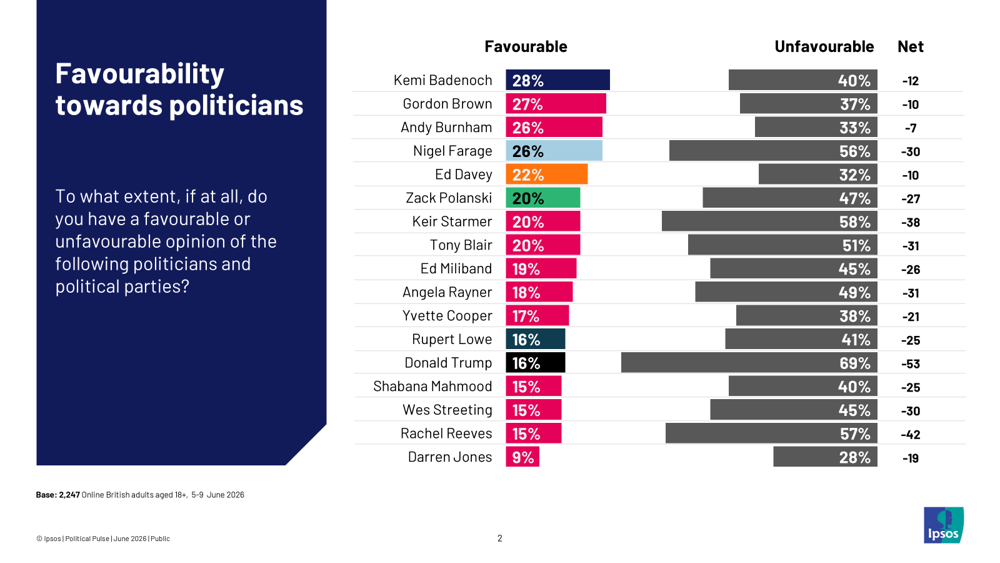
- Wes Streeting’s ratings have also worsened following his resignation from government. 15% have a favourable opinion (-4 ppts since May), compared to 45% who view him unfavourably (+8), giving him a net favourability rating of -30.
- Keir Starmer’s ratings are unchanged from May. 20% are favourable towards the Prime Minister, 58% are unfavourable.
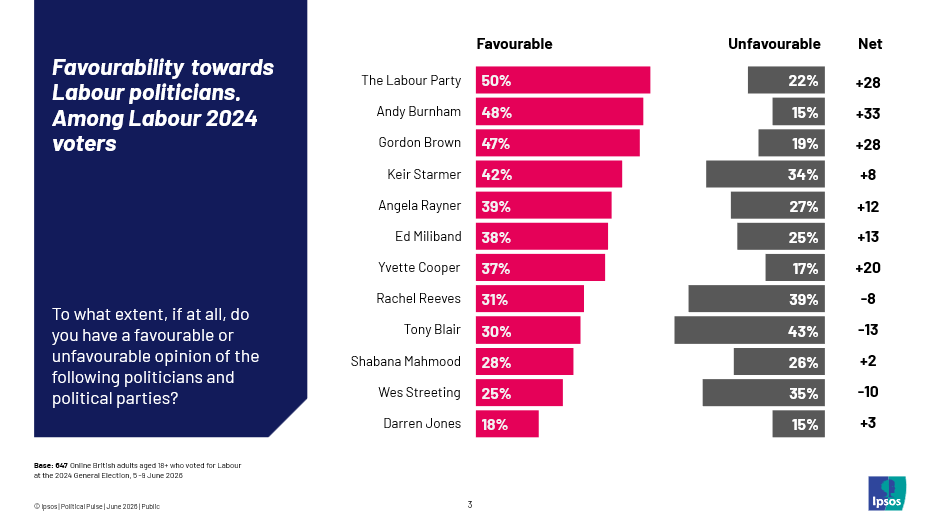
- Despite these changes, Andy Burnham remains the most popular of current Labour politicians asked about, both among the public as a whole and among Labour’s own support.
- Among 2024 Labour voters, 48% have a favourable opinion of Burnham (15% unfavourable); 42% are favourable towards Starmer (34% unfavourable), and 25% are favourable towards Streeting (35% unfavourable).
In hypothetical head to heads against Reform UK led by Nigel Farage, both a Keir Starmer and Andy Burnham-led Labour Party hold similar leads over Farage’s Reform.
- 44% would prefer the Labour party led by Andy Burnham to form the next Government, compared to 31% who would prefer Reform (Labour lead +13).
- 41% would prefer the Labour party led by Keir Starmer to form the next Government, compared to 32% who would prefer Reform (Labour lead +9).

In a head-to-head on who would make the best Prime Minister, Burnham continues to hold a 13 ppt lead over Starmer. 25% think Burnham would make a better Prime Minister, 12% think Starmer,. However, 50% of Britons think that there would be no difference or neither would make a better Prime Minister, which is up 11 percentage points from May 2026.
Likewise the public say they are as likely to considering voting for Labour regardless of whether Burnham or Starmer are leader:
- 30% of Britons say they are currently likely to vote for Labour at the next election.
- 31% say they are likely to vote for Labour if Andy Burnham was leader (although in this scenario, the proportion who are unlikely to consider Labour falls from 62% to 50%, reflecting Burnham’s lower negative personal ratings).
- However, Britons are less likely to consider voting for Labour if Angela Rayner (22%), Ed Miliband (20%), or Wes Streeting (18%) were leader.
Several other Labour politicians perform poorly among the public including:
- Rachel Reeves: 15% are favourable towards the Chancellor (N/C), 57% unfavourable (+2). Net favourability rating -42.
- Angela Rayner: 18% are favourable towards Rayner (-2), 49% are unfavourable (N/C). Net favourability rating – 31.
- Ed Miliband: 19% are favourable (N/C), 45% unfavourable (N/C). Net favourability rating – 26.
- Shabana Mahmood: 15% are favourable, 40% unfavourable. Net favourability rating – 25.
- Yvette Cooper: 17% are favourable (N/C), 38% unfavourable (N/C). Net favourability rating – 21.
- 21% are favourable towards the Labour party as a whole, 53% are unfavourable, giving them a net favourability rating of -32.
Favourability ratings towards other political parties and their leaders
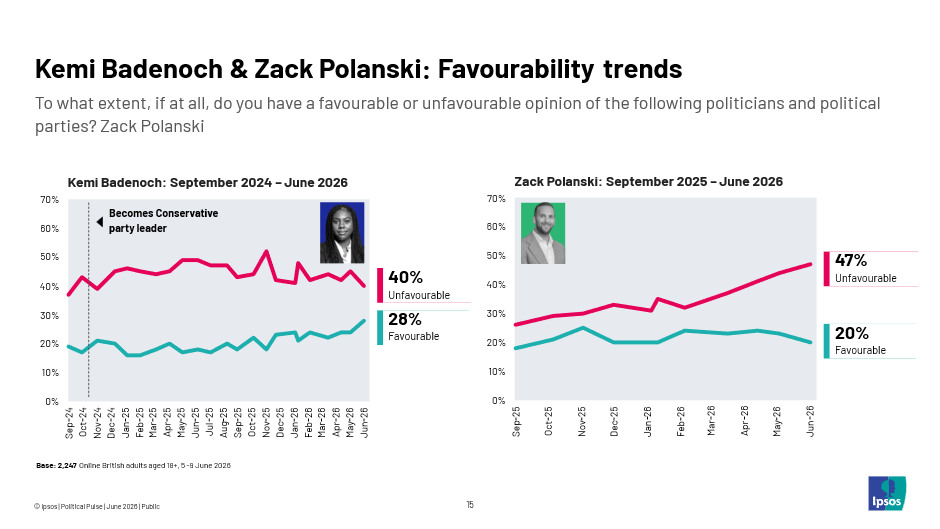
- Kemi Badenoch: 28% have a favourable opinion of Badenoch (+4 from May ’26), 40% unfavourable (-5), giving her a net rating of -12. This is Badenoch’s best favourability rating since becoming Conservative leader. 23% are favourable towards the Conservatives, 47% unfavourable (-24 net favourability rating).
- Nigel Farage: 26% have a favourable opinion of Nigel Farage (-2 from May ’26), 56% unfavourable (+1) giving him a net favourability rating of -30. 27% are favourable towards Reform UK, 53% are unfavourable (-26 net favourability rating).
- Zack Polanski: The leader of the Green Party’s ratings continue to fall. 20% have a favourable opinion (-3), 47% unfavourable (+3), giving him a net favourability rating of -27. This is Polanski’s worst net favourability rating since he became leader of the Green party. 25% have a favourable of opinion of the Green party, 43% unfavourable. Negative views towards the Greens have increased since the start of the year, and this is the party’s highest unfavourability rating since the Ipsos Political Pulse started tracking them over five years ago (in February 2021).
- Ed Davey: 22% have a favourable opinion, 32% unfavourable, giving him a net favourability rating of -10. 24% have a favourable opinion of the Liberal Democrats, 33% unfavourable (-9 net favourability rating).
- Rupert Lowe: 16% of Britons have a favourable opinion towards the Restore Britain leader, 41% unfavourable – net favourability rating -25. 17% are favourable towards Restore Britain, 44% unfavourable (-27 net favourability rating).
Blairites or Brownites
Following Tony Blair’s recent interjection on what the future of the Labour party should look like, half of Britons (51%) have an unfavourable opinion of the former Prime Minister (20% favourable), giving him a net favourability rating of -31. Blair trails his former Chancellor, Gordon Brown. 27% have a favourable opinion of Brown, 37% unfavourable (net favourability -10).
Among 2024 Labour voters:
- 47% have a favourable opinion of Gordon Brown, 19% unfavourable.
- 30% have a favourable opinion of Tony Blair, 43% have an unfavourable opinion. This the highest percentage of 2024 Labour voters who expressed an unfavourable opinion towards any of the Labour politicians asked about in June’s Political Pulse.
Elsewhere in the survey:
- Prior to their high-profile resignations just 11% said they are familiar with John Healey, and just 3% are familiar with Al Carns. Recognition of Al Carns among the public is comparable to “Stewart Lewis” (2% familiarity) a made-up politician included by Ipsos on several surveys.
- Ahead of the tenth anniversary of the EU Referendum, 55% of Britons think it has had a negative impact on the UK (30% say very negative ). 19% think it has made a positive impact and another 19% that it has made no difference.
- 64% think the country is heading in the wrong direction (-4 from May ’26), 16% think it is heading in the right direction (+3 from May ’26).
- Healthcare (58%) and inflation/ the rising cost of living (55%), followed by immigration (50%), continue to be the issues that the public think will be very important to them at the next General Election.
Of the findings, Gideon Skinner, Senior Director of UK Politics at Ipsos, said:
Ipsos’ latest data is a reminder to all potential rivals in a Labour leadership contest of the challenges ahead. While Keir Starmer’s ratings remain poor, those who might be eyeing up a bid for No 10 will need to convince voters looking for change that they have better answers to turn around the entrenched opinion – held for many years now – that Britain is heading in the wrong direction. In this context Andy Burnham remains the most popular (or at a minimum least unpopular) current Labour politician, among both the public at large and with Labour voters, but with his ratings seeing a drop this month he still needs to demonstrate he can persuade those currently sitting on the fence about him that he would offer a better alternative.
Looking across the rest of the political landscape the other parties have their challenges too. Reform are the most popular party overall and have enthusiastic support from their own base, but divide opinion elsewhere and are at the risk of tactical voting. The Greens remain popular among young people, but more widely they and their leader’s favourability ratings are drifting down. Kemi Badenoch’s personal ratings are at the highest they have been as Conservative leader, but her party has not improved at the same rate. And the public’s core issues continue to worry them: concern over the NHS, cost of living, immigration and economic growth, dissatisfaction with the performance of government, and, on the 10 year anniversary of Brexit, few believing it has had a positive impact, even though divisions remain on what people would like the future relationship to look like.
Notes:
- Ipsos interviewed a representative sample of 2, 247 adults aged 18+ across Great Britain. Polling was conducted online between 5-9 June 2026.
- Data are weighted to match the profile of the population. All polls are subject to a wide range of potential sources of error.