Despite strong backing for targeted cost-of-living measures, 2 in 3 (67%) lack confidence that the Labour Government’s Budget addresses the long-term economic issues facing the country
New polling data from Ipsos in the UK, conducted in partnership with BBC Women’s Hour between 28–30 October 2026, reveals deep public pessimism towards the nation's economic health in the immediate aftermath of Chancellor John Healey’s first Autumn Budget. While key interventions aimed at easing household expenses enjoy overwhelming public support, the wider package has done little to dispel entrenched anxiety about personal finances, public services, and the overarching direction of the British economy.
- 2 in 3 (67%) lack confidence that the Labour Government's Budget addresses the long-term economic issues facing the country.
- 80% of Britons view the current state of the British economy as poor, with two-thirds (68%) of those resigned to permanently lower living standards due to deep-rooted problems.
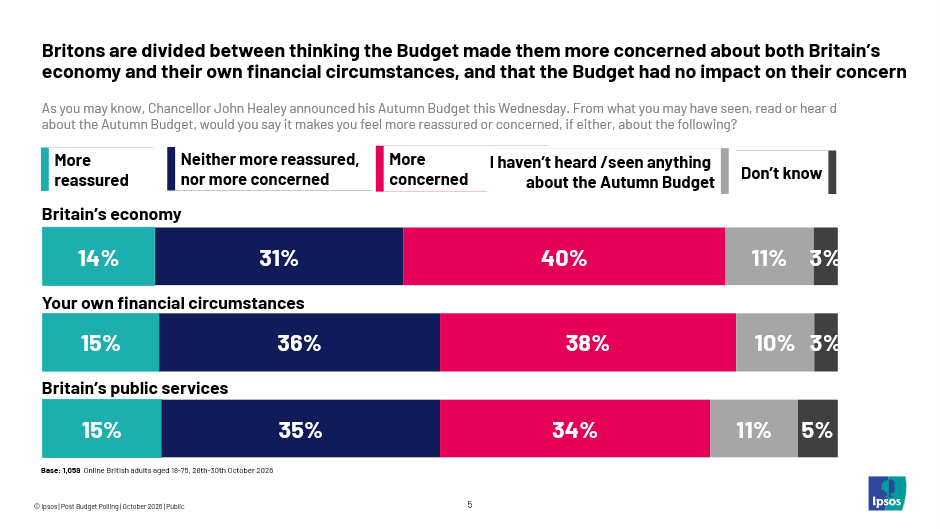
- 40% of the public say Chancellor John Healey’s Autumn Budget has left them more concerned about Britain’s economy, while only 14% feel more reassured.
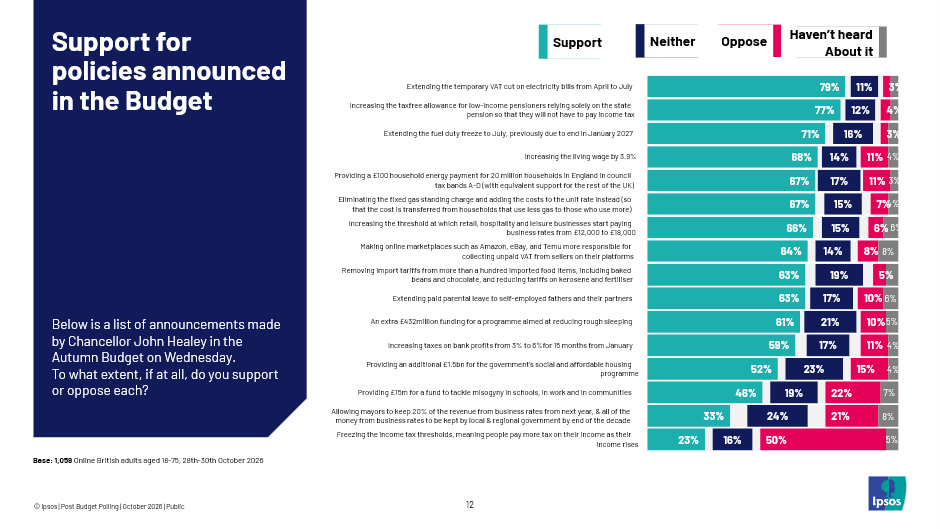
- 8 in 10 (79%) support extending the temporary VAT cut on electricity bills, making it the most popular budget policy announced, followed closely by lifting the income tax allowance for low-income pensioners (77%).
- Half (50%) oppose freezing income tax thresholds, contrasting with strong public endorsement for targeted tax hikes on online retailers (64%) and bank profits (59%).
Entrenched pessimism over the economy and mixed reception for the Chancellor
Public perception of national economic conditions remains subdued, showing little immediate improvement from pre-existing pessimism:
- 80% of British adults currently evaluate the condition of the British economy as "poor", compared with just 16% who deem it "good", yielding a net score of -64.
- Among those who consider the economy poor, two-thirds (68%) believe Britain is facing structural, deep-rooted issues that mean the country must adapt to permanently reduced living standards, against 25% who view current economic struggles as temporary.
- Evaluations of the Chancellor himself remain distinctly divided as much of the public has not yet made up its mind; 29% say John Healey is doing a "bad job" as Chancellor of the Exchequer, whilst 15% believe he is doing a "good job", and 35% answer "neither" and another 21% don’t know.
- Following the fiscal statement, around 4 in 10 (40%) say the Budget made them feel more concerned about Britain's economy (vs 14% more reassured and 31% neither), while 38% report heightened concern about their personal financial situation (vs 15% reassured).
- 67% of the public say they are not confident that the Budget addresses the long-term challenges facing the British economy, with only 20% expressing confidence. A similar lack of confidence is apparent when voters are asked whether the Conservatives (66%) or Reform UK (69%) would deliver a Budget that tackles these long-term issues.
Broad enthusiasm for targeted household relief, but steep pushback on fiscal drag
Public support for the specific announcements delivered by the Chancellor is generally high, with the notable exception being the decision to freeze income tax thresholds:
- 79% of Britons endorse extending the temporary VAT cut on household electricity bills through to July, with just 3% opposed.
- A similar majority (77%) back raising the tax-free allowance for pensioners reliant solely on the state pension to shield them from income tax, while 71% favour prolonging the fuel duty freeze to July.
- Strong majorities also welcome supply-side and targeted funding interventions, including a 3.9% living wage increase (68%), clamping down on unpaid VAT across online marketplaces like Amazon, Temu, and eBay (64%), and a £100 household energy rebate for council tax bands A–D (67%).
- Corporate revenue measures are also viewed favourably; 6 in 10 (59%) back raising the tax surcharge on bank profits from 3% to 6% for 15 months, while 63% support lifting tariffs on over 100 imported food items such as baked beans and cocoa.
- By far the measure with the lowest level of support and highest level of opposition of the 16 tested in this survey, the decision to freeze income tax thresholds, a policy that pulls earners into higher tax bands via fiscal drag, is opposed by half of Britons (50%) with only 23% in support.
Perceptions of fairness and political uncertainty
The polling highlights some public sensitivity around fairness, as well as muted expectations of an imminent parliamentary dissolution:
- More than half of the public (59%) feel that "people like me" are treated worse than they should be by the British Government, with equivalent dissatisfaction voiced for small businesses (60%), workers (58%), pensioners (51%), and young people (49%).
- Conversely, half believe that immigrants (50%), high-income individuals (50%), and big businesses (50%) receive better treatment than they should.
- Looking ahead politically, a quarter of Britons (25%) think it is likely that Prime Minister Andy Burnham will call an early general election within the next 12 months, with 50% considering an early national poll before the August 2029 deadline unlikely.
Technical notes:
- Ipsos interviewed a representative sample of 1,059 online British adults aged 18–75 across Great Britain. Polling was conducted online via Ipsos Digital between 28th and 30th October 2026.
- Data are weighted to match the profile of the population. All polls are subject to a wide range of potential sources of error.