Early support and training tops priority list for SEND
New data from Ipsos in the UK reveals that, as the government prepares reforms to the Special Educational Needs and Disabilities (SEND) system, early support, identification, and training for educators top the public’s priority list.
SEND
- Awareness: Just over a third (35%) of Britons say they know at least a fair amount about the SEND system, rising to almost half (48%) of parents.
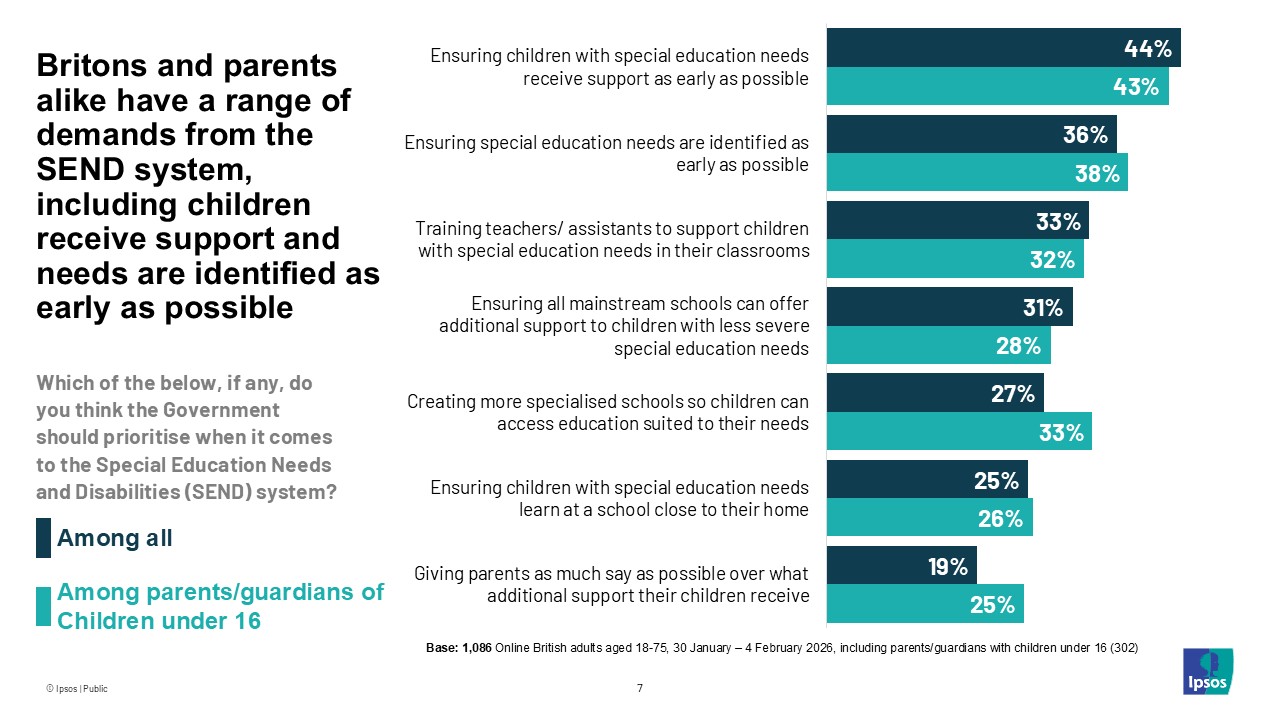
- Priorities: Key priorities for the SEND system include early support for children, early identification of special needs, and enhanced training for educators, while parents also prioritise creating more specialised schools.
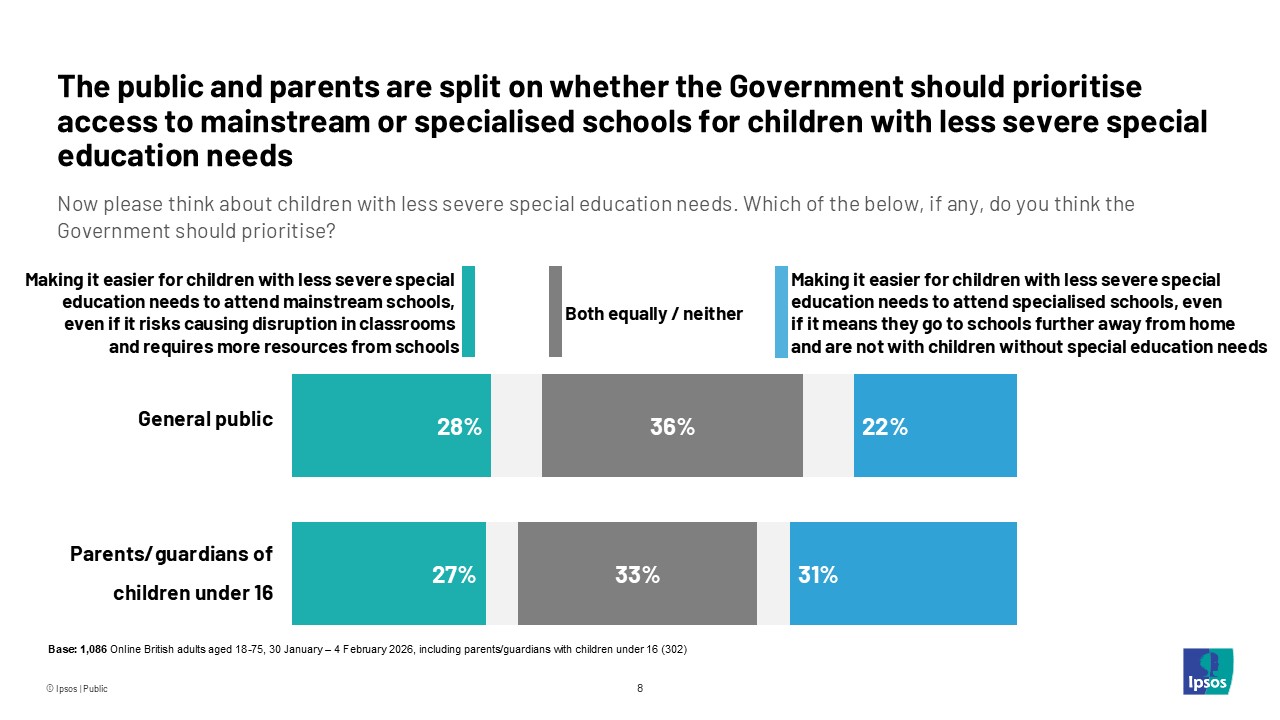
- Mainstream or specialist schools: The public and parents are split on whether the Government should prioritise access to mainstream or specialised schools for children with less severe special education needs. 27% of parents and 28% of the public prioritise making it easier for children with less severe special education needs to attend mainstream schools, even if it risks causing disruption in classrooms and requires more resources from schools. Conversely, parents (31%) are slightly more likely than the public (22%) to favour making it easier for children with less severe special education needs to attend specialised schools, even if it means they go to schools further away from home and are not with children without special education needs.
Overall education system
- Levels of satisfaction:
- A majority of parents of under 16s (65%) and a significant portion of the public overall (54%) express satisfaction with primary school education quality, marking a 5percentage point increase among the general public since May 2023.
- Satisfaction with secondary schools rose by 4 percentage points, with 46% of the general public reporting positive views, including 55% of parents.
- Half (50%) of the British public is satisfied with colleges/sixth form, rising to 58% of parents.
- 59% of the British public is satisfied with the quality of universities, down 7 ppts from May 2023. Two-thirds (67%) of parents are satisfied.
- What schools are doing well:
- When asked what schools do well, the public is most likely to say ensuring pupil’s academic performance (42%) and providing healthy meals (40%). Addressing pupil’s mental health issues (27%), staff wellbeing (26%), and reducing tensions between different communities (26%) receive more mixed reviews.
- Parents are more positive about schools' performance across multiple areas, with half saying they do a good job on academic performance (49%). However, only a third say the same about addressing pupil’s mental health and reducing tensions between different communities (36% each).
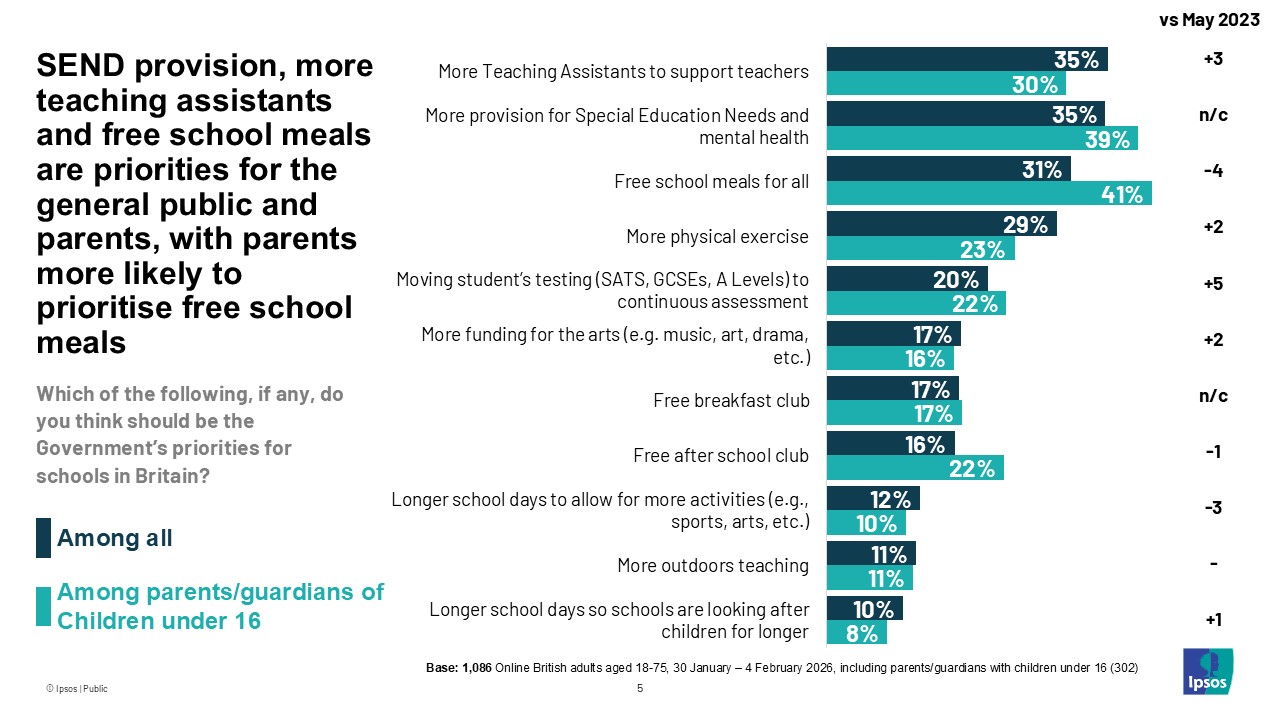
- What should be prioritised for schools: SEND provision, more teaching assistants and free school meals are priorities for both the general public and parents, with parents more likely to prioritise free school meals (31% of the public overall vs 41% of parents).
Commenting on the findings, Jessica Ozan, Research Director at Ipsos said:
Increased satisfaction in primary and secondary education levels in our latest polling are certainly positive developments – however, there is a clear call for more teaching assistants, increased provision for Special Education Needs and mental health, and free school meals. These insights provide a valuable framework for policymakers to consider as they aim to reform SEND provision and balance educational quality with inclusivity and the well-being of students.
Ipsos interviewed a representative sample of 1,086 adults aged 18-75 across Great Britain. Polling was conducted online between the 30th January -4th February 2026.
Data are weighted to match the profile of the population. All polls are subject to a wide range of potential sources of error.