
Half of Scots want energy powers to be devolved
The Holyrood election campaigns have seen heated debates between the parties on energy policy, in the context of growing public concern about energy security and fuel prices in the wake of the US/Israel-Iran war. New Ipsos Scottish Political Pulse results find that:
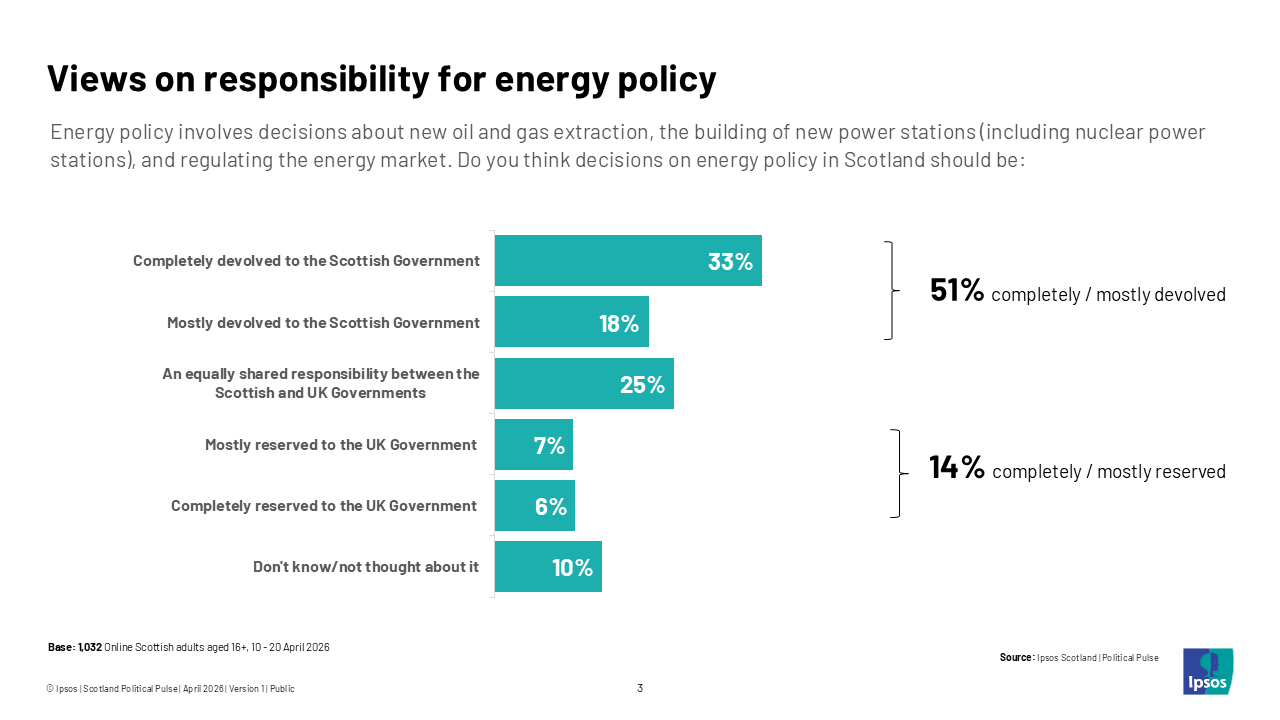
- Over half of Scots (51%) think that energy policy should be devolved to the Scottish Government, while a quarter (25%) feel responsibility should be shared equally with the UK Government and 14% that it should be reserved to Westminster.
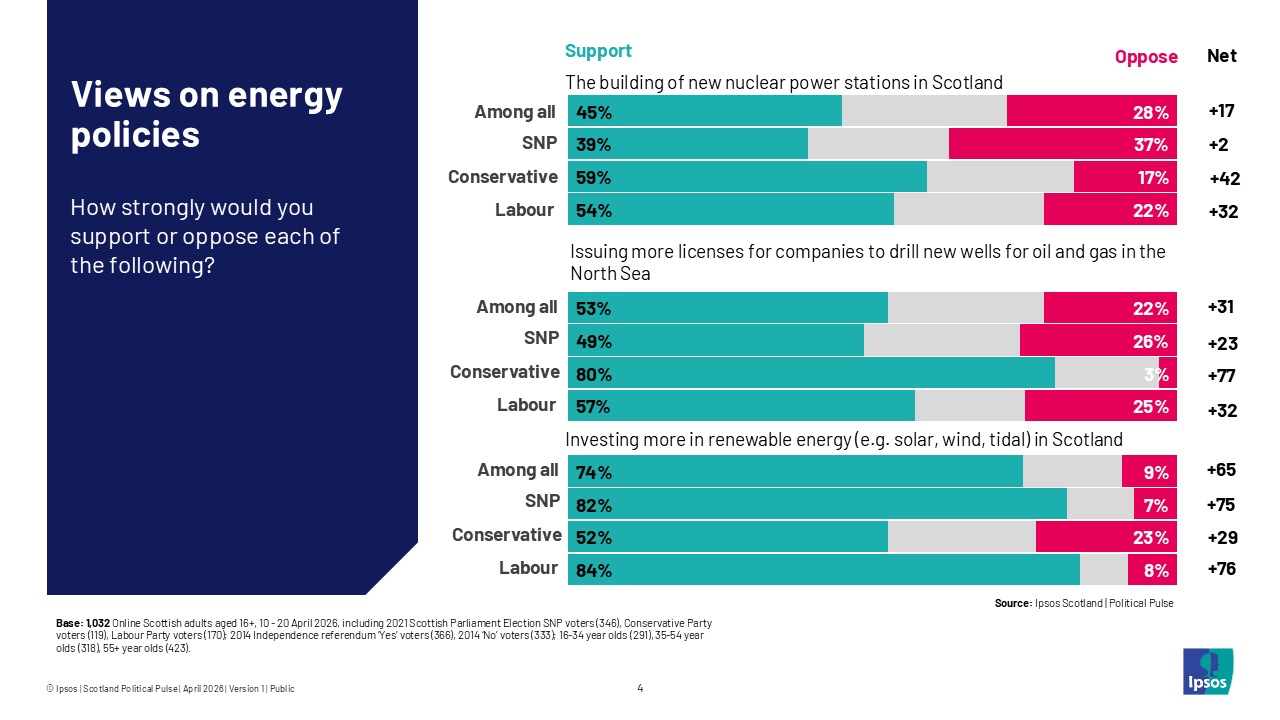
- More Scots support than oppose investing more in renewables (74% support), issuing more licences for new oil and gas drilling (53%) and new nuclear development in Scotland (45%).
- While convinced of the economic and security benefits of further oil and gas drilling, Scots are split over the environmental impact.
Emily Gray, Managing Director of Ipsos Scotland, commented:
Energy policy has shot up the Scottish public’s agenda lately to become the fourth most important issue at this Holyrood election. These new results show that the public are in favour of a broad energy mix – while support for renewables is particularly high, voters for all Scotland’s largest parties are also more likely to support issuing more licences for new oil and gas drilling in the North Sea and new nuclear development than to oppose these. John Swinney has said he will push the UK Government for energy policy to be devolved to Holyrood if the SNP wins the election – and these results suggest that half of Scots would be in favour of energy powers being mostly or completely devolved. The SNP is less in tune with the public on new nuclear development in Scotland, however – while the SNP has long opposed this, more of the public support it than oppose it, and views among the SNP’s own voters are mixed.
Decisions on energy policy in Scotland
Most aspects of energy policy are currently reserved to the UK Government. However, half of Scots (51%) think energy policy should be mostly or completely devolved to the Scottish Government rather than the UK Government – including a third (33%) who think it should be a completely devolved matter. Just 14% think it should be mostly or completely reserved to the UK Government, while a quarter (25%) think it should be a responsibility shared equally between both governments.
Support for energy policy to be devolved is strongest among 2021 SNP voters, with 77% saying it should be mostly or completely devolved and just 6% saying it should be mostly or completely reserved (13% say it should be shared equally). It is lowest among Conservative voters, 43% of whom say it should be reserved and 15% say it should be devolved – though 35% say it should be a shared responsibility. Those who voted Labour in 2021 are more divided, with 39% saying energy policy should be devolved, 39% that it should be shared equally and 18% that it should be reserved.
Views on energy sources
Three quarters of the Scottish public (74%) support investing more in renewable energy in Scotland, while just 9% are opposed.
Over half of Scots (53%) would support issuing more licences for companies to drill new wells for oil and gas in the North Sea (22% oppose). Support for more new oil and gas drilling licences is strongest among 2021 Conservative voters - 80% are in favour while just 3% oppose. However, more 2021 Labour voters (57%) and 2021 SNP voters (49%) support issuing new oil and gas drilling licences than oppose this (25% of Labour voters and 26% of SNP voters are opposed). Support for more drilling licences is higher among those in the North East of Scotland (61% support, 18% oppose) and Mid Scotland and Fife (60% support, 17% oppose).
More Scots also support the building of new nuclear power stations in Scotland (45%) than oppose this (28%). Support for new nuclear power stations is higher among those who voted Conservative (59%) or Labour (54%) in 2021 than it is among those who voted SNP (39%). Despite the SNP’s staunch opposition to new nuclear development, views among 2021 SNP voters are more mixed, with 39% saying they support the building of new nuclear power stations in Scotland, while 37% oppose this.
Views on Rosebank
With two major untapped oil and gas fields – Rosebank and Jackdaw – at the centre of debates around further drilling in the North Sea, Scotland’s political parties have adopted differing positions on whether or not this should be permitted.
When asked to consider whether the impacts of allowing further drilling in the North Sea will be positive or negative across a range of areas, the balance of opinion among Scots is strongly tipped towards the positive impacts it could have for the economy and energy security. A majority think that allowing further drilling in the North Sea will have a positive impact on both Scotland’s economy (62%) and the economy of the UK as a whole (59%), with just 8% and 7% expecting a negative impact to either (around a fifth don’t think it will make much difference).
Similarly, over six in 10 (62%) expect there to be a positive impact on the UK’s dependence on other countries for energy, while just 7% think the impact will be negative (21% think it will not make much of a difference).
The public recognise there is a trade-off, with more expecting that further drilling in the North Sea will have a negative environmental impact than that it will have a positive impact. Around three in 10 (31%) think it will have a negative impact on Scotland’s ability to meet its target to reduce carbon emissions, while 24% expect a positive impact and 32% don’t think it will make much difference either way. Views are similarly split when thinking about the UK’s ability to meet carbon emissions reduction targets, with 30% of Scots saying that allowing further drilling in the North Sea will have a negative impact on this, 25% that it will have a positive impact and 30% that it won’t make much difference either way.
Notes to Editor:
• For further information, please contact Owen Evans, [email protected]
• Ipsos interviewed a representative sample of 1,032 adults aged 16+ across Scotland. Interviews were conducted online between 10th-20th April 2026.
• Data are weighted to match the profile of the offline population. All polls are subject to a wide range of potential sources of error.
• Where results do not sum to 100%, this may be due to computer rounding, multiple responses, or the exclusion of “don’t know” categories.


