Favourability towards Reform UK dips in Scotland while the SNP’s ratings hold up
New Scottish Political Pulse results from Ipsos find that:
- 34% of Scots have a favourable opinion of the SNP, a marginal improvement from September. Reform UK has seen a dip in favourability ratings, with 20% favourable towards the party while 58% are unfavourable – a swing of -4.5 points since September.
- John Swinney is the best rated of the party leaders, with a clear lead over Anas Sarwar and Malcolm Offord on most key leadership traits - although public sentiment is more negative than positive towards all the Scottish party leaders.
- A majority of the public (55%) expect the SNP to win the election, either as the largest party in a hung parliament or as a majority government.
Leaders
None of the Scottish party leaders are viewed positively overall by the public. First Minister John Swinney is the least worst rated, with 30% viewing him favourably and 42% viewing him unfavourably – giving a ‘net’ favourability rating of -12, compared with -10 in Ipsos’ previous poll in September 2025.
Scottish Labour leader Anas Sarwar’s net rating is unchanged from September at -26, with 20% favourable towards him and 46% unfavourable. Meanwhile, Reform UK Scotland’s leader Malcom Offord is the lowest rated of the Scottish party leaders, with a net rating of -37 (14% favourable, 51% unfavourable).
According to the public, John Swinney has a clear lead over Anas Sarwar and Malcolm Offord on most key leadership traits. Swinney is seen as the party leader who most understands the problems facing Scotland (44%), is a capable leader (38%), in touch with ordinary people (36%) and honest (36%). However, the public are less convinced that he has the right plans for Scotland, with more saying he does not have the right plans (40%) than that he does (33%), while 25% are not sure. 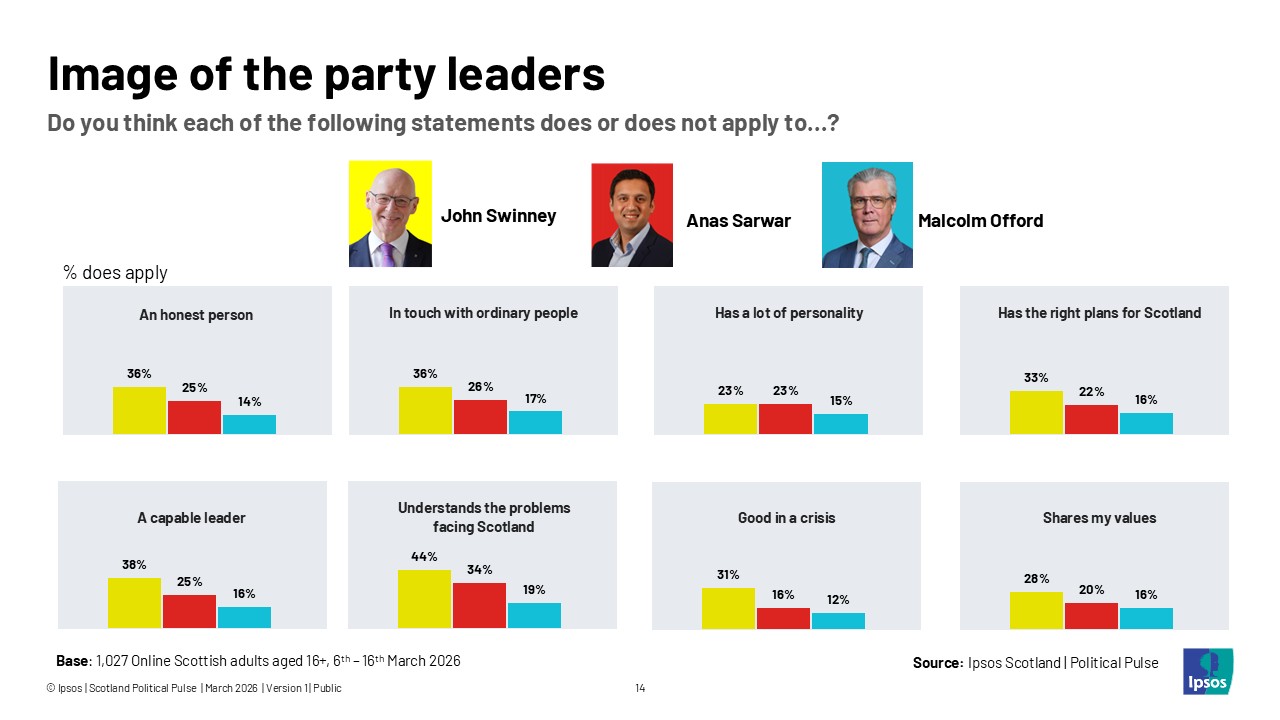 Meanwhile U.S. President Donald Trump’s ratings have fallen in the wake of war in the Middle East, with 74% of Scots now viewing him unfavourably and 12% viewing him favourably. This gives Trump a net rating of -62 - a downward swing of -8 points since September.
Parties
The SNP is the party rated most highly by the public, with 34% of Scots viewing them favourably and 41% unfavourably (a net rating of -7, up marginally from -11 in September). Those with a favourable view of the SNP say this is because the party is most likely to provide Scotland with the stability it needs (45%), has the best policies for Scotland (42%) and because the party’s values are more aligned with their own than those of other parties (41%).
20% of the public are favourable towards Scottish Labour and 48% unfavourable, giving them a net rating of -28 (unchanged since September, which was the worst Ipsos had recorded since this polling series began three years ago). Meanwhile, Reform UK’s ratings have fallen in recent months, with 20% of the public favourable towards the party and 58% unfavourable - a net rating of -38 (a swing of -4.5 points since September).
Views on the current and future Scottish Government
The public’s perceptions of the SNP’s recent record in government remain broadly negative, though views have improved a little compared with six months ago.
Nearly three in ten Scots (28%) say the Scottish Government has done a good job of improving living standards for people on low incomes, a rise of five points since September – although 45% think that the government has done a bad job of this. Similarly, a quarter (26%) say the Scottish Government has done a good job of managing Scotland’s economy, up six points since September - but almost half (48%) think the government has done a bad job of this.
There is a desire for change, with 64% of the Scottish public agreeing that Scotland needs a fresh team of leaders, and just 31% agreeing that the current Scottish Government deserves to be re-elected (46% disagree). However, Scots do not currently see a better alternative, with just over two in ten (22%) agreeing that Scottish Labour is ready to form the next Scottish Government (47% disagree). This is 12 points lower than in March 2024, four months ahead of the UK General Election, when 34% agreed. Fewer still view Reform UK as ready to form the next Scottish Government (19% agree, 58% disagree).
Looking ahead to the election, a majority of Scots (55%) expect the results to go in the SNP’s favour, with one in three (33%) predicting a hung parliament with the SNP as the biggest party and 23% predicting the SNP will be able to form a majority government. Just 15% expect a hung parliament with another party being the biggest, and one in 10 (10%) expect some other result.
Emily Gray, Managing Director of Ipsos Scotland, commented:
Ahead of the Scottish Parliament election campaigns starting next week, our latest Scottish Political Pulse suggests a widespread lack of enthusiasm among the public towards both political leaders and parties. That said, the findings are more encouraging for the SNP than for any other party, with John Swinney the highest-rated party leader and slight improvements in the public’s views of their performance in government on living standards and managing the economy. Meanwhile there are warning signs for Reform UK, with falls in both the party’s and UK leader Nigel Farage’s favourability ratings, and their Scottish leader, Malcolm Offord, emerging as the worst rated of the Scottish party leaders.
Notes to Editor:
- For further information, please contact Megan Hitchcock on [email protected]
- Ipsos interviewed a representative sample of 1,027 adults aged 16+ across Scotland. Interviews were conducted online between 6th-16th March 2026.
- Data are weighted to match the profile of the offline population. All polls are subject to a wide range of potential sources of error.
- Where results do not sum to 100%, this may be due to computer rounding, multiple responses, or the exclusion of “don’t know” categories.