
Great Britain least likely of 31 countries to see university degrees as essential or good value
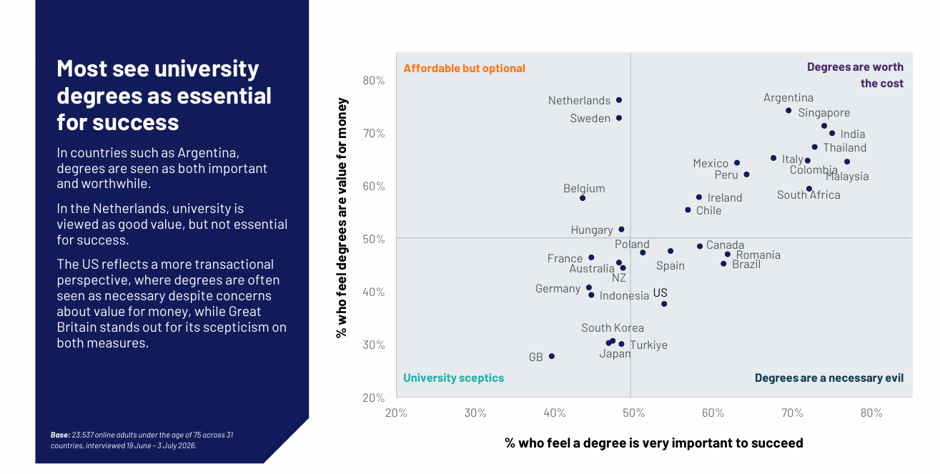
- Only 28% of Britons believe university degrees in their country offer good value for money, placing Great Britain bottom of the 31 countries surveyed.
- 4 in 10 British adults (40%) say a degree is very important to succeed in life, ranking GB again last out of 31 surveyed nations.
- An equal share (39%) advise young people today to enter the workplace directly, making Great Britain one of only two countries surveyed where straight-to-work is seen as a better path than higher education.
Scepticism over university costs and career value
While higher education remains the default route to career opportunity globally, public opinion across Great Britain has diverged significantly from international norms.
- 28% of Britons agree that university degrees offer good value for money, falling 25 percentage points below the Global Country Average of 53%, and placing Britain last out of all 31 countries surveyed.
- Britain further came last in believing a degree is very important to succeed in life (40%, compared to the Global Country Average of 57%).
- 4 in 10 Britons (39%) advise young people to enter the workplace directly after school, compared to 23% who advise going to university first.
- Great Britain ranks 31st out of 31 nations as the only two surveyed countries where the public actively favours entering the workforce immediately over attending university.
- 59% of highly educated Britons agree that a degree aids career progression, compared to 45% among those with lower educational qualifications.
Tech anxieties and digital safety in schools
British adults express pronounced concern regarding the impact of digital technology and online safety on young people, aligning with broader tech-sceptical trends observed across the Anglosphere.
- 1 in 3 British adults (37%) cite the effects of social media and technology such as AI as one of the greatest challenges facing young people in Great Britain today, placing Britain above the global average (30%) and ranking in the top 5 globally alongside Belgium (39%), France (34%), and Germany (30%).
- Just over 7 in 10 (71%) support banning children under 14 from using social media both inside and outside of school, representing an 8-percentage point increase in support since 2024.
- 52% of the public believe the use of Artificial Intelligence (AI, including ChatGPT) should be banned in schools, placing Great Britain in the top 5 most AI-sceptical nations globally alongside Canada (59%), the US (56%), Ireland (57%), and Australia (52%).
Despite pessimism about young people's challenges and futures, majority think young people would have better opportunities in Britain versus abroad
The survey highlights widespread anxiety regarding the state of health and future economic mobility for the next generation, though a majority continue to think Britain offers more for young people than they could find abroad.
- 56% of British adults describe the overall state of mental health among young people in Great Britain today as poor, while 13% describe it as good.
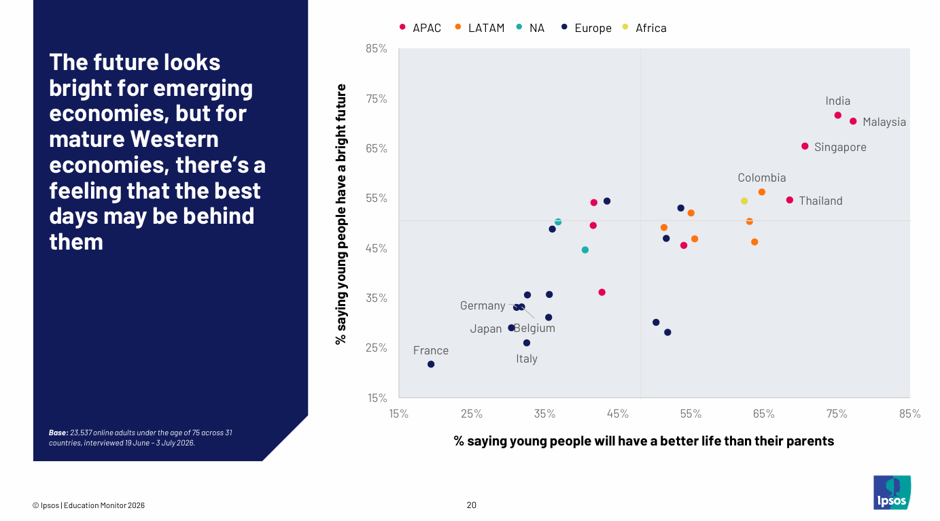
- 1 in 3 Britons (33%) believe young people in Great Britain today will have a better life than their parents, placing it in the bottom 5 alongside France (19%), Germany (31%), Japan (30%), and Italy (33%).
- 36% agree that young people in Great Britain have a bright future overall, but this drops to 27% when considering young people from poorer backgrounds.
- 4 in 10 (39%) agree that young people in Great Britain today would have better opportunities by moving abroad, placing Britain in the bottom 1/3 of the 31 countries surveyed. This compares to 62% globally.
Attitudes toward education in Britain
Public confidence in the overall quality and systemic efficacy of the British school system remains heavily divided.
- Just over 4 in 10 British adults (43%) rate the overall quality of the education system in Great Britain as good, while 26% rate it as poor.
- More than 1 in 3 Britons (37%) agree that the school curriculum in Great Britain adequately prepares students for future careers, whereas 55% disagree.
- The public are divided as to whether the education system in Great Britain contributes to reducing social inequalities, with 42% each agreeing and disagreeing.
Commenting on the findings, Trinh Tu, Managing Director of Public Affairs at Ipsos in the UK said:
Britain stands apart from many other countries in the way it thinks about university. While people still recognise the opportunities a degree can create, many are questioning whether the costs are worth it. With tuition fees and student debt remaining prominent public concerns, only a minority see degrees as good value for money, and Britain is the least likely country surveyed to view a degree as important for success in life.
Interestingly, younger Britons remain more positive about university than older generations, despite being the group most directly affected by the financial costs. Taken together, the findings suggest the debate in Britain is no longer about whether higher education matters, but about whether the benefits of a degree justify the cost.
Methodology
- These are the results of a 31-country survey conducted by Ipsos on its Global Advisor online platform, between Friday, June 19, and Friday, July 3, 2026. For this survey, Ipsos interviewed a total of 23,537 adults aged 18 years and older in India, 18-74 in Canada, Republic of Ireland, Malaysia, New Zealand, South Africa, Türkiye, and the United States, 20-74 in Thailand, 21-74 in Indonesia and Singapore, and 16-74 in all other countries.
- The sample consists of approximately 2,000 in Japan, 1,000 individuals each in Australia, Belgium, Brazil, Canada, France, Germany, Great Britain, India, Italy, Mexico, New Zealand, Spain, and the U.S., and 500 individuals each in Argentina, Chile, Colombia, Hungary, Indonesia, Ireland, Malaysia, the Netherlands, Peru, Poland, Romania, Singapore, South Africa, South Korea, Sweden, Thailand, and Türkiye.
- Samples in Argentina, Australia, Belgium, Canada, France, Germany, Great Britain, Hungary, Italy, Japan, the Netherlands, New Zealand, Peru, Poland, South Korea, Spain, Sweden, and the U.S. can be considered representative of their general adult populations under the age of 75. Samples in Brazil, Chile, Colombia, India, Indonesia, Ireland, Malaysia, Mexico, Romania, Singapore, South Africa, Thailand, and Türkiye are more urban, more educated, and/or more affluent than the general population. The survey results for these countries should be viewed as reflecting the views of the more “connected” segment of their population.
- The data is weighted so that the composition of each country’s sample best reflects the demographic profile of the adult population according to the most recent census data. In Great Britain, the data was weighted by age, gender, and education. “The Global Country Average” reflects the average result for all the countries and markets in which the survey was conducted. It has not been adjusted to the population size of each country or market and is not intended to suggest a total result.
- When percentages do not sum up to 100 or the ‘difference’ appears to be +/-1 percentage point more/less than the actual result, this may be due to rounding, multiple responses, or the exclusion of “don't know” or not stated responses.
- The precision of Ipsos online polls is calculated using a credibility interval with a poll where N=1,000 being accurate to +/- 3.5 percentage points and of where N=500 being accurate to +/- 5.0 percentage points. For more information on Ipsos' use of credibility intervals, please visit the Ipsos website.
- The publication of these findings abides by local rules and regulations.
For information or assistance about this please contact:
Emilios Louca
Research Director
Ipsos Public Affairs +1 (416) 572-4443
[email protected]
Nik Samoylov
Director
Ipsos Public Affairs +1 (416) 572-4471
[email protected]


