
How the Budget landed online - new Ipsos social media analysis suggests a more low-key reaction than the last two years
- Ipsos Synthesio social listening analysis has examined the social media conversation around John Healey’s first Budget, and compared it to Rachel Reeves’ Budgets in 2025 and 2024.
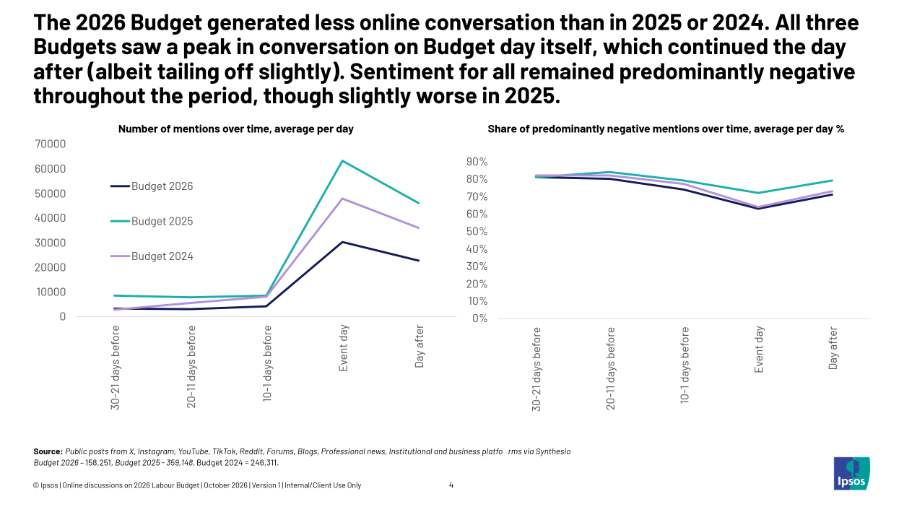
- There was noticeably less social media conversation around the 2026 Budget than in previous years (from the 30 days running up to the Budget, the day itself, and the day after) – slightly less than half the levels we recorded for the 2025 Budget, and about two-thirds that seen in 2024,
- However, the relative overall online sentiment was similar for all three; in common with much political conversation online, around 3 in 4 posts were predominantly negative. However, reaction was slightly more negative following the 2025 Budget than it was in 2026.
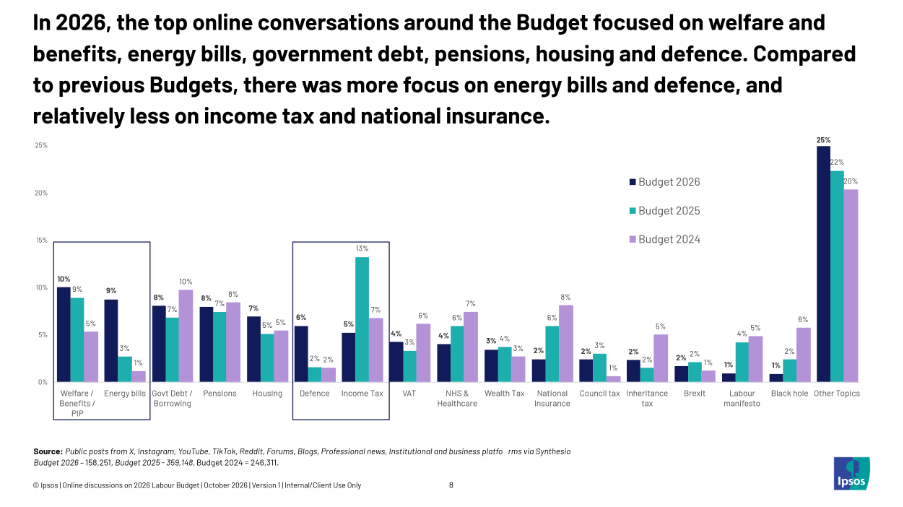
- In 2026, the top online conversations around the Budget focused on welfare and benefits, energy bills, government debt, pensions, housing and defence. Compared to previous Budgets, there was more focus on energy bills and defence, and relatively less on income tax and national insurance.
London, UK. New social media analysis from Ipsos Synthesio in the UK, conducted in the run-up and immediate aftermath of the October 2026 Budget, reveals how social media responded to Chancellor John Healey’s first major fiscal event.
Our market-leading GenAI-powered Ipsos Synthesio capability centres on social listening, which collects and analyses publicly accessible online conversations about specific topics such as brands, industries, or concepts. Our capability spans analysis of social media, forums, blogs, ratings and reviews, search, and AI platform (e.g. ChatGPT) analysis.
Our analysis analysed 158,251 publicly available posts and comments about the UK Budget from social media platforms from 28 September to 29 October 2026 (i.e., the 32-day period covering the 30 days before the Budget, the day itself and the day after) and compared it to the similar periods for the 2025 and 2024 Budgets.
A less discussed Budget online than the previous two years
- Overall, our analysis suggests the 2026 Labour Budget generated just over 158,000 mentions online during the whole period from 28 September to 29 October 2026. This is just less than half (down 56%) of the c359,000 mentions during the equivalent period in 2025, and about two-thirds (down 36%) of the c246,000 mentions in the month before to day after the 2024 Budget.
- A similar pattern is found in the number of mentions on the day itself. There were 30,310 online mentions of the Budget on Budget day 2026, compared to 63,081 in 2025 and 47,901 in 2024.
- However, as is often the case for much political conversation online, all three Budgets received a similar relative proportion of predominantly negative sentiment, although there was slightly more criticism in 2025. For the whole period, 74% of posts about the Budgets were predominantly negative in 2026, 80% in 2025, and 76% in 2024. For the day itself, 63% were predominantly negative in 2026, 72% in 2025, and 64% in 2024.
What did people online talk about, in connection to the Budget?
- The main topics of online conversation around the 2026 Budget focused on welfare and benefits, energy bills, government debt, pensions, housing and defence.
- Compared to previous Budgets in 2025 and 2024, there was more focus on energy bills and defence, and relatively less on income tax and national insurance.
- Specific negative concerns that were discussed included worries that the measures did not do enough to make a significant difference to the cost of living or to underlying weaknesses in economic growth, pressure on businesses through minimum wage increases and business rates, lack of extra funding for defence, and concerns among higher earners (even those who feel they are working people and enjoying only modest financial success) that they were bearing much of the burden.
- There were more positive reactions to help for the cost of living through the £100 energy payments, fuel duty freeze, scrapping of gas standing charges, minimum wage increase and so on, to the £432 million for tackling rough sleeping and extra funding for affordable housing, fiscal devolution, and the small business rate relief for hospitality, retail and leisure businesses.
Commenting on the findings, Director of Politics Gideon Skinner said:
There was much talk ahead of Wednesday over whether the Chancellor would be able to deliver a low-key Budget, and Ipsos’ social media analysis suggests that to some extent he succeeded, at least compared to the previous two years.
Certainly compared to last year there was less focus on income tax, and relatively more attention on the implications for energy bills and defence - although welfare/benefits, government debt and pensions remain perennial hot topics.
However, as we often see in our analysis of political conversation online, the large majority of discussion was still predominantly negative, although the Chancellor may be relieved that it wasn’t quite as critical as for Rachel Reeves last year.
While there was some appreciation of the retail offers to help with the cost of living, energy bills and costs for small business, for fiscal devolution and action on homelessness, many online also questioned whether the help was enough to make a real tangible difference to living standards, and whether the government had set out a convincing strategy to increase economic growth to deal with the country’s underlying challenges.
For further information about our Ipsos Synthesio GenAI capability and to discover how it may be able to support your needs please visit here.
If you would like to discuss our capability, then please do not hesitate to contact Bairbre Cunningham via email at [email protected]
Notes:
- Social listening is the process of collecting and analysing publicly accessible online conversations about specific topics such as brands, industries, or concepts. Analysis spans social media, forums, blogs, ratings and reviews.
- Synthesio study analysed 158,251 publicly available posts and comments about the UK Budget from social media platforms from 28 September – 29 October 2026 (for Budget 2025, 359,184 posts from 27 October-27 November 2025, and for Budget 2024 246,311 posts from 20 September – 31 October 2024).
- It should be understood, therefore, that social media data is not the same as a representative survey of the population; not everyone is on social media, and the topics those who are chosen to talk about on social media may not be a representative selection of all the experiences they face. Instead, its value is in uncovering the stories and narratives that they do want to talk about, and what this reveals about their experiences.
- This research was carried out in accordance with the requirements of the international quality standard for market research, ISO 20252.
- The analysis was conducted in line with the MRS code of conduct.
- To uphold ethical standards and comply with OSA and GDPR, all data sourced by Synthesio is publicly available online (at the time of data collection and analysis), and no information is collected from private social media accounts or behind paywalls.
- All data is anonymised and analysed at an aggregated level, with no reference to individuals or identifiable social media accounts.


