
The Impact of Modern Polling Techniques on Campaigning in the 2001 General Election
House Magazine 'VOX POP'
What will be the impact of modern polling techniques on campaigning in the 2001 general election? Not much, if history is anything to go by. Like PEBs, advertising, and direct mail, telephone canvassing, and door to door canvassing. These things don't actually affect how most people vote.
Elections count, but only at the margins. Some 80 percent of the electorate have their minds made up. Already. And nearly firmly fixed. Difficult to dislodge. They're not 'floating voters'.
Nothing could save Labour from humiliation in 1983, after the election of Michael Foot as Labour Leader and the left-wing take over of the Party. They didn't even quite hold their 'core' vote of 30 percent (28.5%).
Not much of anything could have saved the Conservative Party from a Labour Landslide in 1997, once the Tories had lost their image for economic competence following Black Wednesday in September 1992. They just held their 'core' vote of 30 percent (31.4%).
And with the best result post war, the Liberal Democrats still only gets of the order of 17/18 percent, added to which are the Nationalists, Greens, Referendum Party (in 1997), UKIP, etc., come up to c. 20 percent.
So, 30% + 30% + 20% = 80% (or more), leaving the 20 percent (or fewer) who determine not only the outcome but the margin of every general election, whether 143 seat majority for Mrs. Thatcher in 1983 or 179 majority for Mr. Blair in 1997. Further, there are usually only about 20 percent of the constituencies which can be regarded as marginal, so 20% x 20% = 4%, and with about 30 million voters, that means about 1.2 million voters need to be identified, researched, listened to, and persuaded to stay with you, if you've got them, or switched, if they are leaning toward another party.
So what are the tools that can be used to attract the 'floating voter'? Party election broadcasts. Newspaper advertising. Hoardings. Publicity, in the places that count. TV. Radio. The 'new' media. This will be the first election where the Internet will play a significant part. But only on the margin.
Still, all parties will be spending money on polls and pollsters, advisors and spin doctors in an effort to maximise (Labour) their victory, and minimise (Tories and Liberal Democrats) the size of their defeats. Focus groups will be conducted nightly, and private polls taken daily. The published polls will be poured over until every nuance has been absorbed, and every implication considered.
Modern polling techniques are dividable into two general types: qualitative research, the ubiquitous 'focus group', and quantitative research, 'polls'. These are additive to the published poll information. When I was doing the Labour Party's private polling, the focus groups were mainly used to test communications, leaflets for canvassers, ads for newspapers and hoardings, countless 'red roses' were focus grouped again and again, until the exact tint and shape had been tested nearly to death.
Of greater tactical value was the daily 'quickie', done face-to-face, phoned in late afternoon, and the findings on the reactions to yesterday's events reported to the Leader before that evening's big set piece in order that the speech could be fine tuned to reflect shifting interest is issues, weaknesses identified in the Opposition Leader's speech, or press conference, or breaking news.
Of greater strategic value were the results from the panel callbacks, going back to people interviewed at great length at the outset of the campaign in order to see how they had shifted, and determine 'why'.
The interviewers are used as well as conduits of information on the mood of the country, and some are shrewd observers of a change in how people are feeling and how they are reacting to the 'political climate'.
And talk about 'fast feedback'; we delivered 1,000 interviews nationwide in about six hours, analysed by gender, age, social class, region and all the other demographics.
There's only one role for the private polls for the parties: to help win the election. Before that is dismissed as too cynical, let me say that no pollster does his client any good whatsoever, in the longer term, by doing anything other than being completely honest in the choice of questions (no holds should be barred), in the depth of the analysis (no conclusions rejected because they are not 'p.c.'), and in the directness of the presentation (preferably kept to a close circle).
Turning to the published polls, they do feature the horse race aspect of elections in large relief, for that's what editors think sell newspapers, excite the punters, and get talked about in the pubs and dinner tables across the land. They do a lot more than that, if you look at the fine print. One distinguished professor at the LSE took me aside the other night to ask why we didn't 'break down' the don't knows. But, said I, we do. Why aren't they published?, she then asked, so I'm sending her the Sun from last week, to show her that they published that 7% had said they would not vote, 6% were undecided, and 5% refused to say, making up the 18% who we lump together to call the don't knows.
Which, by the way, is about double the level we found in say 1987. More people then were committed to their political party, if they were Tory or Labour, and they were less likely to say they would not vote, less likely to say they were undecided, and less likely to refuse to say for whom hey would vote. In fact, for years we found a pretty steady 2% who refused to say, but as we had other data on these shy folks, we had a pretty good guess. They tended to be older people, more likely to be women, more likely than the average to be middle class, and very likely to be readers of the Mail during the week, and the Express on Sunday. Armed with this information, we had a good shot at thinking they might just be Tory voters.
Telephone polls get a lower percentage of don't knows than do our face-to-face polls for the Times. In the last poll for the Times, in the third week of April and thus after the decision to postpone the expected election in April, we found 12% who said they wouldn't vote at all, 9% who were undecided, and the 'standard' two percent refuse to say. Whereas only one in a hundred of the under 55s refused, five percent of the 55s and over refused, and now they are evenly spread between men and women, and middle and working class, and are evenly spread throughout the country. They are, still, twice as likely to read the so-called 'mid-market' press, i.e., the Mail and the Express. That doesn't change.
The will not votes are another matter. Among the 18-24s, one in five admit no intending to vote, more than double the over 55s, leading me to once again point out that the 'grey vote' is four times as powerful in this coming election as the youth vote, because there are twice as many of them, and they are twice as likely to vote.
Finally, the undecideds. My observation for what it's worth, is that they aren't the undecideds the parties must worry about, for they tend, in the end, to dither away throughout the election, and end by staying away from the polls. The ones that the parties worry about is the people who give a voting intention, but when pressed to say whether or not they have definitely made up their minds, 'or is there a chance you may change your mind?' We find about a third of the electorate fall into not the 'undecided' camp, but the 'may change mind' group. These are the 'soft' Tories, Labour, of Lib Dems, and as of last month among Labour's intending voters there were slightly more who were firm in their intention than the Conservatives, but that over half of Lib Dem intenders said they might switch.
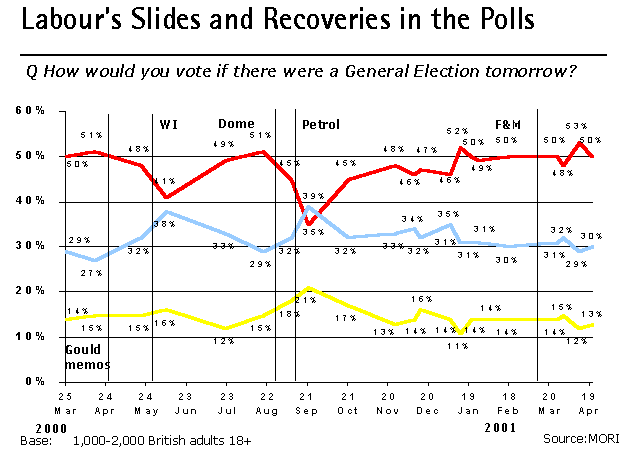
So, with the election expected to be called this week, where do the parties stand? In the c. 35 or so national polls we've seen since 1 November, they nearly all have had Labour at c. 50% (+/-3%), Tories at 30% (+/-3%), and the Lib Dems at 14% (+/-3%), and those figures would project (not forecast!) to a c. 250 seat Labour majority. To get that, Labour would have to soak up all the so-called 'floating vote', and I don't think that is likely. My bet's on Labour at about 44% again, the Tories on 34%, the Liberal Democrats on 16%, and 6% other.
But I've been wrong before. Last time I said 'just over a hundred' on the eve of John Major going to the Palace, and it was 179 six weeks later. In six weeks we'll know.
Professor Sir Robert Worcester is Chairman of MORI.


