
Ipsos Polling confirms Holyrood26 as the “loveless election” in Scots minds
More Scots feel negative than positive about the Holyrood election result, with ‘disappointed’ and ‘frustrated’ the most common words chosen to describe how they feel about it. Expectations of what the Scottish Government will achieve in the next five years are low.
- 39% said the election result made them feel negative about the next five years, vs. 29% who said it made them feel positive.
- More people think it is unlikely than say it is likely that the Scottish Government will have a positive impact in the next five years across a wide range of areas, but particularly improving people’s own standard of living and reducing social divisions in Scotland.
- People are divided on when, if at all, there should be another referendum on independence, with 48% saying they think there should be one within the next five years.
Rachel Ormston, Research Director at Ipsos Scotland, commented:
The so-called ‘loveless’ election in May has left many in Scotland feeling negative or indifferent. The SNP Government will need to demonstrate real impact over its fifth parliamentary term to counter this public disillusionment. Meanwhile, although MSPs have endorsed the Scottish Government’s motion to ask the UK government to grant a Section 30 order, giving them the power to hold another referendum, the Scottish public remains divided on when another referendum should take place. Just under half would favour a referendum within this five-year parliamentary term, but others would prefer a date further in the future, or are unsure when, if ever, it should be held.
Feelings about the election
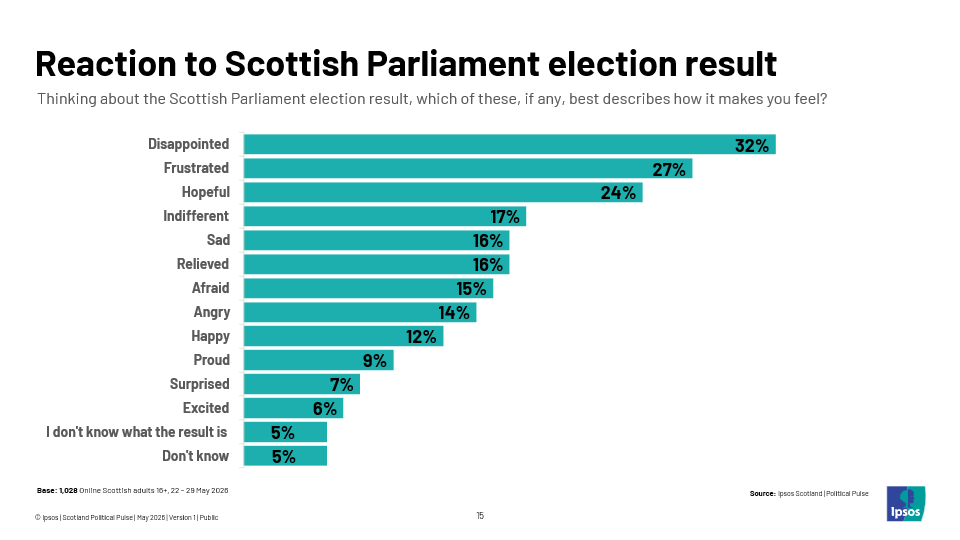
When asked to choose from a list of words how the election result made them feel, the most common response was disappointed (32%), followed by frustrated (27%). Around a quarter (24%) said they felt ‘hopeful’, while 17% were indifferent. Younger people were more likely than average to feel ‘hopeful’ (29% of 16–34 year-olds chose this response), while older people were more likely to feel disappointed (41% of those aged 55 or older, compared with 18% of 16-34 year-olds). Just 6% overall said they felt ‘excited’ by the result, including just 11% of those who had voted SNP on their constituency vote.
More said the election result made them feel negative about the next five years than said it made them feel positive (39% vs. 29%). Unsurprisingly, this was strongly correlated with how people had voted – over half of those who voted Labour, Reform UK, Liberal Democrat or Conservative on their constituency vote said the result had made them feel negative, compared with just 17% of those who had voted SNP.
Expectations of the new Scottish Government
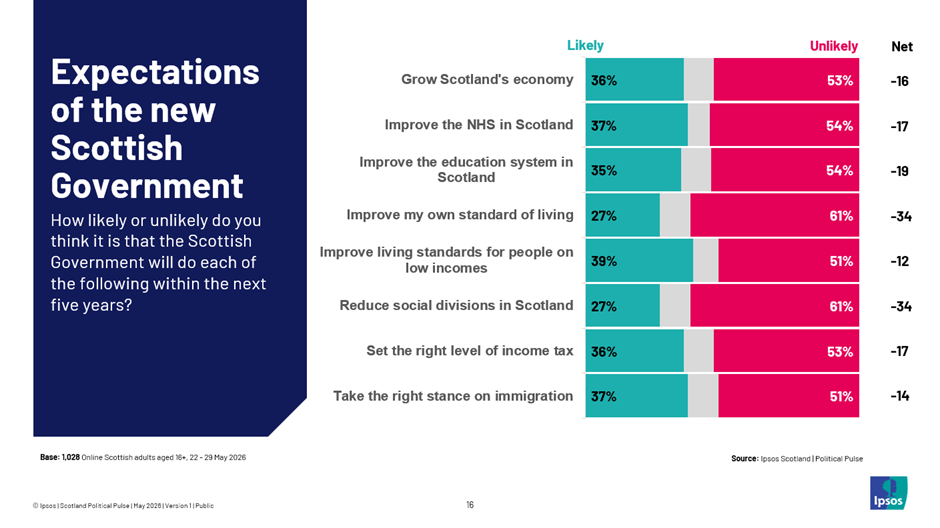
Expectations of what the Scottish Government will achieve over the next five years are low. Overall, more people think it is unlikely than say it is likely that the Scottish Government will: improve their own standard of living (‘net’ -34); reduce social divisions in Scotland (-34); improve the education system in Scotland (-19); set the right level of income tax (-17); improve the NHS in Scotland (-17); grow Scotland’s economy (-16) or take the right stance on immigration (-14), or improve living standards for people on low
Party ratings
Following their election victory on 7 May, the SNP remained the party with the most positive favourability ratings from the public – 44% had a favourable view of the SNP, with 38% unfavourable. Their ‘net’ rating – the proportion favourable minus the proportion unfavourable – was +6, up from -1 in our pre-election survey in late April, and the only party to receive an overall positive ‘net’ rating. Fieldwork took place 22-29 May, with most interviews complete before Peter Murrell, former Chief Executive of the SNP, plead guilty to embezzling party funds. As such, it is too early to say whether this will impact on favourability.
Reform UK had the lowest favourability ratings among Scots – a ‘net’ rating of -47, a swing of -3 since our April survey. Other parties’ net ratings were also negative (but more in line with their April ratings): -40 for the Scottish Conservative and Unionist party, -26 for Scottish Labour, -11 for the Scottish Liberal Democrats and -10 for the Scottish Green Party.
Leader ratings
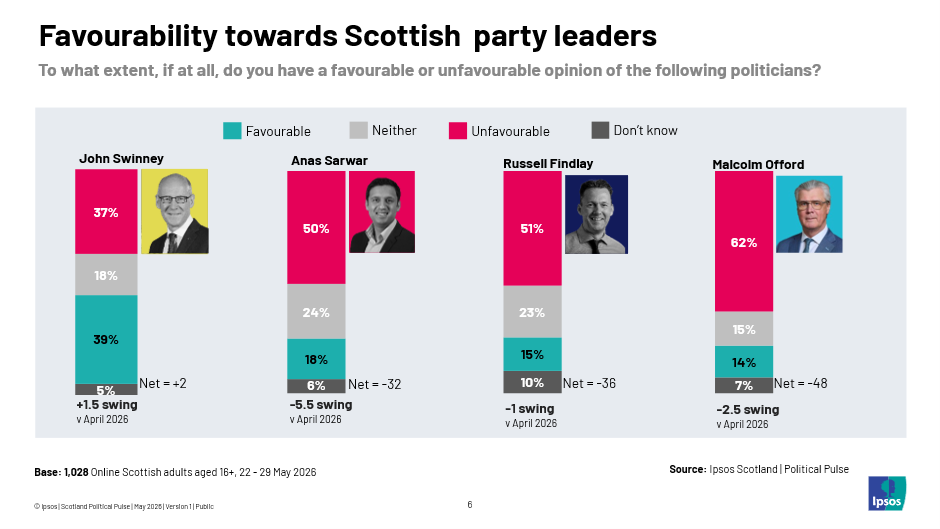
In line with the party ratings, John Swinney was the only Scottish party leader to receive a net positive rating, albeit only just, on +2. Reform’s Malcolm Offord is the least highly rated Scottish leader overall, on -48, a swing of -2.5 since our April poll. Anas Sarwar also saw a negative swing in his favourability ratings, from -21 in April, to -32 in late May (a swing of -5.5). Ratings for other leaders were closer to their ratings in late April: -36 for the Conservatives’ Russell Findlay, -11 for Scottish Liberal Democrat leader Alex Cole-Hamilton, and -11 and -15 respectively for the Scottish Greens’ Gillian Mackay and Ross Greer.
At the UK level, Keir Starmer’s ratings have slipped back, from -35 to -40. Kemi Badenoch’s overall rating is slightly less negative (-32, compared with -38 in April), while Nigel Farage continues to have the lowest overall favourability ratings among Scots (-49, down from -46 in April).
When should there be another independence referendum, if at all?
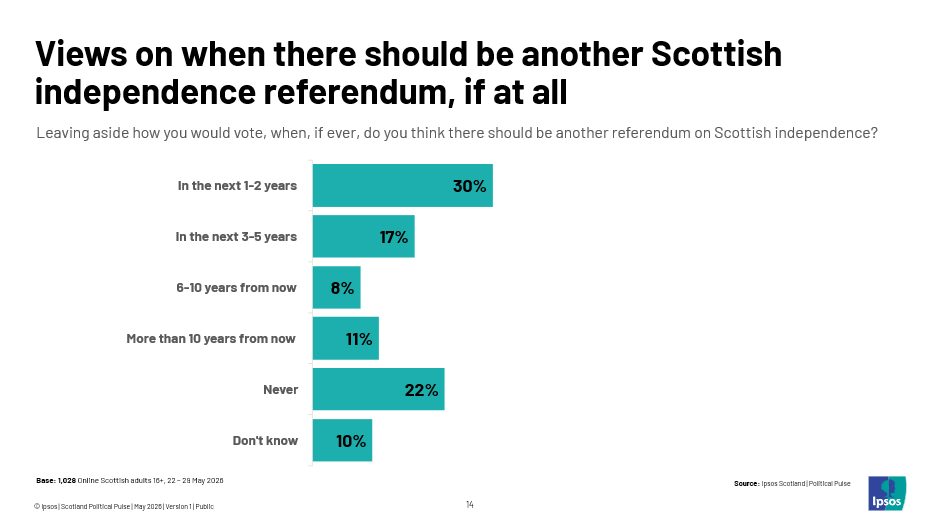
Around half (48%) of Scots would support having another referendum on independence within this parliament (in the next 5 years), with 19% saying it should be further into the future, and 22% saying they think there should never be another referendum. Unsurprisingly, this is very strongly correlated with vote, with 81% of those who voted SNP saying they would like to see another referendum within the next 5 years. However, even among those who voted for one of the four unionist parties in May, between 18% and 24% say they think there should be another referendum in this parliamentary term.
Direction of the country
While Scots remain more likely to say things in Scotland are heading in the wrong direction (45%) than to feel it is heading in the right direction (22%), the balance of opinion remains a little less negative compared with 2025 and early 2026.
Technical notes:
• For the full findings of the poll please visit the Ipsos website: www.ipsos.com
• Ipsos interviewed a representative sample of 1,028 adults aged 16+ across Scotland.
• Interviews were conducted online between 22-29 May 2026. Most of the fieldwork was completed prior to Peter Murrell, former Chief Executive of the SNP, pleading guilty to embezzlement on 25 May.
• Data are weighted to match the profile of the offline population. All polls are subject to a wide range of potential sources of error.
• Where results do not sum to 100%, this may be due to computer rounding, multiple responses, or the exclusion of “don’t know” categories.


