Ipsos Veracity Index 2025
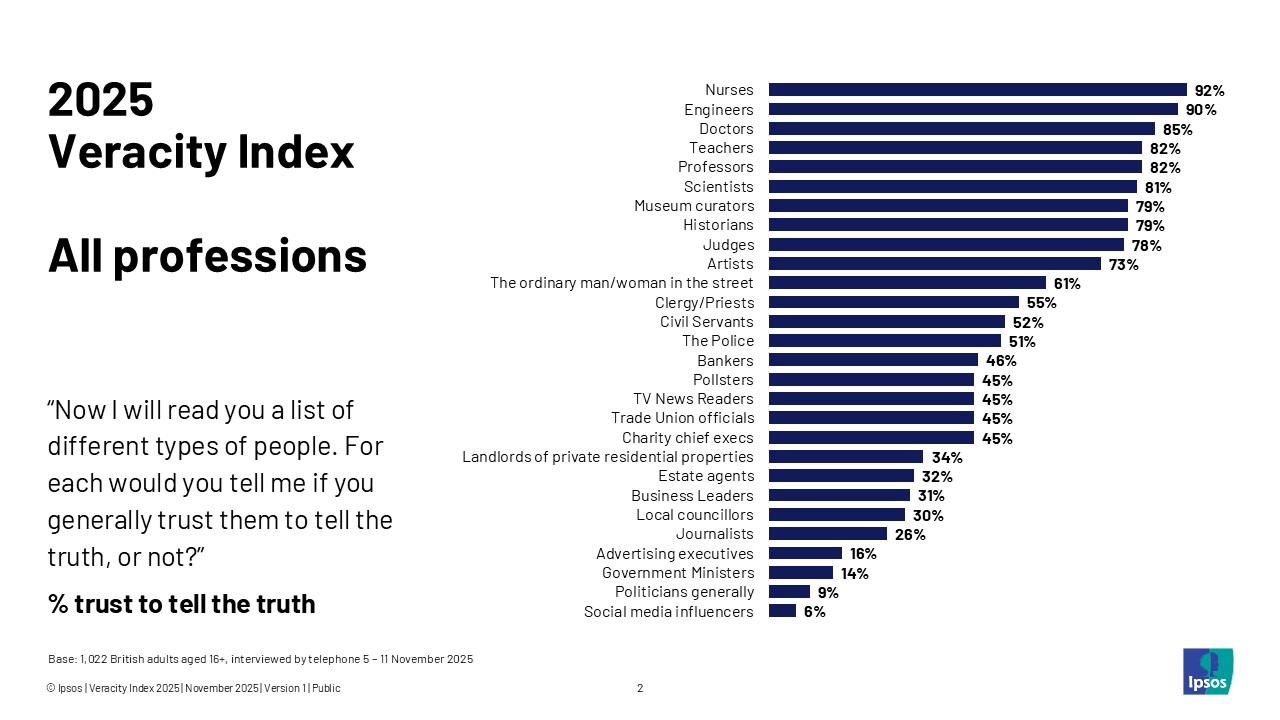
The 28th edition of the Ipsos Veracity Index, first launched in 1983, shows continuity and change in public trust towards leading professions in Britain. The five most trusted professions look similar: nurses are Britain’s most trusted profession for another year alongside engineers, followed by doctors, teachers and professors. But some professions have experienced significant declines compared with their 2024 performance.
De-influencing?
Just six per cent of Britons say they trust social media influencers to tell the truth. This profession was added to the index for the first time this year and their score makes them the least trusted profession for 2025, below politicians, government ministers and advertising executives. This score is also the lowest recorded for any profession since the index began in 1983. Yet it sits in tension with other recent Ipsos polling which found that 15% of Britons – and 25% of 16-34 year olds – get news from online influencers every day.
Eighty-seven per cent say they do not trust social influencers to tell the truth, a figure that increases to 92% of degree holders, 95% of Millennials and 97% of Green party supporters.
Even though politicians have now lost their bottom spot to this new group, they still receive their joint-lowest score since 1983 this year, with just nine per cent saying they trust politicians to tell the truth. While trust in politicians has always been low, the last time trust was at nine per cent was in 2023. Fourteen per cent say they trust Government Ministers to be truthful, similar to the 2024 score of 15%.
Significant declines for police and local councillors
Trust in the police and local councillors have fallen the most of any profession since 2024:
- Fifty-one per cent say they trust the police to tell the truth, a fall of eleven points since last year and the lowest score for this profession since the survey began in 1983. Trust is lower for people from ethnic minorities and Green Party supporters (both 42%), as well as Reform UK supporters (39%).
- Trust in the veracity of local councillors is down ten points, to 30%. This is the lowest figure for trust in this group since they were first added to the Index in 2006 (equalling the previous low of 31% in 2011). Differences are most pronounced between supporters of different political parties: 50% of Labour supporters think councillors are truthful, as do 35% of Conservatives. But just 17% of Reform UK supporters say the same.
Other professions to have seen notable falls in public trust include priests and the clergy (down eight points to 55%), charity chief executives (on 45%, a fall of six points), as well as business leaders, estate agents and TV News Readers (all down five points).
Trust by party support
This year’s Index allows analysis of the views of supporters of four parties – Labour, Conservative, Reform UK and the Green Party. This reveals large differences in trust between those who feel closer to the two traditional parties and the two more recent challengers.
Both Labour and Conservative party supporters tend to be more trusting than the average Briton, as well as than supporters of Reform UK and the Green Party. The average trust score across all 28 professions in this year’s index is 52% for the entire British sample. But the average for Labour and Tory supporters is 62% and 59%, respectively. For Green supporters it is 51%, while for Reform UK supporters it is just 44%.

The biggest differences between Labour supporters and the public are for charity chief executives – 66% trust them to tell the truth against 45% overall, a difference of 21 points. Labour supporters are also 20 points ahead of the British average for civil servants and local councillors, show a 19-point lead on trust in government ministers, and a 17-point higher level of trust for trade union officials. They are more likely to trust most of the professions in the index compared with the British public overall.
Among Conservative supporters, trust in TV News Readers is 21 points above the GB average (66% versus 45%). There are also big differences for bankers, business leaders and the clergy, all of whom score 16 points above the British average among Conservatives. The police are also more trusted (63% versus 51%), while Conservative Party supporters are less likely than the average to say they trust trade union officials to tell the truth (33% compared with 45%).
There are a few professions which score more highly among supporters of the Green Party than among the wider British public: trade union officials are 15 points ahead, trusted by 60%, while artists enjoy an eleven-point advantage over the wider picture, and civil servants and professors are also 8 ppts higher than average. However, there are just as many examples where Green Party supporters are less trusting – there is a 19-point deficit in trust in bankers (27% vs 46%), and an 18-point lag for estate agents. Trust in the clergy is 12 points behind the national level among Green Party supporters, while trust in business leaders and ad executives is 11 points lower.
Among supporters of Reform UK, there is only one group they claim to trust more than the average Briton – the ordinary person in the street. Seventy per cent say they trust the ordinary person, ahead of 61% for Britain overall. Otherwise this group are less likely to trust a number of professions. The gap is largest for charity chief executives (-23ppt vs the British average) but it is a similar size for civil servants (-22), trade union officials (-21) and TV News Readers (-20). Additionally 60% say they trust judges, 18 points behind the British average of 78%. Other professions which show a double-digit deficit in trust compared with the overall British population are teachers, scientists, local councillors, professors, the police, pollsters, government ministers and journalists.
New professions for 2025
Three new professions feature in this year’s index: social media influencers, historians and artists. Social media influencers are discussed earlier; below we detail analysis for the latter two groups:
Historians are trusted to tell the truth by 79% of the British public, making them the joint-seventh most trusted profession in Britain alongside museum curators. Trust is higher among Conservative and Labour party supporters (88% and 86%) and those in social grades ABC1 (84%), as well as people from a white ethnic background (82%). Three in ten of those from ethnic minority backgrounds say they do not trust historians to tell the truth (30%), alongside 20% of 25–44-year-olds and those in social grades DE, and 19% of Reform UK supporters.
Seventy-three per cent say they trust artists, who are the tenth most-trusted profession. Trust is especially higher among Green Party supporters (84%) and degree-holders (78%). Distrust is higher among younger people and those from minority ethnic backgrounds – 24% of Millennials (currently aged between 30 and 45) and 25% of Gen Z (aged 29 and under) do not trust artists to tell the truth, alongside 25% of those from minority backgrounds.
Mike Clemence, research director at Ipsos said,
New to the Ipsos Veracity Index for this year, social media influencers have sunk directly to the bottom of the list of trusted professions. Just six per cent trust them to tell the truth, which is the lowest score recorded for any profession since the index began in 1983. Despite this, we know that the role of influencers continues to grow.
While we have seen a slight dip in trust across a number of groups, the police and local councillors stand out, showing the largest drop since 2024 of eleven and ten points respectively. But nurses, engineers and doctors still lead the pack as Britain’s most trusted professions.
There are also large gaps in trust between supporters of different political parties. Both Labour and Conservative party supporters are more trusting than the average Briton, while Green Party supporters are broadly in line with the national picture. But Reform UK supporters are notably less trusting overall, showing particularly lower levels for professions including charity CEOs, civil servants, TV news readers and judges – although they are notably the most likely to trust the ordinary person in the street.
Technical note:
Ipsos interviewed a representative quota sample of 1,022 British adults aged 16+. Interviews were conducted by telephone between 5 and 11 November 2025. Prior to 2020 the index was carried out face-to-face; mode effects should be kept in mind when comparing the results with previous years’ data, especially when differences are close to the margin of error. Data is weighted to match the profile of the population. All polls are subject to a wide range of potential sources of error.