
Just a quarter of British adults support resident doctors going on strike, half of pre-election figure
New research from Ipsos in the UK shows that just one in four (26%) British adults support resident doctors going on strike, in polling taken since their latest round of industrial action was announced (9-10 July). Two in five (41%) Britons say they oppose the strikes, and 24% are neutral, while 2024 Labour voters are divided on resident doctor’s industrial action. 35% of Labour voters say they support resident doctors going on strike, 32% say they oppose and one in four (24%) say they neither support nor oppose. Conservative and Reform UK 2024 voters are clearly opposed (62% and 58% respectively), as are around 4 in 10 Lib Dem voters (43%).
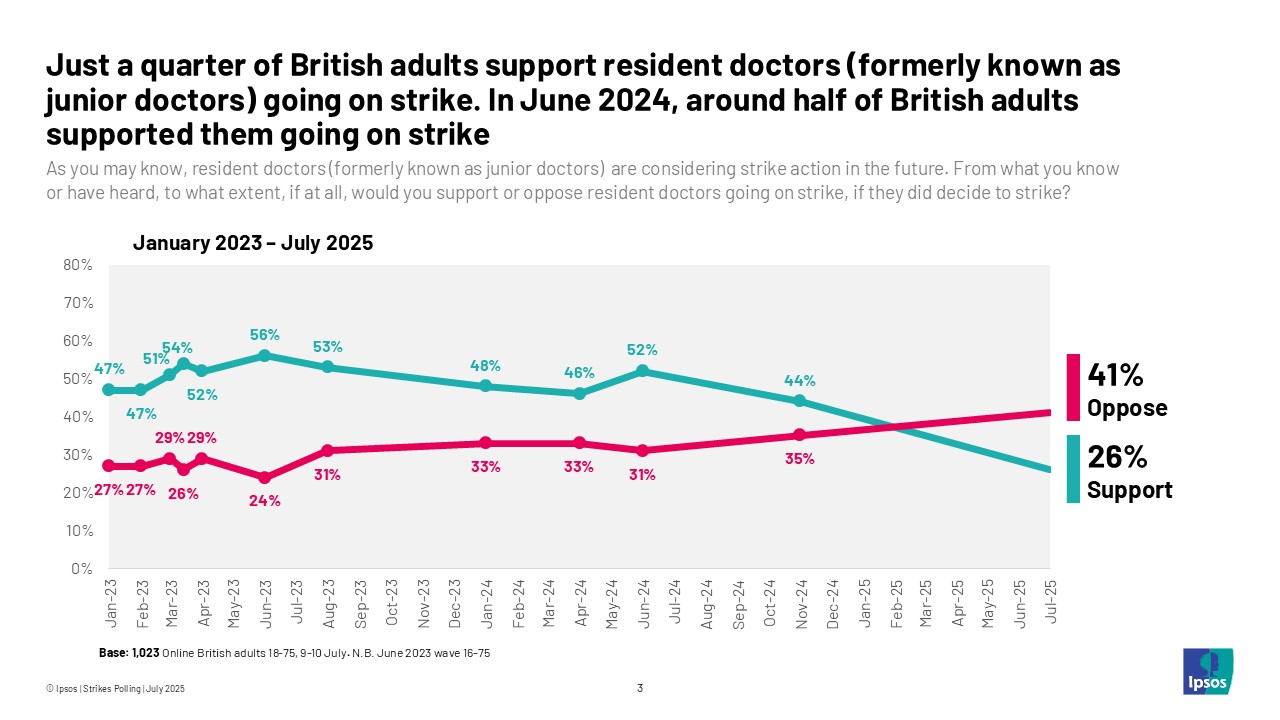
Support for resident doctors taking industrial action has halved since June 2024 (52%) under the previous government, the last time they went on strike, and support had already begun to fall under Labour to 44% in November 2024.
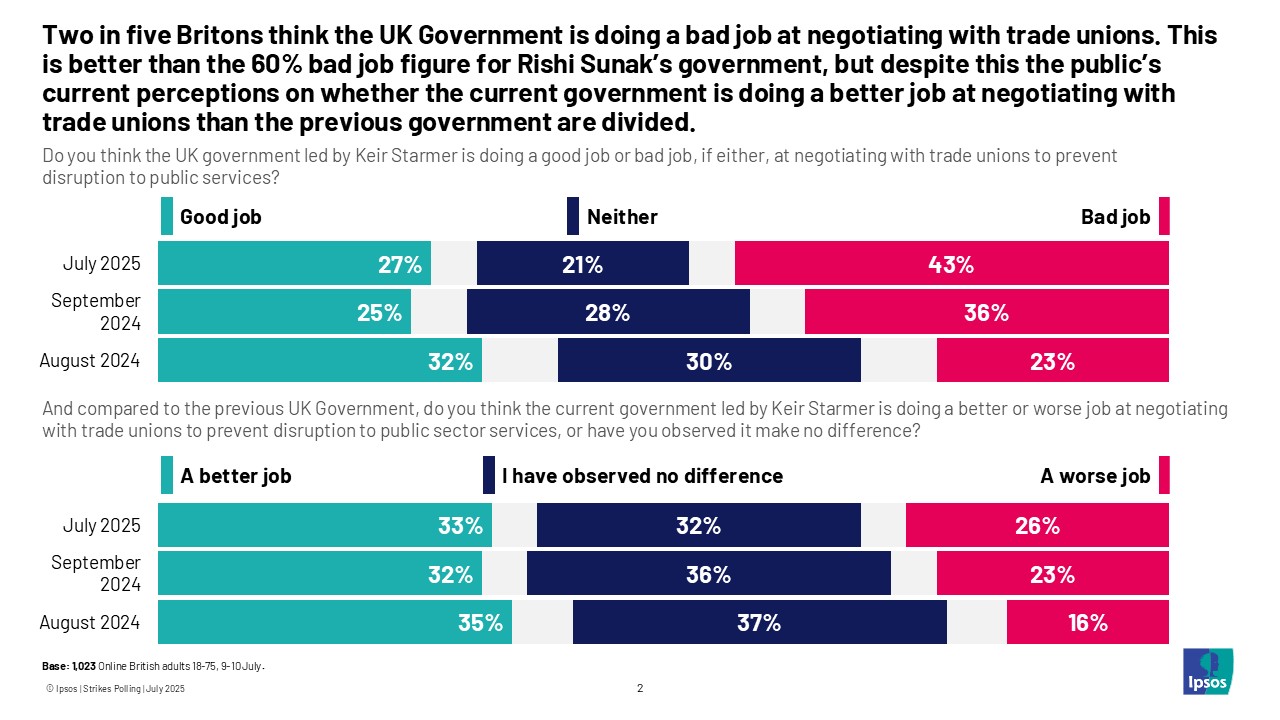
More broadly, over two in five (43%) Britons think the UK government is doing a bad job at negotiating with the trade unions, up 7 points from October 2024 (36%) and nearly double the proportion of public who thought the government was doing a bad job in August last year (23%).
This is better than under Rishi Sunak when 60% thought his government was doing a bad job in June 2024, but this is not fully recognised by the public, who are currently split on whether the current UK government is doing a better (33%) or similar job (32%) at negotiating with trade unions than the Conservatives, with 26% thinking it is worse.
Commenting on the findings, Gideon Skinner, Senior Director of UK Politics at Ipsos said:
If resident doctors do take strike action this summer, it will be the first time for some years that they go on industrial action without broad-based support from the public – including from Labour voters. Although there is increasing criticism of the way the Labour government is handling negotiations with unions, Labour is not yet receiving the negative ratings that Sunak’s government saw – while public perceptions towards the wider picture of public finances are also likely to be playing a part.
Technical note:
- Ipsos interviewed a representative sample of 1,023 adults aged 18-75 across Great Britain. Polling was conducted online between the 9-10 July 2025.
- Data are weighted to match the profile of the population. All polls are subject to a wide range of potential sources of error.


