Labour equals historic low in Ipsos records as 8 in 10 think Britain is getting worse as a place to live
Ipsos’ latest Political Monitor is now released, with fieldwork carried out 30 October – 5 November 2025.
Voting intention
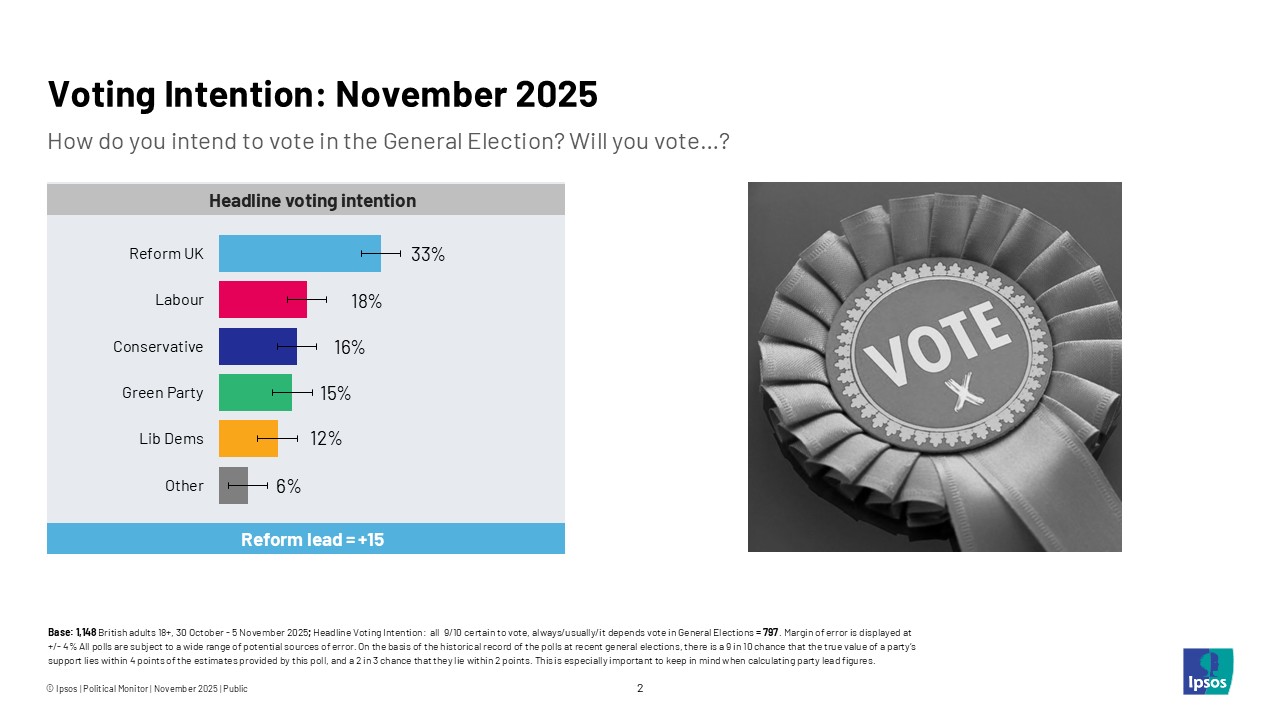
- Reform UK 33% (-1 vs September 2025), Labour 18% (-4), Conservatives 16% (+2), Green Party 15% (+3), Liberal Democrats 12% (n/c), Others 6% (n/c).
- Reform UK holds a lead of + 15 points over Labour (slightly up from +12 in September due to the fall in Labour’s share).
- Labour’s vote share of 18% matches the lowest Ipsos has ever recorded for the party, back in May 2009 (Ipsos first started recording voting intentions in 1976).
- The Green party’s vote share of 15% is the highest Ipsos has ever recorded for the party.
- Reform UK continues to successfully hold on to 9 in 10 of their 2024 voters (92%), while also attracting voters from other parties, especially the Conservatives (27% of 2024 Conservative voters now say they will vote Reform UK).
- The Conservatives and Liberal Democrats are holding on to 47% of their 2024 voters each, while four in ten (40%) 2024 Labour voters say they would vote for the party again.
- Labour are losing voters to a mix of the Green party (16% of 2024 Labour voters say they will vote for the Greens), Reform UK (15%), and the Liberal Democrats (8%). 13% say they would not vote or are undecided.
Satisfaction ratings
- Only 13% are satisfied with the way Keir Starmer is doing his job as Prime Minister (n/c since September), with 79% dissatisfied (n/c), a net rating of -66 (n/c). This continues to be the lowest satisfaction rating recorded by Ipsos for any Prime Minister going back to 1977, worse than previous lows recorded by Rishi Sunak just months before the general election (-59, April 2024), and John Major (-59, August 1994).
- 11% are satisfied with the way Rachel Reeves is doing her job as Chancellor of the Exchequer (-2 since September), and 71% dissatisfied (+2), a net rating of -60. This satisfaction score is the lowest recorded by Ipsos of any Chancellor going back to 1977, including Kwasi Kwarteng in October 2022, just after the mini-budget (net -53).
- Government satisfaction has remained steady since September, with 11% satisfied (-1 vs September) and 82% dissatisfied (n/c), net of -71.
- Among Labour’s own supporters, only half (50%) are satisfied with Keir Starmer, while 43% are satisfied with the government.
- 17% are satisfied with Kemi Badenoch as Leader of the Opposition, 58% dissatisfied, net -41 (up from -47 in September). Almost half (47%) of Conservative supporters are satisfied with Kemi Badenoch, up from 33% last month.
- Three in ten (31%) of the public are satisfied with the way Nigel Farage is doing his job as Leader of Reform UK, while 52% are dissatisfied, for a net score of -21 (relatively unchanged from September’s score of -19). Among Reform UK supporters, nine in ten (89%) continue to be satisfied with Nigel Farage.
- 20% are satisfied with Ed Davey as leader of the Liberal Democrats (51% of LibDem supporters), 42% dissatisfied, net -22, down from -15 in September.
- A quarter (24%) are satisfied with Green party leader Zack Polanski, with 32% unsatisfied (net -8). A large proportion don’t know him enough (44%), though he is popular among Green party supporters (82% satisfied).
Most capable Prime Minister
- Among the three main party leaders, Nigel Farage retains a small lead as most capable Prime Minister (25%), while 17% choose Keir Starmer and 9% Kemi Badenoch. Yet there continues to be little enthusiasm for any of the party leaders, with half (50%) not picking any of the three.
- Reform UK voters overwhelmingly back Nigel Farage (83%) as best Prime Minister, while six in ten (60%) Labour supporters choose Keir Starmer. While 46% of Conservative supporters back Kemi Badenoch, 43% do not select any of the three main leaders.
State of the country
- Eight in ten (80%) Britons believe that Britain is getting worse as a place to live (up slightly from 76% in July 2023). 78% believe that the quality of public services has got worse in the last five years – a figure that has little changed since 2023.
- A third (33%) of Britons say they are finding it difficult to manage on their present income (up from 25% in February 2023). 49% say they are worried about their household’s financial situation (up slightly from 45% in February 2023).
- Two-thirds (66%) of Britons do not believe this government's policies will improve the state of Britain's economy in the long term. 65% do not believe that this government’s policies will improve the state of public services.
Best party on key issues
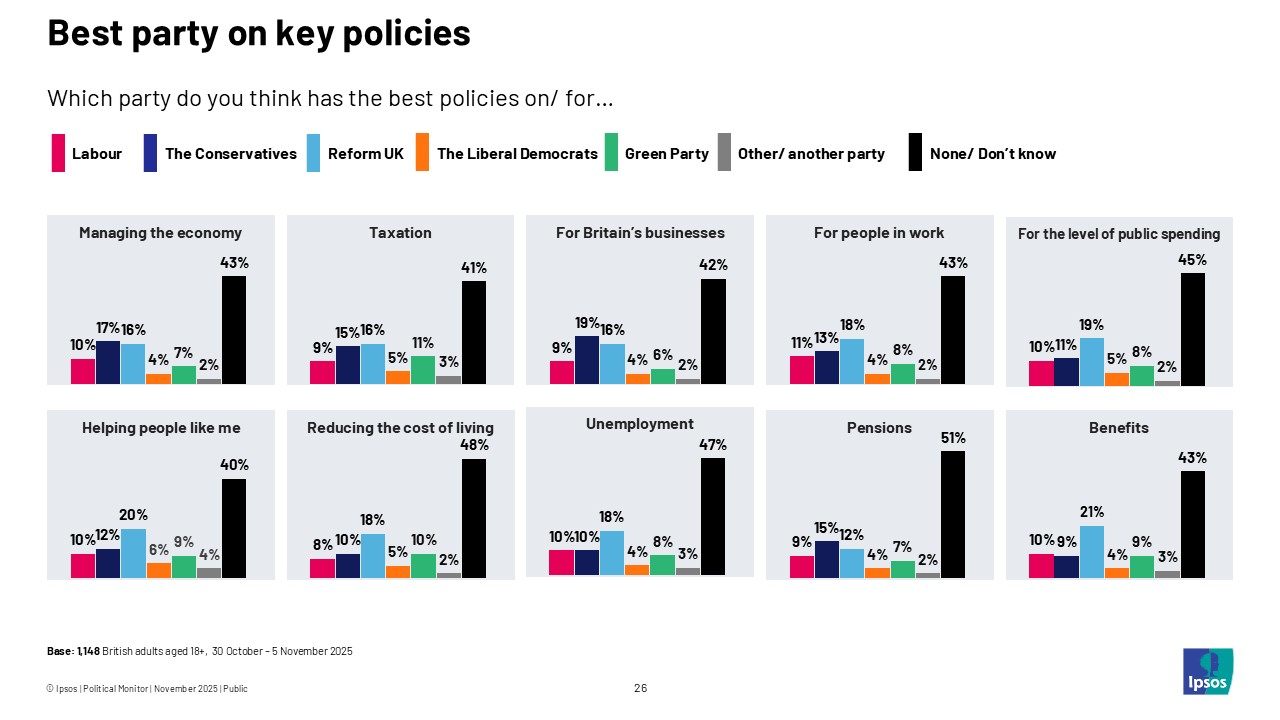
- When asked who is the best party on a range of key policy issues, Britons are most likely to say a combination of none of the above or don’t know:
- The Conservatives (17%) and Reform UK (16%) narrowly lead Labour (10%) on managing the economy but 43% say none (16%) or don’t know (27%). The picture is similar for the best party on taxation.
- Reform UK slightly leads on reducing the cost of living (18%), with the Conservatives on 10% and Labour on 8%, but half (48%) say none (19%) or don’t know (29%).
- On helping people like me, Reform UK leads with 20%, followed by the Conservatives on 12% and Labour on 10%, but 40% say none (16%) or don’t know (24%).
- On healthcare, traditionally a Labour strength, Reform UK (16%) and Labour (14%) are neck-and-neck, with the Conservatives on 7% but nearly half (45%) saying none of these (18%) or don’t know (27%).
- Reform UK is also significantly ahead on managing asylum and immigration (35%), followed by the Green party on 10%, Labour on 7% and the Conservatives just on 5%, but 36% still say none (17%) or don’t know (19%). Reform are also preferred by 24% on crime and ASB, vs 9% Labour and 8% Conservatives, but 45% say none (16%) or don’t know (29%).
- The Greens, meanwhile, lead on the environment at 36%, with Reform on 13%, Conservatives 7% and Labour 5%, but a third (34%) say none (11%) or don’t know (23%).
Gideon Skinner, Senior Director of UK Politics at Ipsos, said:
The latest Ipsos results demonstrate the severe difficulties facing Labour ahead of the Budget, as they find themselves unable to turn around a deep public sense of national decline. On top of continued record unhappiness with Keir Starmer, Rachel Reeves’ satisfaction ratings have also hit a record low this month, the worst for any Chancellor since we started monitoring in 1976. This comes in the context of persistent economic anxiety, with more people today struggling to cope than we were seeing in 2022 when the cost-of-living crisis first started to bite. And clearly most people lack confidence this government’s policies will lead to economic upturn – in fact historically we’ve only seen similar levels of scepticism over the government’s long term economic plans in the last years of the Major and Sunak governments, and under Brown after the financial crash. Meanwhile Reform UK continue to hold a steady lead in voting intentions, helped by this frustrated desire for change and their own strengths on immigration and (to a lesser extent) on crime – though it should still be noted that many of the public do not see them – or indeed any party- as having the answers either on many issues.
The only other time in Ipsos records going back to the mid-1970s that Labour was this low was in May 2009, in the aftermath of the expenses scandal and during the fall-out from the economic crisis. That was a one-off nadir that they did recover from to some extent, denying the Conservatives a majority in 2010, which might be of some minor comfort to Labour. However, present circumstances are different - record low satisfaction ratings for the PM and Chancellor, years of deep public pessimism over the state of the country, economy, and public services, and a more fragmented political landscape with new challengers on all sides at the same time as a "none of the above" public mindset. So, while there is still time before the next election for Labour to try to turn things around, the challenges are much greater now.
Technical note:
- Ipsos interviewed a representative probability sample of 1,148 British adults aged 18+, via the Ipsos UK KnowledgePanel. Data was collected between the 30th October – 5th November 2025. Panel members are recruited via random probability sampling, by sending letters to randomly selected addresses, which invites them to join an online panel. This approach means every household in the UK had a known and non-zero chance of being selected to join the KnowledgePanel. Those who are digitally excluded are provided with a tablet and free, restricted data connection. A sample of 2,301 adults aged 18+ were invited to take part in the survey. The sample was stratified by nation, age, qualifications and vote at the 2024 general election (as collected immediately after the election). The achieved sample was weighted in two stages:
- Design weights were applied to correct for the unequal probabilities of a person being selected for a survey, notably residents in smaller households have a higher chance of being selected.
- Calibration weights were applied through rim weighting to correct for differential non-response. Data was weighted to the adult population profile on age and gender, Government Office region, ethnicity, qualifications, work status and work sector (public sector/other), social grade (office coded), number of cars in household, constituency type, and newspaper readership (print and digital). Population targets were obtained from the 2021/22 Census, ONS population estimates and other large-scale probability surveys.
- A two-part voting intention question is used with prompting on main parties and a follow-up “squeeze” question of those who are undecided or refuse the first question. Prompted parties are: Conservative, Labour, Reform UK, Liberal Democrats, SNP in Scotland and Plaid Cymru in Wales. A turnout filter is used based on two questions: current stated likelihood to vote (at least 9 out of 10 certain to vote) and previous voting behaviour (if they say they “always” or “usually” vote in general elections or that “it depends”).
- All polls are subject to a wide range of potential sources of error. On the basis of the historical record of the polls at recent general elections, there is a 9 in 10 chance that the true value of a party’s support lies within 4 points of the estimates provided by this poll, and a 2 in 3 chance that they lie within 2 points. This is especially important to keep in mind when calculating party lead figures.
- Note that this is a new methodology implemented since June 2025. It involves a new form of data collection (online random probability panel instead of quota telephone survey), an updated voting intention (which involves prompting for Reform UK), and an updated weighting scheme. This is based on our learnings during and since the 2024 General Election. This means that comparisons with previous waves need to be made with caution. In particular, at this stage we are not making direct comparisons with previous satisfaction ratings for opposition party leaders. As always, we continually review our methods and may make further changes to our methodology in the future.