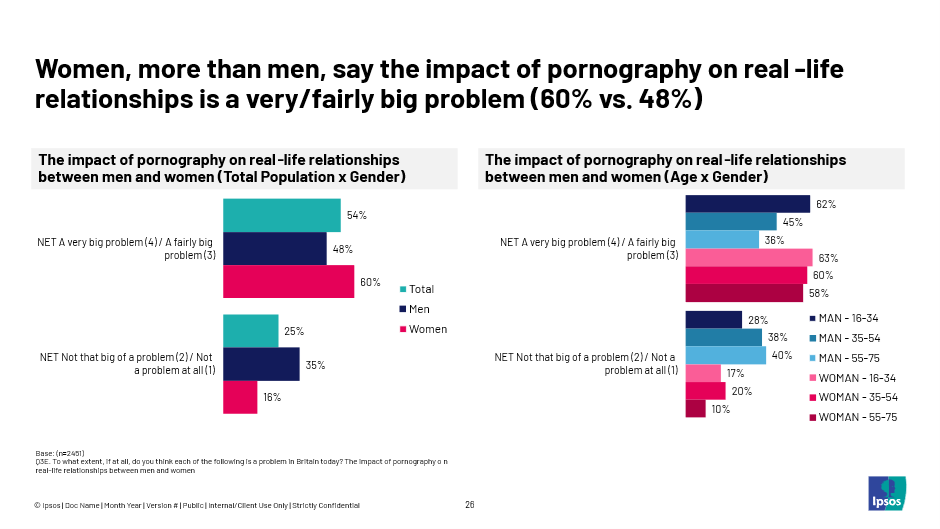
More than half of Britons (54%) think the impact of porn on real-life relationships between men and women is a problem, rising to 6 in 10 (62%) men aged 18-34
- More than half of Britons (54%) think the impact of porn on real-life relationships between men and women is a problem, rising to 6 in 10 (62%) men aged 18-34
- The majority of the public further think the potential for AI-generated porn (70%) and the age at which people start watching porn (66%) are problems, including 2 in 3 men for each
New research from Ipsos in the UK, conducted in partnership with JOE media, details perceptions and behaviours around pornography, as well as wider views around historical conversational taboo topics such as religion and political views.
The polling is the latest instalment of Ipsos in the UK and JOE media’s Modern Masculinity campaign, which has provided an evidence-based picture of modern masculinity and dispel myths surrounding young British men. Other topics explored throughout this partnership can be found on the Ipsos website here.
Pornography perceptions and behaviours:
*Note: all questions pertaining to porn were only asked to those 18-75, excluding 16–17-year-olds.
- Perceptions of why people watch porn: The primary reason Britons perceive people to watch porn is for sexual arousal or release (68%), followed by addiction (40%) and because they don’t have a partner (35%).
- Experience watching porn: 2 in 5 (40%) of Britons say they have ever watched porn, rising to 3 in 5 (60%) men and falling to 1 in 5 (20%) women. The largest share of young men (18-34) are divided between watching porn multiple times per week (12%), at least once a week (16%), and less often than once a month (15%). Just 5% of young men say they watch porn at least once per day.
- Views on porn within relationships: 3 in 10 (31%) Britons say that it would make them uncomfortable if their partner watched porn, but they would not consider it to be cheating, rising to 4 in 10 (39%) among women. Young men (18-34) were significantly more likely to feel this way (29%) relative to older age groups (c18%). Across all age groups, the largest plurality of men said they would be comfortable if their partner watched porn (38%), exceeding the share of the general public who said the same (27%).
Pornography as a problem: Britons more likely to consider porn a problem as compared to potential knock-on effects of porn restrictions on overall freedom. Women are more likely than men to consider porn to be a problem, with limited differentiation across age groups. - Impact of pornography on different groups: Britons primarily consider porn to have a negative impact on young men (58%), young women (55%), men of all ages (50%), and women of all ages (46%). Compared to other male age groups, young men are most likely to consider porn to have a negative impact across all groups asked about.
- How easy it is to access porn: More than half (57%) of Britons think the ease of accessing porn is a problem, rising to 2 in 3 (65%) women and falling to half (50%) of men. While older women (55-75, 69%) are more concerned than younger women (18-34, 60%), concern is higher amongst younger men (54%) than older men (c48%).
- How much violence there is in porn: An equal share (57%) think the amount of violence in porn is a problem, again rising to nearly 2 in 3 (64%) women and falling to half (50%) of men, with little differentiation between age groups.
- The impact of porn on real-life relationships between men and women: 54% of the public think that the impact of porn on real-life relationships between men and women is a problem. Women (60%) are more likely to consider this a problem relative to men (48%). There is little differentiation amongst women of different ages; however, men aged 18-34 are significantly more likely to consider this a problem (62%) compared to men in older age groups (45% among men aged 35-54; 36% among men aged 55-75).
- The potential for AI-generated porn: 7 in 10 (70%) of the public consider the potential for AI-generated porn to be a problem. This includes 3 in 4 (74%) women and 2 in 3 (66%) men, with little differentiation between age groups.
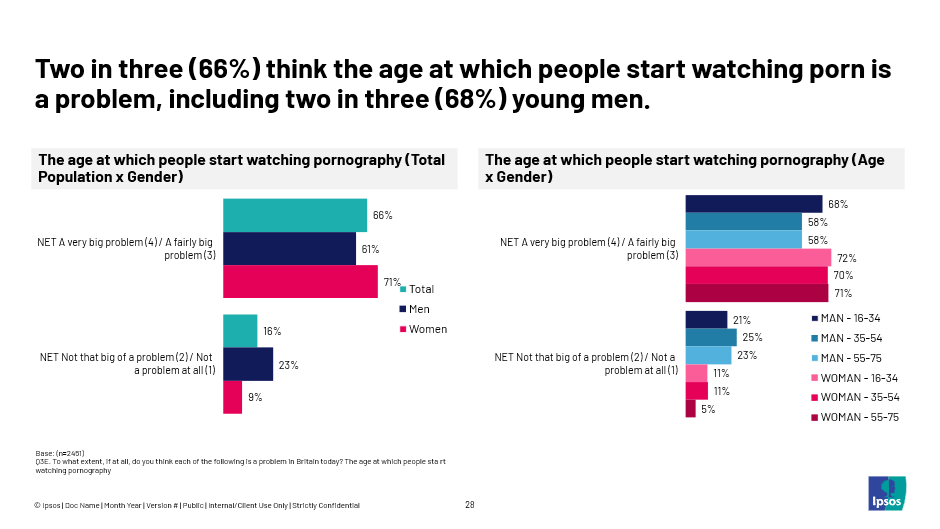
- The age at which people start watching porn: 2 in 3 (66%) think the age at which people start watching porn is a problem, including two in three (68%) young men.
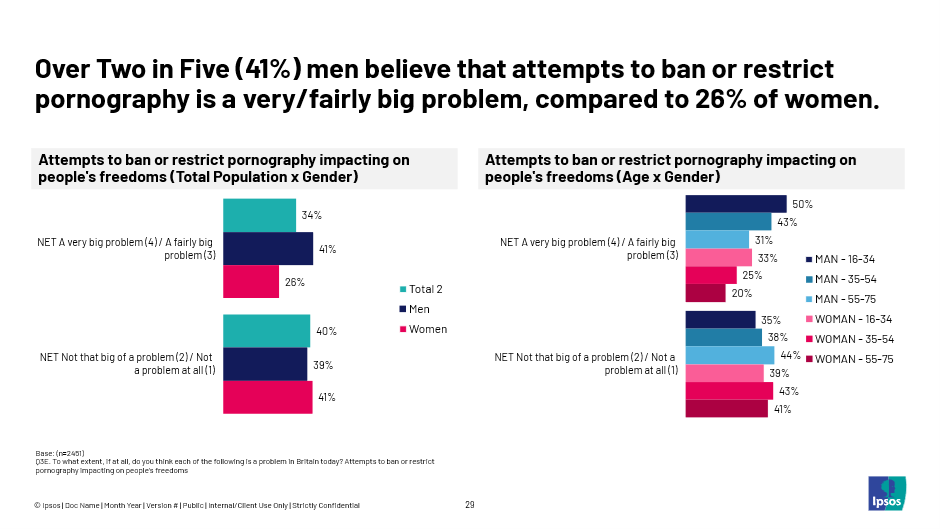
- Attempts to ban or restrict porn impacting on people’s freedoms: 1 in 3 (34%) Britons think attempts to ban or restrict porn impacting on people’s freedoms is a problem, rising to 2 in 5 (41%) men and falling to 1 in 4 (36%) women. Men aged 18-34 are most likely to hold this opinion (50%), with young women significantly more likely to feel this way relative to older age groups (33%).
Online Safety Act
- Majority support use of age verification checks: 3 in 4 (73%) support the use of age verification checks to access platforms that may host content related to suicide, self-harm, eating disorders, and pornography. Support is higher amongst women (81%) relative to men (65%), though support amongst women aged 16-34 (68%) is notably lower than other age groups (84% among women 35-54, 89% among women 55-75).
- Doubts about the Online Safety Act’s effectiveness: Half (53%) of Britons are not confident that the Online Safety Act is preventing children from seeing illegal and harmful material, with just 1 in 5 (22%) saying they’re confident that it is. Confidence is highest amongst those aged 16-34, rising to 26% among women and 40% among men in this age group.
Taboos today: Despite conventional wisdom, more than half of the British public think that it is always or usually acceptable to swear during day-to-day conversations with coworkers about religion (55%) politics (64%), future plans to marry / have kids (57%) and money (50%). Just 4 in 10 (40%) find it acceptable to swear during work conversations, while talking about sex at work may well remain the last taboo, with fewer than 3 in 10 (28%) finding it acceptable to do so. Men are more likely than women to consider it acceptable to talk about each of the areas asked about.
- Swearing: 44% of men think it’s acceptable to swear in conversations at work compared to 37% of women who say the same. This difference is driven by older age groups, all but disappearing amongst men (45%) and women (43%) aged 16-34
- Discussing sex: 1 in 3 men (33%) think it’s acceptable to talk about sex at work, falling to 1 in 4 (24%) women. There was little differentiation by age groups within genders.
- Religion: 3 in 5 (59%) men consider religion an acceptable conversation topic at work, falling to half (50%) of women. Those aged 55-75 were the least likely to find it acceptable (47%, vs 57% among those 35-54 and 60% among those aged 16-34).
- Politics: 7 in 10 (69%) men think it’s acceptable to talk about politics at work, falling to 59% of women. Young women were the least likely to consider it acceptable (55%), as compared to 59% of women 35-54 and 63% of those 55-75. There was little differentiation amongst men of different ages.
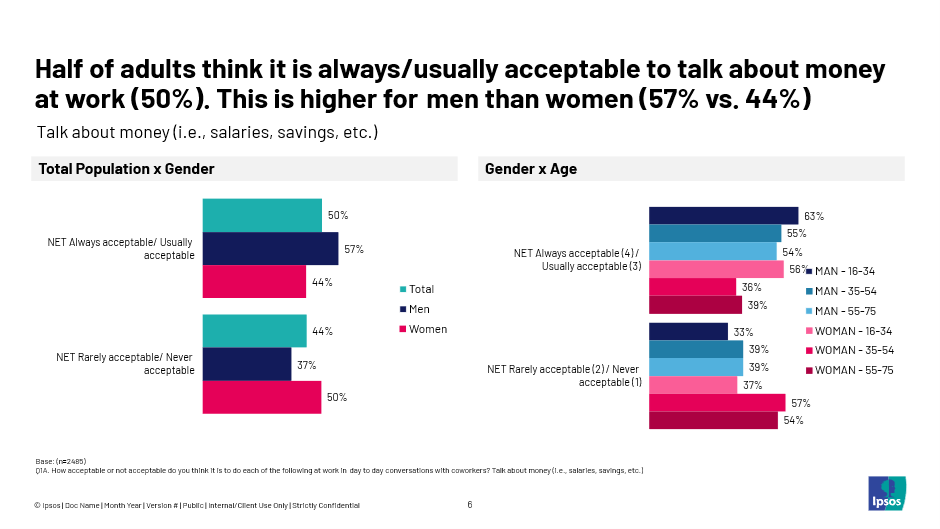
- Money: Nearly 3 in 5 (57%) men think it’s acceptable to talk about money (i.e., salaries, savings, etc.) at work, falling to 44% amongst women. Those aged 16-34 of both genders are the most likely to find this acceptable, with women aged 16-34 significantly more likely to say so (56%) as compared to women aged 35-54 (36%) and 55-75 (39%).
- Future plans: 2 in 3 (66%) men think it’s acceptable to ask people about their plans to get married or have kids at work, falling to 49% among women. Men aged 16-34 (61%) are much less likely to think this is acceptable relative to men aged 55-75 (71%).
Taboos today compared to 20 years ago:
- Relative to 20 years ago, the largest share of the public think it’s become more acceptable to swear (43%) and talk about sex (38%) while at work.
- Britons are more divided as to whether it’s become more acceptable to talk about money (36%), politics (34%), or future plans to get married or have children (28%), or whether there’s been no change (money: 34%; politics: 32%; future plans: 29%).
- The public are more likely to think that it’s become less acceptable to talk about religion at work (34%) rather than more acceptable (30%). A further 25% think there’s been no change.
Age gaps in relationships:
- Half of Britons (47%) think there is no limit to the maximum acceptable age gap within a heterosexual relationship, regardless of whether the man or woman is older.
- Britons aged 55-75 are most likely to hold this view (62% among men and 63% among women), falling to around 3 in 10 Britons aged 16-34 (28% among men and 31% among women).
- The largest share of young men consider 5 years to be the upper limit, regardless as to whether the man (25%) or the woman (21%) is older.
- By contrast, the largest share of young women think that 10 years is the upper limit if the man is older (20%), and are divided as to whether the upper limit should be 5 years (15%), 7 years (14%), or 10 years (18%) if the woman is older.
Richie Jones, Chief Client Officer at Ipsos in the UK, says:
This latest chapter of our partnership with JOE media moves the conversation highlights how the digital world is fundamentally reshaping the way we relate to one another. What’s particularly striking is that young men are not passive observers in this shift; they are often the most vocal in identifying pornography, and the rise of AI-generated content alongside, as a genuine problem for real-life relationships, challenging some discourse that suggests that young men are indifferent to the impact of the content they consume.
The data reveals an uncomfortable but necessary truth: while we are becoming more open about traditional taboos like money or politics, the intersection of sex, technology, and expectations remains a complex and fraught territory. We see a generation navigating a world where ease of access to harmful content is at odds with their desire for healthy, authentic connections. Ultimately, these findings prove that addressing the challenges of modern masculinity requires us to look honestly at the digital influences that underlie social fabric.
Notes:
- Ipsos interviewed a representative sample of 2,485 adults aged 16-75 across Great Britain. Base size of 16-24 men (176) and 16-24 women (168). Polling was conducted online from the 13th-18th February 2026.
- Data are weighted to match the profile of the population. All polls are subject to a wide range of potential sources of error.