A New British Model?
Executive Summary
There is increasing interest in comparing the different approaches to balancing economic and social welfare priorities across countries in Europe and beyond. This has led to new models that have attempted to explain and classify the current government's approach in Britain — for example, Will Hutton has talked about the "social democratising" of the Anglo-Saxon model, and last year Nick Pearce (Director of ippr) and colleagues outlined the "Anglo-Social Model". This describes the approach as an attempt to combine the economic performance and flexibility of liberal welfare states with the social protection and equality of Scandinavian countries.
Alongside an emphasis on work as a route out of poverty (with, for example, a focus on tax credits to help people in low income jobs) and some structures to deal with the inequalities a flexible labour market will tend to encourage (for example, the minimum wage), a key element of the British model has been much increased spending on public services, focusing on health and education (with, for example, the latter up over 50% since 1997).
And, for many commentators, this seems to have been relatively successful, with the economy in particular out-performing most of our usual comparison countries on employment, inflation and growth — even if there are increasing concerns about the level of government and private debt that has been required to sustain this.
But does public opinion across countries reflect the picture painted by analysts? Do the public recognize the relative economic success in Britain and are they noticing any impact from increased spending on public services compared with other countries? Do their priorities for welfare policies reflect those being pursued by the government?
Until recently it has been relatively difficult to answer these types of questions, as there has been very little up-to-date information on the public's perceptions of government policy and performance across different countries. A new quarterly study by Ipsos — the International Social Trends Monitor — aims to fill this gap, with consistent questions asked in Britain, France, Spain, Germany, Italy and the US. This report outlines new findings and draws in other sources such as Eurobarometer and the European Social Survey.
There is economic optimism in Britain
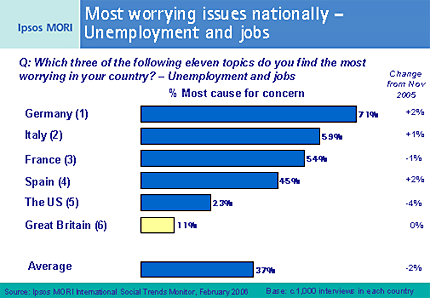
The British do recognize their relative economic success. For example, just 11% of people in Britain see unemployment as the most important issue facing the country, which is by far the lowest level across the countries surveyed, and compares with 71% in Germany, 59% in Italy and 54% in France. Even the US is more focused on jobs, with 23% saying unemployment is the most important national issue. This suggests that people have a great deal of sensitivity to unemployment as an issue, as differences in actual rates are not nearly as large as differences in levels of concern imply, varying from around 5% in the UK and US, 7.5% in Italy, 8.4% in Spain and up to around 9% in France and Germany.
And the British are even (uncharacteristically) bullish about the future, being more confident than their European neighbours about what will happen to their own standard of living and the economic situation in the country as a whole. France is particularly pessimistic.
The good news for the British government is that they do seem to be getting some credit for this success. Britons have the among the highest levels of confidence in their government to reduce unemployment (even given the already relatively low levels), with 38% saying they are confident, compared with just 21% saying they are confident in Angela Merkel's government in Germany (although this is an improvement from the Schröder government). This is vital for Labour, as our previous work on long-term trends in political opinion has shown just how closely related ratings of economic competence and electoral success can be (See note).
But we're not so positive about nearly all other social issues
But perceptions of performance on key public services are generally much less encouraging. Britons are among the most likely of the six countries to see crime and health care as worrying issues, with, for example, twice as many saying they are worried about health care here than in Spain (this will be particularly disappointing for the government, as we have shot up the OECD ranking of spend per capita on health in the last few years). And crime is in fact the top concern in Britain, with people here being nearly twice as likely as US residents to see this as the most pressing issue in the country.
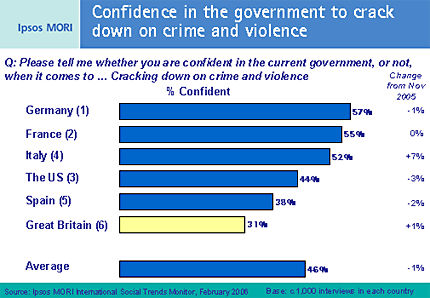
And the really bad news for the British government is that, in the same way they get credit for the economy, they get the blame for perceived failures in health care and crime. So, for example, just 31% are confident in the government to crack down on crime and violence in Britain, compared with almost double that in Germany.
Similarly we are among the most worried about immigration, behind only Spain. But the really marked difference is in confidence in the government to promote the integration of immigrants, which is clearly lowest in Britain, with just 25% saying they are confident, compared with 45% saying they are confident in Spain. There may therefore be lessons to be learnt from the Spanish approach, which has involved an amnesty for existing undocumented immigrants coupled with tightening of entry for new immigrants — although the current socialist government is probably also benefiting from a comparison with rather inconsistent approaches by previous governments.
The British also do count terrorism as a key concern, but this is over-shadowed by the focus on the issue in Spain, which will be a result of significant ETA activity around the time of fieldwork, before the permanent ceasefire was declared. But again the most worrying aspect for the British government is that they are not seen to be very convincing on this key issue: they receive the lowest confidence ratings of the six countries, and this has declined since the end of 2005.
Education provides one bright spot for the British government. We know from the European Social Survey that satisfaction levels with public education services in the UK are among the highest in Europe. The Deloitte/Ipsos Government Delivery Index in Britain (which tracks expectations for the future of key public services) also shows that of all the big services it is education that people are most consistently positive about. Reflecting this, education does not come out as a top concern for Britons in the International Social Trends Monitor. However, it has to be said that ratings have declined and concern has increased significantly from the end of 2005 (probably as a result of coverage of disagreements over the education White Paper).
Inequality is not a national concern in Britain
Despite its relative economic success, a key worry for many commentators is whether the British model actually helps reduce inequality or not — and there are arguments and data that seem to support both views. But one thing that is clear is that this concern is mostly not shared by the general public — because Britons just do not seem to care that greatly about poverty and inequality when compared with other countries, particularly Germany and France.
For example, from a study of twenty countries we're fourth least likely to think it is important to support people who are worse off, and second least likely to agree that the government should reduce differences in income levels. This seems to be partly because we're much more likely than most of our European neighbours to think that poverty is down to laziness rather than injustice.
But this lack of focus on the government's role in reducing inequality should not be taken as a sign that the British public are particularly eager to cut government spending. It is true that there is little confidence in the government to cut taxes (with only the new German government less expected to make cuts), but there also appears to be relatively little concern about current tax levels, with only 17% of people seeing taxes as one of the most pressing national issues. This suggests there may even be some scope for increases in tax-take to support public service spending for a little longer.
Overall ratings of the government and leader are more negative in Britain than other major countries
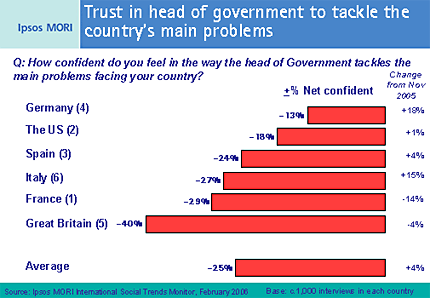
When people are asked for an overall assessment of confidence in the head of the British government to deal with the country's main problems the message is fairly clear — we come bottom of the six countries. Of course, it could be argued that this does not take account of the good feeling generated from the government's perceived economic competence (as people do not see the economy as a problem so do not have it in mind when answering this question). It will also be a lot to do with the declining personal popularity of Tony Blair. Long-term trends show how during his first term the Prime Minister was a real asset, with ratings significantly higher than the party's share of the vote, but that this turned around part way through the second term, and the PM is now less popular than his party (although it is possible to overstate this, and looking at long-term data, it is his high initial rating and not his decline that has been exceptional, at least until very recently).
But a further overview question on whether people would most like the current government or the opposition to be in power suggests deeper problems. This shows more people would like a change of government in Britain than the current one, and we are placed towards the bottom of this table too, alongside the (at the time of fieldwork) Berlusconi government in Italy, which has now been ousted.
Conclusions
Looking across the study, there is a clear contrast in British perceptions of their government's relative economic success and their failure on many other key social issues. We are the most positive and optimistic of these six major countries on a number of economic and personal financial measures — but we are among the most negative on just about all other major social welfare issues, including healthcare, crime and immigration. And, more importantly, Britons have low levels of confidence in the government on these compared with other countries. The one exception is education, but views here have been slipping recently.
Of course, this contrast will be at least partly related — when we are not worried about our own jobs and income, we have more time to worry about other things. But the particularly concerning aspect for the government is that the balance in opinion between these two distinct sets of views has resulted in negative views of the government overall. This must be a major concern for Labour, as all our other work on the determinants of electoral success shows that perceptions of economic competence are critical — and if views of the current government are (at best) equivocal in the currently very positive economic climate, then prospects do not look bright.
Of course, there is an optimistic version of how this will develop — that it has taken time for public service spending and reform to feed through and people will start to notice the impact in the coming months and years. But the pessimistic version — that resources to support public service improvement are drying up before they can do much more than raise expectations — seems more likely. This is something we'll be tracking closely in the coming year, at this crucial time when Tony Blair's successor finds out what sort of foundations he has been left to build on.
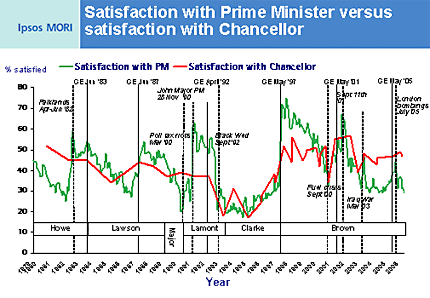
Indeed, our long-term tracking data on perceptions of the Chancellor suggests that if Gordon Brown does take over, he will have record-setting personal ratings to draw on, as seen in the chart below. This shows his ratings are now significantly ahead of the PM, and he is no doubt benefiting from being associated with economic success and maintaining a reasonable distance from aspects of policy that are perceived as less successful. But the fuel crisis in the Autumn of 2000 shows he has no special immunity; when he did get involved in a difficult situation for the government, his popularity fell to a very similar level as the Prime Minister. This association with failure is clearly likely to be much more frequent if he does become PM.
And finally, the other key theme that the study brings home is just how different priorities are across Europe and the US. Some of these variations are event-driven (such as the focus on crime and terrorism in Spain at the time of the last survey) and therefore likely to be relatively short-lived. However, others seem much more consistent across surveys and over time, and are perhaps related to national values that will remain fairly steady — for example, Britons' apparent lack of interest in government's role in addressing inequality compared with other European countries. Indeed, the compromise and small incremental steps suggested in the Anglo-Social Model is perhaps the best that the government can hope to achieve — it is difficult to see any sustained support for Scandinavian levels of redistribution in Britain given our rather less sympathetic national views.
Note
- Duffy, B and Skinner, G (2003) The more things change … Government, the economy and public services since the 1970s MORI