
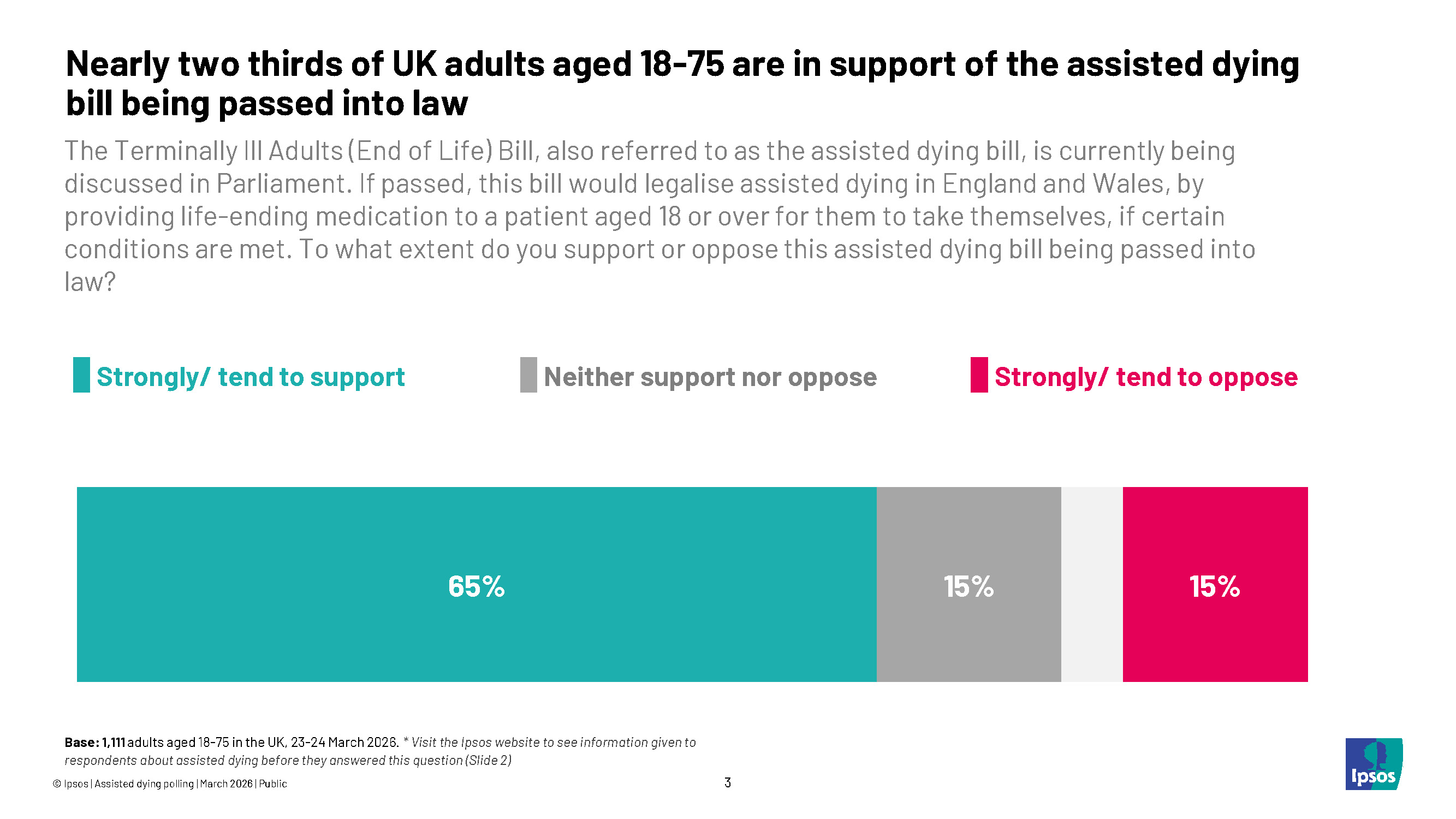
65% of respondents either strongly support or tend to support the assisted dying bill being passed into law
Polling conducted for ITV News by Ipsos, found 65% of respondents either strongly support or tend to support the assisted dying bill being passed into law. In contrast, 15% of respondents said that they either strongly oppose or tend to oppose it. 15% said that they neither support nor oppose the bill and a further 5% said that they didn’t know or didn’t wish to answer.
Ipsos clarification:
This survey supersedes the previous version, replacing the condition that “the High Court must also confirm it is satisfied that these conditions have been met” with the following condition amended during the committee stage: “The Voluntary Assisted Dying Commissioner will refer the case to a multidisciplinary 'Assisted Dying Review Panel’, consisting of a senior legal figure, a consultant psychiatrist, and a social worker to determine, among other things, that a person was terminally ill and had capacity to make the decision to end their own life”. Tables from the previous survey are available here.
Technical Note:
For ITV News, Ipsos interviewed a representative quota sample of 1,111 adults aged 18-75 in the United Kingdom using its online i:omnibus between 23rd to 24th March 2026. Of these, n=711 support the bill (strongly/tend to support), and n=173 oppose the bill (strongly/tend to oppose). The sample obtained is representative of the population with quotas on age, gender, region and working status. The data was weighted to the known offline population proportions for age, working status and social grade within gender, and for government office region and education, to reflect the adult population of the United Kingdom.
Respondents were provided with a definition of assisted dying before completing the survey that specifies that:
- The patient would need to be of sound mind
- The patient would be terminally ill, and it is believed that they have 6 months or less to live
- The patient would have made a voluntary, clear and settled decision to end their life (and made and signed a declaration to that effect in the presence of a witness), with time to consider all other options
- The patient is ordinarily, and has been resident in the country for at least a year
- The patient is registered as a patient with a general medical practice
- The Voluntary Assisted Dying Commissioner will refer the case to a multidisciplinary 'Assisted Dying Review Panel', consisting of a senior legal figure, a consultant psychiatrist, and a social worker to determine, among other things, that a person was terminally ill and had the capacity to make the decision to end their own life.
- If the conditions are met, a health professional may help to prepare and assist with the medication, but the decision to self-administer the medicine and the final act of doing so must be taken by the patient themselves


