2 in 3 Britons support legalisation of assisted dying in principle as legislation returns to Parliament, but conditions make a difference
- 68% of British adults support making it legal for a doctor to assist a terminally ill patient in ending their life by prescribing life-ending medication if the required conditions are met.1
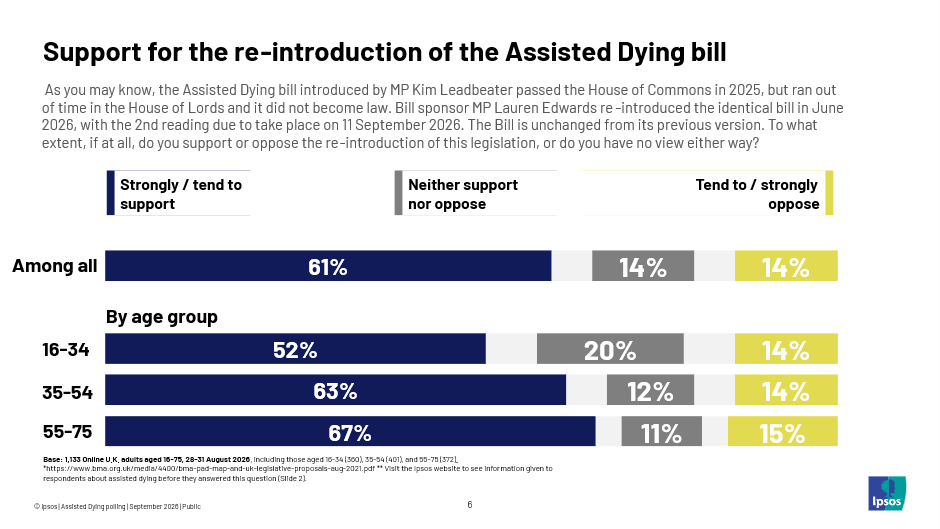
- 61% of the public back the re-introduction of the Assisted Dying bill ahead of its second reading.
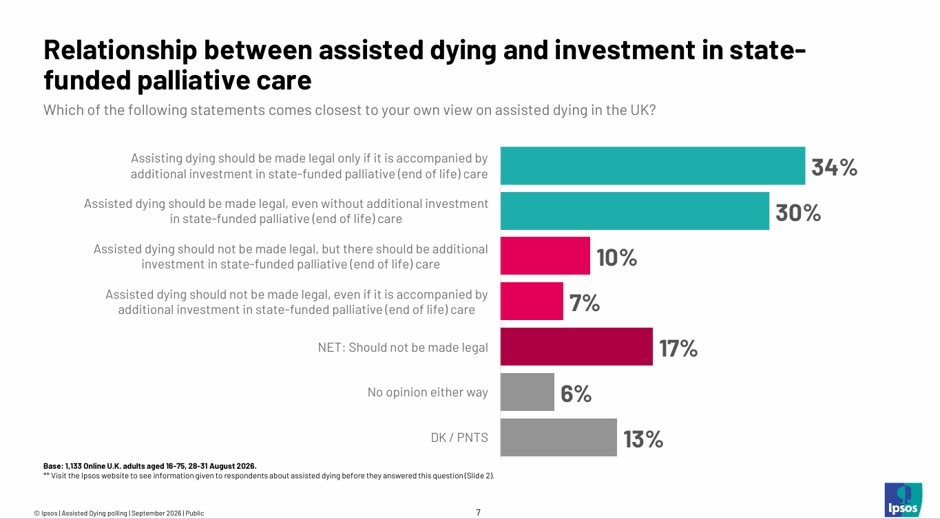
- However, support is shown to be more conditional when asked if legalisation should be linked to increased funding for state-assisted palliative (end of life) care. Around a third (34%) believe assisted dying should only be legalised alongside additional investment in palliative care, while 30% support legalisation even if such funding does not increase. One in six (17%) say it should not be made legal at all.
Broad support for assisted dying for terminally ill patients
Public approval for assisted dying remains high when considering terminally ill adults, and the required conditions are met.1
- 68% of Britons believe it should be legal for a doctor to assist a terminally ill patient by prescribing life-ending medication for self-administration, similar to levels seen in recent years (though note in previous years the exact description of the conditions in the survey question wording was slightly different, reflecting changes in the proposed legislation).
- Around 2 in 3 British adults (65%) support a doctor directly administering life-ending medication to a terminally ill patient (again broadly similar to recent years).
- Support for re-introducing the Assisted Dying bill stands at 61% overall, rising to 67% among those aged 55–75, compared to 52% among 16–34 year olds.
Support has boundaries on non-terminal illness and palliative care trade-offs
While topline support for assisted dying in terminal cases continues, the public draws clear distinctions regarding non-terminal conditions and wider NHS funding.
- Six in 10 (62%) support assisted dying for patients who are not terminally ill facing unbearable physical suffering.
- Conversely, 43% of British adults oppose allowing assisted dying for patients who are not terminally ill but are suffering from unbearable mental or emotional distress, with only 31% in favour.
- When considering end-of-life resources, 34% say assisted dying should only be legal if accompanied by extra state-funded palliative care investment, while 30% believe it should be made legal regardless.
Commenting on the findings, Gideon Skinner, Senior Director of Politics at Ipsos in the UK, said:
Our latest polling shows that the underlying levels of majority public support for legalising assisted dying for terminally ill patients in principle have remained pretty consistent, as Parliament prepares to debate the issue once again.
However, the public's openness for legal reform has clear boundaries. While Britons broadly support assisted dying for those facing incurable, unbearable physical suffering, they are less supportive when it comes to patients who are not terminally ill, but still suffering extreme mental or emotional distress, where opposition outweighs support.
An additional consideration for lawmakers is how discussions about legalising assisted dying interact with funding for broader end-of-life care. Around a third of Britons (34%) say that assisted dying should only be legalised if it is accompanied by increased state funding for palliative care.
As lawmakers weigh the upcoming second reading, the key challenge for Westminster will be whether they can develop legislation that addresses the consistent underlying support for assisted dying while also navigating these public boundaries and concerns.
Notes:
- Ipsos interviewed a representative sample of 1,133 online British adults aged 16–75. Polling was conducted online between 28–31 August 2026.
- Data are weighted to match the profile of the population. All polls are subject to a wide range of potential sources of error.
1 Assisted dying refers to a patient aged 18 or over being provided with life-ending medication if at least two doctors think that all the following conditions were met:
- The patient would need to be of sound mind
- The patient would be terminally ill, and it is believed that they have 6 months or less to live
- The patient would have made a voluntary, clear and settled decision to end their life (and made and signed a declaration to that effect in the presence of a witness), with time to consider all other options
- The patient is ordinarily, and has been resident in the country for at least a year
- The patient is registered as a patient with a general medical practice
- The Voluntary Assisted Dying Commissioner will refer the case to a multidisciplinary “Assisted Dying Review Panel”, consisting of a senior legal figure, a consultant psychiatrist, and a social worker to determine, among other things, that a person was terminally ill and had capacity to make the decision to end their own life
If the conditions are met, a health professional may help to prepare and assist with the medication, but the decision to self-administer the medicine and the final act of doing so must be taken by the patient themselves.