
Polls Apart: The SNP Victory in Scotland
The scale of the SNP victory at last week’s election shocked many but the signs were there well in advance and we shouldn’t be too surprised, writes Mark Diffley.
 The landslide victory by the SNP in last week’s Holyrood election has been variously described by commentators as ‘staggering’, ‘crushing’ and ‘a seismic shift.’ It is even more remarkable given the performance of Labour in Scotland at the 2010 general election and what the polls were reporting up until early 2011. But should we be too surprised at the outcome?
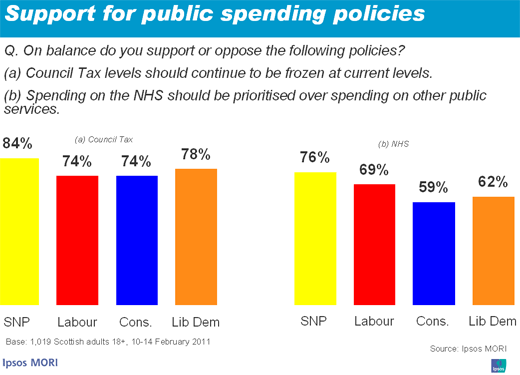
Firstly, we knew that the stated priorities of the SNP were shared by the public. Our survey for BBC Scotland in October 2010 revealed that, of a range of financial options available to the Scottish Government, Scots would be most resistant to reducing NHS budgets, allowing local authorities to increase Council Tax and the raising of prescription charges. This was reinforced in February when our survey revealed the popularity of two policies which turned out to be at the forefront of the SNP’s manifesto. Over three quarters of Scots (78%) supported a freeze in Council Tax, including 74% of Labour supporters. In addition, over two-thirds (68%) supported prioritising NHS spending over other services, again a measure backed by a large majority of Labour supporters (69%). In other words, it became increasingly difficult for Labour to differentiate itself.
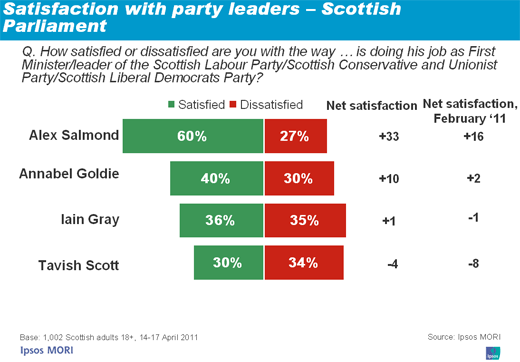
As well as promoting policies which appeared to resonate with voters, the SNP had another key advantage, one which would become more and more obvious and visible as the election grew nearer; the popularity of Alex Salmond. Since we began measuring public opinion of the First Minister, his satisfaction rating had not fallen much below 50% in any survey and peaked at 60% in April 2011, significantly ahead of any of the other then party leaders.
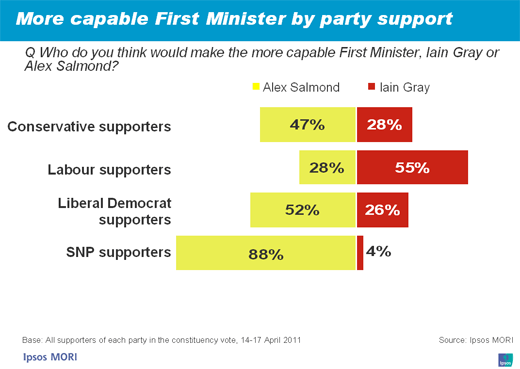
When asked to choose head-to-head between Alex Salmond and Iain Gray, Scots overwhelmingly thought Salmond would make the most capable First Minister. Nor was this view confined to SNP supporters. Among Tories and Liberal Democrats, Salmond was backed by a rate of about 2 to 1. The most damming verdict though came from Labour supporters, over a quarter of who saw Salmond as preferable to their man.
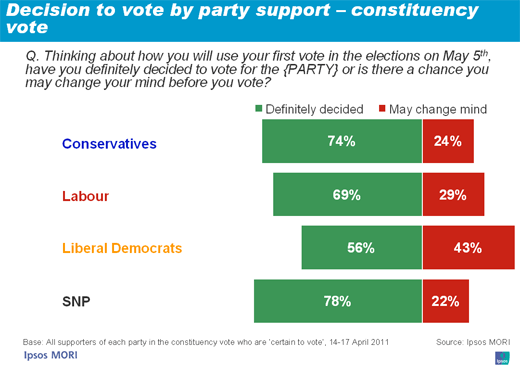
Our April 2011 poll, which appeared in the Times on April 21st, provided the first indication of the possible scale of the SNP victory, at least in terms of vote share. On both the constituency and regional list ballots, we polled the SNP with a double-digit lead over Labour, indicating a landslide victory was a real possibility. As would prove to be the case come election day itself, this increased support came at the expense of all three of the other main parties, particularly the Liberal Democrats, whose popularity had fallen into single figures for the first time in the parliamentary session. The SNP lead was substantial among all those expressing a party preference, as well as among those who told us they would definitely vote, suggesting that Labour would not necessarily be penalised by a low turnout on polling day. However, clues to the strength and solidity of each party’s support were evident by looking at how likely voters were to change allegiances between our poll and the election itself. This revealed that SNP supporters were most likely to have definitely made up their minds, with supporters of other parties more susceptible to last minute changes of heart. Indecision was most prominent among Liberal Democrat supporters, four in ten of whom were still undecided. It also revealed that nearly one in three Labour supporters (29%) remained open to the possibility of switching allegiance before the election, higher than the 22% of SNP supporters who felt the same way. This adds further evidence in explanation of the SNP margin of victory.
The reasons behind the SNP landslide will be studied for years to come. Our survey data tells us that the factors described above, particularly the policies pursued by the SNP and the popularity of their leader have been significant to the outcome. There will be other contributory factors which are not yet quantifiable. For example, what effect did Labour’s campaign tactics have on their popularity? And how damaging was the UK coalition government to the chances of the Scottish Liberal Democrats at the Holyrood election? These are questions which the research community will attempt to answer over the coming months and years. We will also be exploring what impact new leadership will have on the fortunes of the three losing parties and how the prospect of independence for Scotland will play, now it is even more clearly established on the political agenda.
- Ipsos Scotland: Public Opinion Monitor - February 2011
- Ipsos Scotland: Public Opinion Monitor - April 2011


