Reform UK still holds 8-point lead, but the gap shrinks amid doubts over their readiness for government - Ipsos poll
Ipsos’ latest Political Monitor is now released, with fieldwork carried out 22-27 January 2026.
Voting intention
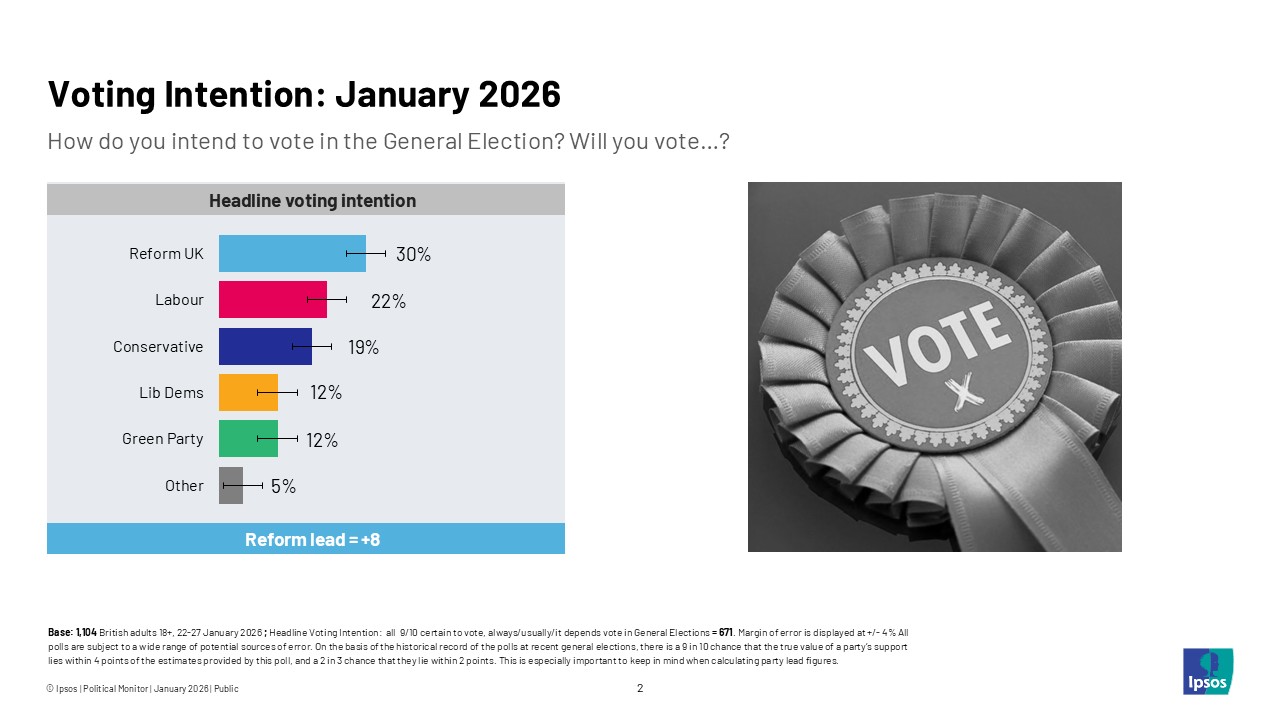
- Reform UK 30% (-3 vs November 2025), Labour 22% (+4), Conservatives 19% (+3), Green Party 12% (-3), Liberal Democrats 12% (n/c), Others 5% (-1).
- Reform UK still holds a clear lead of + 8 points over Labour, but this is down from +15 in November 2025.
- Labour continue to lose their 2024 voters to a mix of parties, including Greens (13%), Reform (8%), and LibDems (8%), while 15% of their 2024 voters are undecided or would abstain (they are holding on to 47% of their 2024 vote). The Conservatives are mainly losing to Reform UK (32% of their 2024 vote) and holding 52% of their vote, while Reform are holding on to 76% of their 2024 vote.
Satisfaction ratings
- Only 15% are satisfied with the way Keir Starmer is doing his job as Prime Minister (+2 from November 2025), with 77% dissatisfied (-2), a net rating of -62 (barely changed from -66 in November). While this has plateaued in recent months no Prime Minister going back to 1979 has ever recorded a figure this low at this stage of their premiership (though Sunak was only slightly better with a net score of -55 in May 2024).
- 12% are satisfied with Chancellor Rachel Reeves (+1 since November 2025), 73% dissatisfied (+2), net satisfaction -61. Reeves continues to have the worst satisfaction scores Ipsos has recorded for a Chancellor of the Exchequer; previous lows included Kwasi Kwarteng (October 2022: 12% satisfied, 65% dissatisfied, net -53), Ken Clarke (December 1994: 17% satisfied, 70% dissatisfied, net -53) and Norman Lamont (March 1993: 18% satisfied, 70% dissatisfied, net – 52), both under John Major.
- 13% are satisfied with the government (+2 since November), while 79% are dissatisfied (-3), for a net satisfaction of -66.
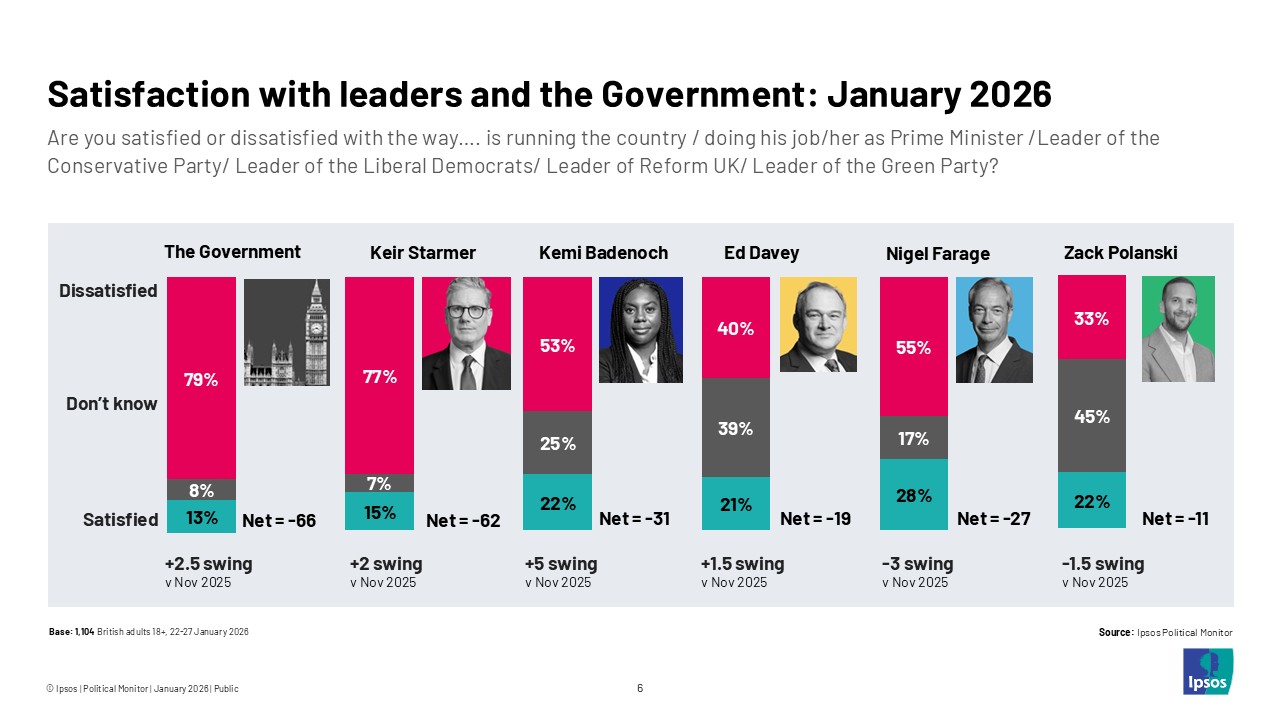
- 22% are satisfied with Kemi Badenoch as Leader of the Opposition, +5 from November. 53% dissatisfied (-5), leading to a net of -31 (up from -41 in November).
- 28% of the public are satisfied with the way Nigel Farage is doing his job as Leader of Reform UK (-3), while 55% (+3) are dissatisfied, for a net score of -27 down from -21 in November).
- 21% are satisfied with Ed Davey as leader of the Liberal Democrats (+1), 40% dissatisfied, for a net rating of -19.
- 22% are satisfied with Green party leader Zack Polanski, with a third (33%) dissatisfied (net -11, but 45% say they don’t know).
Perceptions of the government
- Two thirds (67%) of Britons disagree that competent is an accurate description of the current Government. Just 15% agree. This is worse than the 45% who disagreed and 33% who agreed in September 2024 soon after the election.
- Just before the last General Election, 14% agreed that competent was an accurate way to describe the then Conservative government led by Rishi Sunak and 68% disagreed. So, numbers for Starmer’s government today are similar.
- Six in ten (60%) disagree that the current Labour government deserves to be re-elected (+2 from September 2025), 19% agree it does (-3). In June 2024, 71% disagreed the Sunak government deserved to be re-elected.
Most capable Prime Minister
- Among the three main party leaders, Nigel Farage retains a small lead as most capable Prime Minister (21%, -4 ppts since November), while 18% (+1) choose Keir Starmer and 12% (+3) Kemi Badenoch.
Are Reform / The Conservatives ready for government?
- A quarter (25%) of Britons agree that Reform UK are ready to form the next government, while 58% disagree. Their position has slightly worsened from September 2025 (when 53% disagreed).
- Just 14% agree the Conservatives are ready to form the next government. 65% disagree. Figures are similar to September 2025, where 15% agreed and 64% disagreed.
- The picture for Reform and the Conservatives is worse than previous successful opposition parties just before they won elections.
- In July 2024 49% agreed Keir Starmer’s Labour Party was ready for government. 34% disagreed.
- In May 2010, 65% agreed David Cameron’s Conservative Party was ready for government. 26% disagreed.
- In April 1997, 55% agreed Tony Blair’s Labour Party was ready for government.
- A similar picture is observed when asking whether Nigel Farage and Kemi Badenoch are ready to be Prime Minister.
- 24% agree Nigel Farage is ready to be Prime Minister and 59% disagree.
- 16% agree that Kemi Badenoch is ready to be Prime Minister and 57% disagree.
- Before the last General Election, 41% agreed Keir Starmer was ready to be Prime Minister. In April 2010 51% agreed David Cameron was ready and in April 1997 53% agreed that Tony Blair was ready.
Broken Britain
- 68% agree that British society is broken (16% disagree). This is up from 58% in August 2011 and 63% in September 2008.
- A majority of supporters from all political parties agree British society is broken, including 90% of Reform UK supporters, 66% of Conservative supporters, 64% of Greens, 57% of Lib Dems and 55% of Labour supporters.
Gideon Skinner, Senior Director of UK Politics at Ipsos, said:
Reform UK still has a clear lead in the latest Ipsos poll, but this has shrunk since the end of last year. However, people are not feeling much more positive about the government’s performance – satisfaction with the Prime Minister and Chancellor remains historically low, and perceptions of the government’s competence are as poor as they were under Rishi Sunak. But, particularly compared to successful opposition parties and leaders of the past, there are doubts over Reform and the Conservatives’ credibility to govern, and only a minority think Nigel Farage or Kemi Badenoch are ready to step into No.10 – despite the enthusiastic backing Reform gets from its own base, and despite the slight improvement in Badenoch’s scores over the last few months.
This means the fragmented political scene continues, with Reform still setting the pace, but no party convincing more than a minority of voters. It's likely that this is at least partly fuelled by the idea of 'Broken Britain' really hitting home for many people, with almost seven in ten of the public feeling that society is in disrepair. This sense of discontent is shared across supporters of all parties (but especially Reform voters) and will link both to dissatisfaction with the government’s performance but also to doubts over whether the other parties are able to deliver the type of change that people want to see as well. Labour may find some small comfort in the dip in Reform’s lead - but the real task ahead is winning back public trust by tackling the core problems causing this widespread feeling of national malaise.
Technical note:
- Ipsos interviewed a representative probability sample of 1,104 British adults aged 18+, via the Ipsos UK KnowledgePanel. Data was collected between the 22nd-27th January 2026. Panel members are recruited via random probability sampling, by sending letters to randomly selected addresses, which invites them to join an online panel. This approach means every household in the UK had a known and non-zero chance of being selected to join the KnowledgePanel. Those who are digitally excluded are provided with a tablet and free, restricted data connection. A sample of 2,301 adults aged 18+ were invited to take part in the survey. The sample was stratified by nation, age, qualifications and vote at the 2024 general election (as collected immediately after the election). The achieved sample was weighted in two stages:
- Design weights were applied to correct for the unequal probabilities of a person being selected for a survey, notably residents in smaller households have a higher chance of being selected.
- Calibration weights were applied through rim weighting to correct for differential non-response. Data was weighted to the adult population profile on age and gender, Government Office region, ethnicity, qualifications, work status and work sector (public sector/other), social grade (office coded), number of cars in household, constituency type, and newspaper readership (print and digital). Population targets were obtained from the 2021/22 Census, ONS population estimates and other large-scale probability surveys.
- A two-part voting intention question is used with prompting on main parties and a follow-up “squeeze” question of those who are undecided or refuse the first question. Prompted parties are: Conservative, Labour, Reform UK, Liberal Democrats, SNP in Scotland and Plaid Cymru in Wales. A turnout filter is used based on two questions: current stated likelihood to vote (at least 9 out of 10 certain to vote) and previous voting behaviour (if they say they “always” or “usually” vote in general elections or that “it depends”).
- All polls are subject to a wide range of potential sources of error. On the basis of the historical record of the polls at recent general elections, there is a 9 in 10 chance that the true value of a party’s support lies within 4 points of the estimates provided by this poll, and a 2 in 3 chance that they lie within 2 points. This is especially important to keep in mind when calculating party lead figures.
- Note that this is a new methodology implemented since June 2025. It involves a new form of data collection (online random probability panel instead of quota telephone survey), an updated voting intention (which involves prompting for Reform UK), and an updated weighting scheme. This is based on our learnings during and since the 2024 General Election. This means that comparisons with previous waves need to be made with caution. In particular, at this stage we are not making direct comparisons with previous satisfaction ratings for opposition party leaders. As always, we continually review our methods and may make further changes to our methodology in the future.