
Right place, right time: How Google feeds create value for brands and buyers
There are as many ways to use the internet as there are users. But whether we’re browsing with a touchscreen or a trackpad—and whether we’re shopping, reading, or socializing—nearly all of us encounter feeds as we navigate the online world.
This means that feeds play a critical role in driving awareness and consideration. From global firms to startups, many businesses will make their first contact with consumers through these platforms: 86% of feed users have discovered new products or brands on a feed, according to Google/Ipsos Consumer Feed Behavior Research from August 2022. But users have a variety of feeds to choose from, and the field is only growing more crowded. Where should digital marketers focus their attention? What draws people to feeds, and what keeps them coming back?
With these questions in mind, Ipsos partnered with Google to gain a deeper understanding of the ways consumers use feeds, and how marketers can drive growth on these surfaces. The survey collected attitudes and behaviors towards Google, YouTube, and competing platforms in nine markets, offering a close look at how they shape online experiences across different age groups, demographics, and devices.
The following findings from the U.S. market offer data-driven insights on the value Google feeds can offer for brands and consumers alike—and underscore the opportunities that these platforms present for marketers looking to make an impact.
What is a Google feed, and who uses it?
Feeds are so omnipresent, and so integral to online experiences, that they can be difficult to recognize or define. Loosely speaking, however, a feed is a vertical sequence of content which a user can scroll through: a simple but powerful experience found at the core of different products and platforms across Google’s digital ecosystem.
In its analysis, Ipsos evaluated users’ experiences with feeds across Google and YouTube, which present a stream of recommended content.
Google feeds are positioned at various stages of users’ journeys, from their homepage to online destinations—and consequently, reach a broad range of people at various points in time. Ipsos’ analysis suggests these experiences are a cornerstone of users’ overall digital experience: 96% of feed users spend time on Google feeds, with 87% of feed users saying they visit Google feeds multiple times a week, according to Google/Ipsos data.
Bringing value to brands and shoppers
Feeds are central to online experiences: users connect, learn, communicate, and explore through these interfaces. But what keeps them there? Ipsos found that content feeds across Google and YouTube offer particular utility for online shoppers. According to the study, over half of consumers use Google feeds alongside other platforms when researching products or brands to try.
This is in large part because Google feeds span across the entire digital shopping journey, from first look to checkout. That starts with discovery: Ipsos found that 86% of feed users have discovered new products or brands on a Google feed. Convenience is another key asset: Ipsos’ polling suggests that Google feeds offer a seamless means for shoppers to make impulse purchases, with most consumers saying that they take action immediately after discovering new brands on Google feeds.
Even after users have clicked through and purchased a product, content feeds on Google and YouTube continue to strengthen the relationship between brands and consumers, whether by offering complimentary resources, subsequent updates on a purchase, or related products and recommendations.
In short, Google feeds capture the entire customer journey, presenting a unique advantage for marketers. But these findings also underscore the range of shoppers using these feeds, and the range of use cases that must be accommodated.
Digital tools mean that marketers can cast a broader net than ever before. But how do you reach the right people—and maintain value for them—when almost everyone is using these platforms to shop for almost everything?
Relevant content—and purposeful creative—are key
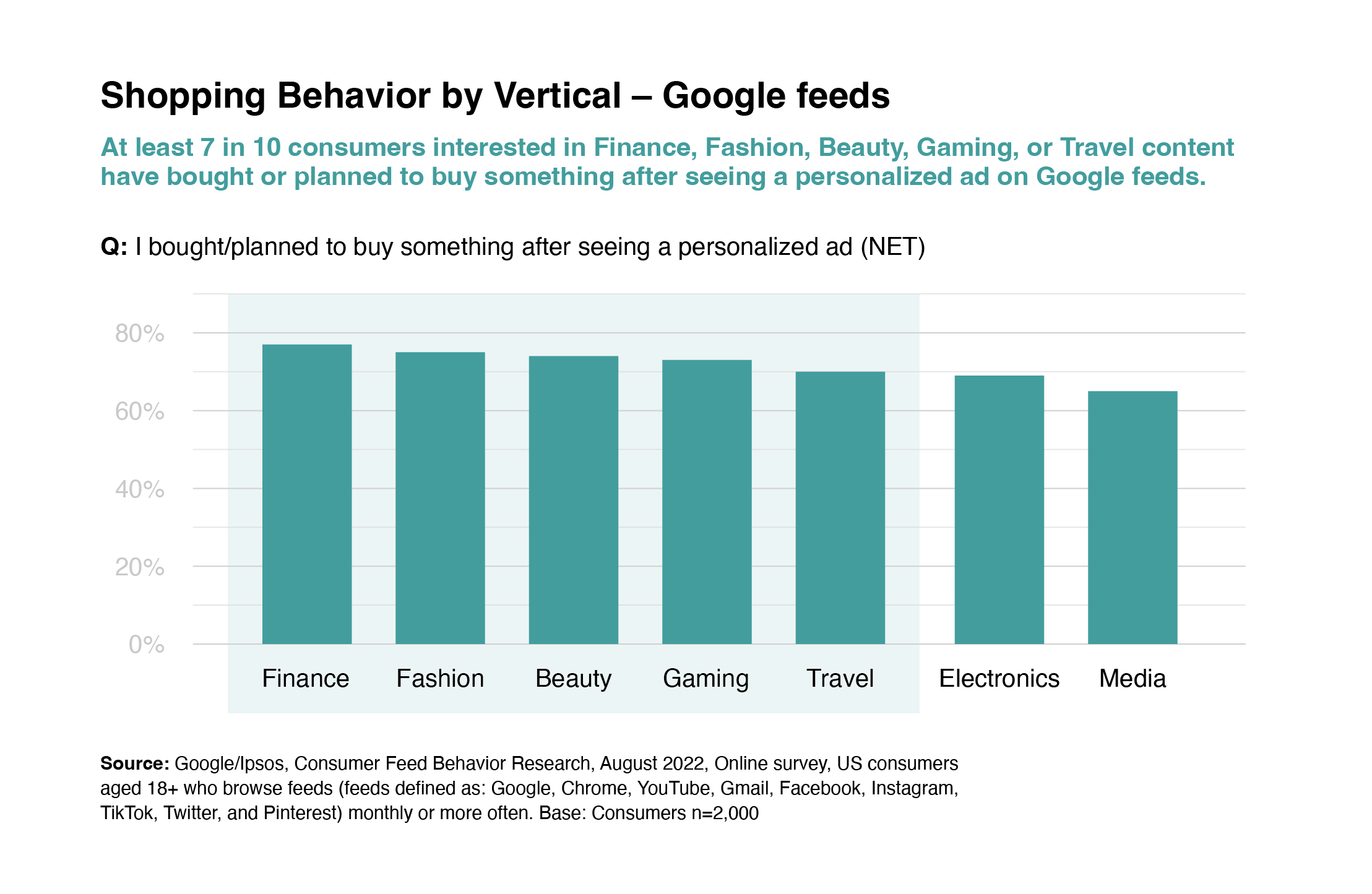
Where other platforms might cater to a specific hobby, type of shopper, or shopping experience, Google feeds branch across nearly every consumer vertical. In order to facilitate campaigns that will resonate with this wide audience, Google feeds are designed to recommend content that is relevant to users’ specific interests. Ipsos’ research suggests this can be a major factor in spending: at least 7 in 10 consumers interested in finance, fashion, beauty, gaming or travel content have bought or planned to buy something after seeing a personalized ad on Google feeds.
For example, 74% of consumers interested in beauty content have bought or planned to buy something after seeing a personalized ad on Google feeds, while 73% of consumers interested in gaming content have bought or planned to buy something after seeing a personalized ad on Google feeds.
The importance of relevant content should come as no surprise: online advertising is all about reaching the right people in the right place, wherever and whenever that might be. But Ipsos found that advertisements which speak to users’ preferences and interests are valuable not just for brands, but for consumers.

According to Ipsos’ study, feeds across Google and YouTube have a high success rate in connecting shoppers with relevant products—even ones they hadn’t set out to find. Nearly 80% of consumers prefer Google feeds for personalized updates relevant to their interests, and one in three consumers say they have purchased something on Google feeds they were not originally shopping for.
In short, consumers engage more deeply with advertisements and experiences that are meaningful to them—and Ipsos’ research shows that Google’s immersive surfaces and formats are uniquely positioned to help brands deliver on that expectation.
The flexibility of Google feeds enables marketers to pair the power of recommendations with compelling multimedia creative, whether static (Ipsos found that 55% of consumers say they are more likely to click on an image ad with a prominent call-to-action) or video-based (49% of consumers say they are more likely to purchase a new product or brand they see in a video ad in their personalized feed).

With feeds catering to so many different users, tailored content also plays a key role in the qualitative experience, whether that means presenting aspirational visuals that will connect with users, or supporting the diversity and authenticity of a brand’s image.
Ipsos found that 43% of consumers say they are more likely to click on ads featuring people from a variety of backgrounds. With multi-asset campaigns, Google feeds let marketers cast their brand from a variety of angles, painting a richer and deeper picture.
Conclusion
Whatever their reason for browsing, most users will continue to connect through feeds. With Google feeds, marketers have the opportunity to connect with people while they’re active and engaged, whether they’re searching, scrolling or shopping—and to suggest their next must-have.
For more actionable insights on how you can drive engagement and deliver results across immersive surfaces, visit Google’s Keyword blog. And as you build your next campaign, consider leveraging Google’s toolkit for effective and engaging ads that reach the right people at the right time.

![[WEBINAR] TOAST 2026: Under Pressure - Fewer, Fragmented, Fought-For](/sites/default/files/styles/list_item_image/public/ct/event/2026-07/thumbnail-templates_1_0.png?itok=MxL-wPJW)
