
Bikes, Trains & Automobiles… What is the new normal in consumer mobility?
Although the chaos of the COVID pandemic is largely behind us, the impact on how we move around our world for both work and leisure is still unclear. In addition, technology has enabled the emergence of entirely new modes of mobility, including peer-to-peer “sharing” and subscription ownership models.
Are options like sharing and subscriptions emerging as a new normal around the world OR does the more traditional combination of vehicle ownership and public transportation still hold sway?
Revisit our webinar to hear Ipsos’ automotive sector experts discuss the latest research from our 2022 Mobility Navigator program focused on Shared Mobility. During this session, we explore various topics including: Has the new normal increased the need and desire for shared mobility options? What mobility options are consumers using, and for what kind of trips? What are the perceived advantages and disadvantages of the various options for moving around our world? Why are consumers selecting the services they use, and foregoing the ones they don’t? How different is the mobility landscape in major urban areas around the globe vs. more suburban/rural areas?
Today’s AI-generated audio transcript is offered below. Apologies in advance for inconsistencies that have been included.
0:04
Thank You for joining for today's Ipsos Webinar, featuring insights from our mobility navigator research with a focus on shared mobility.
0:14
Today's webinar is being presented by our team of automotive industry experts, and you can read them on the slide, coming up in front of you.
0:23
Throughout today's session, you will remain in listen only mode, however, throughout the webinar, you can submit questions using the Q&A feature.
0:33
We'll try to answer questions at the end of today's session, however, if time, run short, then your question will be answered by e-mail.
0:41
Today's webinar is also being recorded and will be directly e-mailed to you.
0:47
So now, without further ado, it is my pleasure to welcome today's first speaker, Mike VanNieuwkuyk, senior vice president and automotive senior client officer.
0:58
Mike, you have the floor.
1:01
Great, thanks Alex. Everyone, thanks for joining us today.
1:05
So for those of you who have met with us before, you'll recognize that the mobility navigator study has multiple components.
1:13
So we did earlier in the year one electrification, another one on autonomous and eight asked this being the third installment on shared mobility.
1:21
But there's some interesting things this year that we've done, and I and my colleagues, John, Kaiser and Chance, Parker, who are the two gentlemen who run this particular study. They're going to share with you some exciting stuff that we've done this year to kind of expand this particular module. So, let's go to the next slide, I'm just gonna kinda set it up real quick for you in terms of the agenda and then I'm going to turn it over to these guys.
1:45
So, John's going to actually start out. He wants to kinda share with us, or she can share with you, that kind of mobility landscape, what's happening. Where is it going?
1:53
Some of the sort of movement that's, that's showing up in today's world, and kinda looking forward down the line.
2:01
And that'll lead into a discussion on what we've done with this particular year's module within the study to kind of some of those interesting things that are happening.
2:11
I'll turn it over to chance to kind of walk you through some highlights.
2:14
When I say highlights that there's a lot of information here. It goes really deep. It goes really wide. So we're going to kind of give you a little taste of, as much of it as we can. But remember, there's a lot more that can be done with this, and certainly we're, we open to talk through some of those details with you offline as well.
2:34
All right, so with that, I'm going to turn the discussion over to John. Kaiser. John Floor is yours.
2:41
Great. Thanks. Thanks Bank, certainly appreciate it. You go on to, to the next slide.
2:46
And ultimately, what are we seeing is, is what amounts to is a lot of, what did we would say, expansion of mobility options. A lot of variety is coming, and it's coming pretty fast to the market. In particular, we see of course, we would say ride hailing.
3:04
We see the influx of electrification as well as commercial autonomous solutions, particularly in California, I'm in, in California, I'm in the Sacramento area. But in San Francisco, there's a few commercialized solutions you can utilize today. We're also seeing insight into new, like air taxis, coming up in the in the coming years, as well as, when he called micro mobility, and so forth. A lot of things are happening. There's a lot of instruction, and that's causing what we would call it a lot of change, and that change is needed for us to You know, I guess you could say capture. What is transpiring And so, with this shift with all of these increased mobility options, we want to make sure that we address it, and be able to capture what's happening. So, this year, we have expanded the different transportation options, mobility options of what people would be utilizing. And you can see across the personal options the four or higher options. As well as even the micro mobility for higher options and inclusive of even what subways and busses and so forth.
4:06
There's a lot of things out there that encapsulates is what's transportation and a lot of choices for consumers.
4:13
So it's just trying to understand what's driving their choices, and those are some of the things we have available on our, our module this time.
4:20
So if you go on to the next slide, what we would say is, with all this growth in the space and specifically with, you know, that mobility as a service, we are experience as well as some what we call turbulence. There's going to be new providers coming out. They're going to try new things. We've seen some recent news with Apple making some adjustments of what they are looking to do while they are interested in getting into the autonomous space and offering services. There are kind of putting a pause on some things. We are seeing expansion of different car sharing applications in the US as well as abroad, But then we're also starting to see what amounts to is these drone solutions coming up. There could be personal drones. There could be, I guess, you could call it, you know, air taxis, reference. But there's a lot happening in this space and there's this disruption is causing a huge growth and this growth is expected to be quite large.
5:15
And if you go onto the next slide, we just highlight this, that this is our prediction that what's going to be as mobility, sir, this is what's happening over the next decade, is tremendous amount of business. That is expected, and it's going to grow to over $100 billion, is expected for the size of this category. So, it is it is important to understand. What is transpiring here? It is trying to take advantage of what your opportunities are, to understand what the consumers choices are. What's driving those choices? And that's ultimately why it matters to be in this space here. On the next slide.
5:54
What we have highlighted here is, there are a lot of providers in this space. You would say with traditional OEMs and offering different solutions in the market, as it relates to different vehicle types, whether that's autonomy, or whether that is air mobility type solutions that we're seeing.
6:12
We also see the electrified solution with the autonomous as well, but there are also other providers that, that providing solutions you with, perhaps be aware of, some of the, you know, ride hailing solutions and the car sharing solutions, But there's also tech companies. And in addition to that, we're getting into different types of delivery as, well, options, and we'll talk about that later the end of our session.
6:36
I'll highlight some of those opportunities of what's out there with all of this disruption, all of these providers, what are we able to take advantage and who's gonna win out in these different no solutions, is ultimately important to monitor, and to get or get a .... So with all of this backdrop, This is really caused a lot.
6:56
All these changes made us want to upgrade this module in particular. And so what we've observed in years past, when we look at an overview of, of a country, we want to not just look at the overview of the country. We wanted to do a bit of a deep dive. So, this this year, we have a deep dive capability in four key cities in the US. With New York, Chicago LA, and San Francisco. We've also broaden our sampling more to be representative of the GP sample as well as new vehicle owners, so we can understand those distinctions And we also boosted our sample A bit than we've done in past modules because of this importance. And we've even added for this module as France, We also then, to a deeper understanding of their choices between weekday behavior, weekend behavior types, of trips, which solutions are they taken in, these types of trips, and then some overall performance ratings. There's a lot of richness that's in here. We're going to scratch the surface.
7:55
But this is causing us to really want to rethink what we're doing for next year in 20 23, and then expand this. So, it's not just perhaps, one time we're doing this, but perhaps multiple, because we are seeing a great demand for this data, and understanding this.
8:12
So we can, as companies, are investing to understand their priorities of what they should be focused on, and what they could take advantage of, what's happening, the market. So, there's, there's a lot of exciting data here. We're gonna like, scratched the surface.
8:25
So, with that, I'll transfer it over to Chance, and you could go through some of those key highlights, and then I'll wrap it back up, and we come towards the end. So with that, I'll hand it over to Chance, So, thank you.
8:37
Thanks, John.
8:38
Just, again, 2, 2, 2 level, set a bit.
8:42
This is the last of three modules of the navigator study, as Mike mentioned, we started off in the spring by looking at what's going on in the world of electrification and automotive.
8:53
This summer, we touched on autonomous driving at the other advanced technologies that are, that are taking place in the automotive industry. And then, as John mentioned, we're going to do a bit of a deeper dive into the issues of shared mobility and mobility as a service today.
9:08
This one is a little bit less sort of automotive industry focused, as you might guess, because the topic itself is broader.
9:16
So, you know, what, it, what are we talking about when we talk to these people?
9:21
Shared mobility module is all about what do people think of these various mobility options. What are their attitudes toward them? Are they even aware of them?
9:32
Do they have any interest in using them in the future?
9:35
We are really excited, as John mentioned, about some of the additional data about the trip types they take. You know, are there patterns of use different for a commute versus the leisure trip?
9:47
Again, we're, we're identifying and focusing on what the benefits to and the barriers, from adoption are. We've had John mentioned the performance ratings. Again, it's, it's super exciting if you're a research nerd like me, to look at the depth of the data.
10:03
So I'm going to try to strike a balance today of helping you understand what is in the data, what some of the trends are, but we're also going to spend some time thinking about what we might be able to do with the data as well.
10:19
So with that, we're going to go over some specific topics. I'm going to start with the basic switches.
10:24
What do people know about? What do people use And what do they plan to do in the future?
10:29
And as John mentioned, this study has historically been a vehicle owner focus.
10:34
So that's where I'm going to start. But rest assured, we're going to be looking at the results for a bunch of different groups of consumers as well as we go forward.
10:42
So, if you look at what happened with familiarity with this, sort of the, the most common of the most well-known opt ins, You can see that familiarity is up as well.
10:56
Familiarity is up a little bit.
10:59
Sort of across the board, with some of the newer options like ride hailing, car sharing, In-car subscriptions. Also showing increases.
11:07
In fact, the biggest increases year over year are with some of these newer options like ride hailing, car sharing, Karr subscriptions.
11:17
Still, despite that growth, we see that only the traditional modes of transportation. You see taxi here, car rental here.
11:24
I don't have it on the chart, but mass transit is up there around 70% as well. Those modes of transportation are still the only ones that are understood well, by the majority of the population.
11:35
There's still a bit of a big gap between those traditional options and the newer options.
11:41
But again, no spiking gers year over year.
11:44
It's also important to know, you know, when you see these different descriptions like car sharing, bike sharing, scooter sharing, cars, encryption, micro transit, what are those things mean, we don't leave that up to the people that we're surveying.
11:56
We give them a very specific description of each of these items, so that they understand what they are.
12:03
You know, a car subscription service would be something that would typically be offered by an OEM or even a rental car company that allows you to pay an ongoing subscription fee and swap out cars all the way along the way.
12:17
You might have a sedan for your normal car, but hey, I've got a weekend coming up. I might need an SUV, you can go swap it out and take that for awhile.
12:25
Car sharing, on the other hand, bike sharing, those are services more like tierro lime.
12:32
Where you can, you can effectively replace something like a traditional rental car with somebody.
12:38
Some other consumers, car that is willing to hire that out for you.
12:42
But, again, familiarity sort of up across the board. Not any real big shifts in, and what modes are the most familiar, and the least, familiar.
12:52
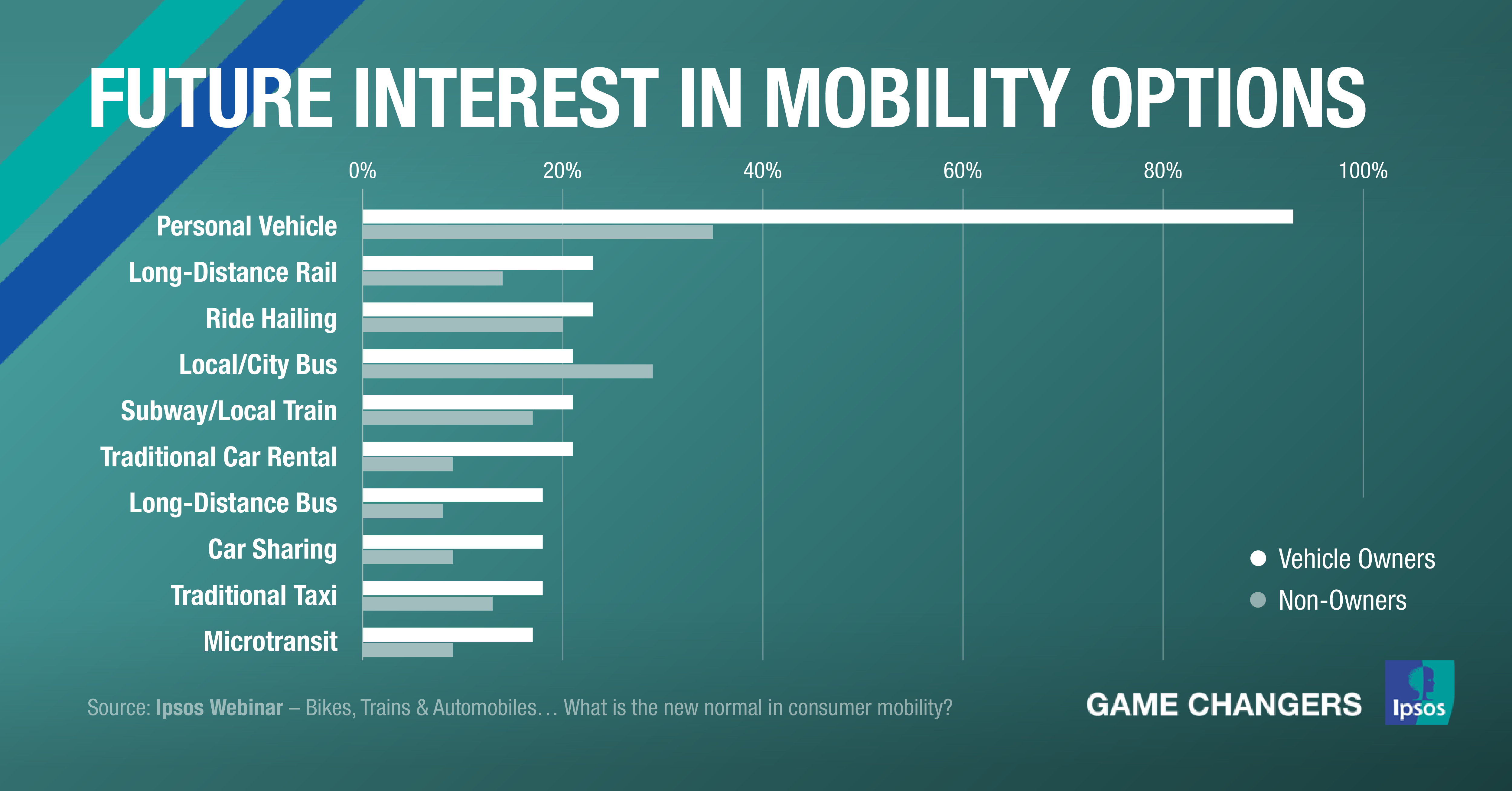
If we look then, at what are the levels of metric for shoot future years, year over year again.
12:58
Up a bit.
12:59
No real shifts in the order of things, we continue to see interest in ride hailing, running just a bit ahead of traditional car rentals.
13:08
It's also interesting actually, to if you, if you look at this chart, it, familiarity does not equal interest in future use. If you remember back to that previous chart.
13:18
Traditional taxis are one of the mobility modes that have the highest levels of familiarity, but they are certainly not one of the modes that people most intend to use in the future.
13:30
OK, so, we know what people are familiar with. We know what they think they might do in the future, but what are they actually doing?
13:38
We actually ask about usage in a couple of different ways.
13:41
OpEx, sort of the benchmark question that we look at every year is is the answer to that question.
13:47
What transportation modes have you used in the last year? And here are the results that we see for 2022.
13:54
You can see that we remain a car culture in the US. Virtually.
13:59
Everybody has used a personal vehicle over the past year, but we also continue to see ride hailing, making significant strides in the market.
14:08
You can see that even though it's well below target personal vehicles, it's above virtually every other source are options for mobility.
14:19
We see it above taxis, we see it above car rentals.
14:22
We also see that sort of the mass transit options like subways, local bus services, they're sort of struggling to get back to pre coven.
14:32
Usage rates, If you will.
14:35
This is just a little bit of supporting data from the American Public Transportation Association.
14:40
You can see here, they've tracked mass public transit ridership, starting in January of 2020 through July of last year.
14:48
And, and again, there was this huge decline in use in users because of the pandemic and and they're just struggling to get back to the levels that they saw pre pandemic.
15:00
Who knows if they ever will, especially as services like ride hailing, car sharing and the like. We continue to grow.
15:09
So, with that, sort of of the backdrop of what's happening, sort of 30,000 foot level, let's shift our focus to some different comparisons of different owner groups.
15:19
So, we started with vehicle owners, the traditional focus of the study, what does the world look like for people that don't own a vehicle, I mean, in theory, people that don't own a vehicle, they should be good candidates to use some of these other mobility options, so, we're gonna look at them for a second.
15:36
This is just a quick snapshot of how vehicle owners and non vehicle owners look from a profiling standpoint, just some basic data.
15:43
In some ways, they're very similar. The age is not that different.
15:47
You know, the gender split is not that different.
15:50
Where they live isn't terribly different.
15:52
Non vehicle owners tend to live a little bit more in urban areas, then vehicle owners do, but where they're wildly different is in their levels of income and what and correspondingly, what percent of them own their own home. So they are very different as far as what they're able to afford.
16:09
So when we look at the types of transportation that they've used in the past year, here we have the dark blue bar indicating vehicle owners and the sort of teal bar showing you the data fernand owners.
16:24
Not surprisingly, we see non owners much more likely to use some of the less expensive forms of transportation.
16:31
Such as public transportation like no subways and local city bus, for the most part, for transportation options. Sort of tell the story for the non vehicle.
16:42
They may avail themselves to ride hailing a youth traditional taxis. And again they use public transportation, subways, local trains, and things like that. They don't use, car rental is very often. They don't use car sharing very often.
16:57
So again, big differences in those two groups.
17:02
If we look at future interest for these two groups, again, it doesn't look that much different.
17:07
We see that non owners are more interested in things like local bus services, ride hailing and subway systems.
17:14
We also see that there is some indication that they might hope to acquire a personal vehicle in the future because that that is actually the mode that they're most interested in.
17:24
just above local and city bus.
17:28
So, OK, So if that's what the world looks like, if we, if we put on our vehicle owner or a non vehicle owner glasses, what about the general population group versus vehicle. John mentioned that we have added more of a general population focus this year.
17:43
Well, what do we see when we look at those folks?
17:48
Let's start again with the basics. Let's start with familiarity. This is vehicle owners versus the general population.
17:54
In general, vehicle owners tend to be a little bit more familiar with pretty much every mobility option.
18:01
There just a little bit more mobility aware, I guess, but the patterns are very similar, You know, the level, there's not a big difference between the vehicle owner data and the general population data.
18:13
Similarly, if we look at their sort of future interests, mobility options going forward, very similar.
18:23
And that actually is, is for a very good reason, and I mentioned it earlier.
18:27
And that's because the U S this is a car culture, and the vast majority of our population own vehicles.
18:34
So, the overlap between the vehicle owner, base, and the base of that, just the general population, is very large. So, there, the results are going to look similar.
18:44
It's very different in other parts of the world, In fact, even though this is a webinar in the US, focused on the US, John mentioned that the study includes data from other countries.
18:56
And I personally think one of the most fascinating things to do is to look at the differences across country countries.
19:02
And when you do this, you'll see places like Brazil and Japan, where vehicle owners don't make up a majority of the general population.
19:09
So if you're not able to tease out what the, the non vehicle owners are, the general population has just to say about these issues, and you just focus on vehicle owners, you're missing at least half the story, if not more.
19:24
Let's make a shift again. Let's not look at the data based on vehicle owners.
19:28
But instead, let's look at what we see when we look at the other kinds of mobility options that people use.
19:35
So in this first chart, we're looking at the types of transportation used in the past year and we're isolating those consumers that said they had used traditional rental cars in the past year.
19:47
So you can say that yes they're very likely to also use a personal vehicle But they're also very likely to use ride hailing, traditional taxi, subways and local trains, things like that.
19:58
I'm a little bit less likely to use car sharing, which is kind of interesting, right.
20:03
I mean, car sharing is sort of the New Age option or alternative to rental cars.
20:10
But right now, for the traditional rental car users, only about half of them have dabbled in that that mobility option.
20:17
If we now sort of flip the coin and when we look at what the usage patterns look like for ride hailing users, we see that there, much less likely use a rental car.
20:30
Just over half report using a traditional rental car versus 82% of rental car users also using ride hailing.
20:37
They are also very likely to use taxis.
20:40
Again, just differences in the in the data that that is fascinating and interesting and potentially valuable depending on it The business question you're trying to answer.
20:50
And then finally, I'm going to finish up with that.
20:54
literally the most open minded of our group, the car sharing group, they'll use pretty much anything.
21:00
They seem to have the most open relationships, if you will, with their mobility modes. They'll go out with anybody in everybody.
21:07
They use ride hailing. They use taxis. They busses, they use the subway, they use traditional car rentals.
21:14
So they're very agnostic, they use whatever is handiest and easiest for them to use given the situation.
21:24
What is driving people to?
21:25
And from these various options, and this section, we're going to spend a little bit of time looking at the perceived advantages and disadvantages or barriers that people associate with some of the various mobility modes. So let's start with the £800 gorilla in the United States anyway. And that's personal vehicle.
21:43
When you ask people what the biggest advantages to using a personal vehicle for transportation are, they tend to focus on the convenience and flexibility that this affords them.
21:54
They're in control of their own destiny. They also appreciate privacy and security, but really, it's about convenient independence, things like that.
22:03
On the flip side, when we ask people, well, what would be a problem for you, or a concern, or a barrier for you and using a personal vehicle, it's really all about the money, right.
22:14
It's, it's really about concerns about the costs of owning and operating and insuring vehicle. Yeah, there are concerns about traffic congestion right reliability, but you can see really how dominant the cost concerns are.
22:29
Well, let's look at something like ride hailing, so this is completely different, obviously completely different option and completely different set of perceived advantages.
22:39
People appreciate that they don't have to drive. They might even, they might even not be able to drive you see that bottom one.
22:46
It's available.
22:47
Even if I'm unfit or unable to drive, those are part of the attractions, but they also really appreciate, appreciate the ease of process.
22:55
Right? It's easy to order. It's, it's easy to pay. I can schedule it. I know the price in advance, those are all things that are that are perceived advantages of ride hailing.
23:05
When you look at the disadvantages, though, you see personal security and cost, really at the top of the list.
23:13
They also mentioned concerns about availability. Maybe it's not available when and where I need it.
23:20
People have a little bit of confusion and concern about variable or surge pricing, but again, security and costs are related to driving barriers for for ride hailing adoption.
23:31
Well, what about people that use them more traditional sort of option, like the subway or the local train? Well?
23:37
obviously, people appreciate the fact that this offers them a respite from driving and the ability to be productive in other ways. They don't have to deal with traffic, they don't have to drive, they don't even need to own a vehicle.
23:49
They can do other things.
23:51
It's also, you know, it's, it's a great option, obviously, for people that don't have access to a vehicle.
23:57
Conversely, though, if you look at the barriers somewhat similar to what we saw with ride hailing, people are concerned about their personal safety.
24:05
They're concerned about.
24:07
Cleanliness also concerned about, obviously, you can only go on a subway where the tracks go.
24:13
So, if those tracks, don't go to your destination, that's a problem.
24:16
What's interesting here, and tying back to my previous point, about being able to look at results across countries, it's those top two concerns, safety and cleanliness. Those are really US centric concerns.
24:28
If we look at this across all the countries that we measured, you know, the percentages are much lower.
24:35
And if we look at individual countries like Japan, Germany, Brazil, those concerns are almost non-existent.
24:42
So that, again, is just an interesting, and I think, fascinating look at how these these results, and how the challenges vary from country to country.
24:52
So, let's transition again to some other ways that we can look at the data.
24:57
Another thing that we do with the data commonly is we try to understand who these people are. Not just what do they know. What do they do?
25:04
What are they? What are their attitudes towards specific modes? But who are they? Right.
25:09
So, this is sort of a look at a ride hailing user versus someone who chooses not to use ride hailing.
25:15
So the people that you might need to conquest, if you're trying to grow ride hailing business, so you can see that users tend to be a bit younger.
25:24
They are more likely to have children more likely to live in a major metro area, a little bit more affluent, not too much more.
25:31
Have some big, attitudinal differences, right? Users hate looking for parking.
25:36
The users.
25:40
Have no preference for brands.
25:43
They don't want to weigh, although neither group really wants to weigh.
25:46
If we look at the same thing for people that use rental car users, this again.
25:51
The user's, sorry, they are a bit younger, more children, again, very similar.
25:58
But again, this is just an example of of how we can mine the data for value that's important.
26:05
I'm going to shift gears again. one of the things that John mentioned earlier was our expansion of the sample to cover more metro markets.
26:14
So we started to look at the data across these different cities.
26:18
And here, we're looking at familiarity with modes of transportation, with the general population, results in blue and New York City, consumers in teal.
26:29
So in general, New Yorkers are much more familiar with wood.
26:34
All the modes. But there, the gap is really big when it comes to the less traditional mobility options such as ride hailing subscriptions, micro transit services, things like that, they're much more familiar than the general population with those items.
26:49
But we also find that not all metro consumers are the same.
26:53
This is that same chart, now, comparing what we just saw for consumers in New York versus San Francisco.
27:00
Now, look, the differences aren't great big here, but I do think it's interesting.
27:05
That's, consumers in San Francisco are generally not quite as familiar with some of these new options like ride hailing car sharing, Karr subscription services, even though they're right next door to Silicon Valley, where some of these business models got their start in the first place.
27:23
We also can see that, that things vary tremendously when we look at other cities. So, this is now two completely new cities. This is Los Angeles versus Chicago.
27:35
Consumers in Los Angeles remain more of a car centric culture compared to people in Chicago.
27:42
Well, consumers in Chicago tend to have a much higher level of interest in things like mass transit and ride hailing hailing.
27:48
It's also not on this chart because the numbers are relatively low and I'm just showing you top five, but I also found it fascinating.
27:55
That consumers in Chicago are much more interested in what I would call outdoor options like bike sharing and scooter sharing.
28:05
And people in LA were, I suppose I'm not from Chicago, I suppose that might be because they have a more defined biking culture or bypass or things like that.
28:16
It is interesting that, you know, certainly the weather is going to be worse. I might have expected people in LA to be more interested in those kinds of services, but in fact they are not.
28:27
Another thing that John talked about that's new this year, that I think is super exciting, is the Performance rating that we've gathered this year.
28:34
So, we've gathered a range of performance ratings and satisfaction ratings that we asked people to to rate for the various service mode or mobility modes that they've used.
28:46
This is just a simple look at some of the more commonly used services with sort of a red light green light approach.
28:54
Green means that they have a high score. Red means that they have a low score, and obviously yellow is in the middle.
29:01
Just look at some of the stark differences.
29:03
We see two modes, rental car, and car sharing, that are both that, the top of the list, because they tend to do very well, although they're very different, right, Rental car is a very traditional, old-school approach.
29:16
Car sharing is relatively new, but they both do very well, with the exception of value for rental car.
29:22
Conversely, if we look down at the bottom of the list, you'll see ride hailing and subways.
29:29
I find it interesting that ride hailing despite the growth that it's experiencing, and despite all the positives about it, the execution of ride hailing still has some issues, right?
29:40
I mean, we saw safety is an issue. People rated low for safety.
29:44
We saw cleanliness is an issue and people in fact made it low for for cleanliness.
29:49
So, there are definitely things to learn about where the strengths and weaknesses of these various modes are.
29:55
In addition to just asking people what barriers are, we can actually look at what their actual experience was. We can even look in some cases at individual providers for these services.
30:07
And again, it's just a fascinating, it's fascinating to think about the different ways we can cut the data to answer various business questions, because I hope you understand now that the breadth and depth of the data that Mike talked about is not just an empty promise. Think about this performance rating comparison I just showed you for the general population.
30:27
We can look at that by different countries, different cities, different regions.
30:31
We can look at it for different types of trips.
30:33
You know, what's what do people say, and how do they rate these services when they're using them for commuting, versus when they're using them, perhaps, for a leisure trip, or when they're just using them to run errands.
30:45
We've talked at length about our ability to look across different vehicle segments or, I'm sorry, consumer segments we could look at users are certain types of mode. We can look at different psychographic or demographic groups. It's just fascinating.
31:00
And obviously, it goes well beyond those ratings, questions, all of the charts that I've shown you, whether it's familiarity or interest or usage, we can do the same thing.
31:11
We can look across countries. We can look across types of trips.
31:14
We can look across different consumer segments.
31:17
And, again, for a research nerd like me, the, the, the, the options are endless, obviously, there's no way in, in a one hour webinar or whatever time we have together that. We could go through all of it.
31:30
But I just hope I able to convey a bit of the excitement that we feel about the data in this study, in addition to some of the interesting findings that we've shared with you today.
31:41
So, with that, we're going to transition it back to John, who is going to talk a little bit about some of the more future forward and future looking items that the study includes done.
31:52
Great, thanks, Chance. I certainly appreciate it as we do think about it. A lot of richness and that current two modes of operation. A lot of depth that we can get into, But we really want to now also, like, you say, transition to what that, what's out going to be in the future? What's the expectations? What is the interest levels have gone to the next slide?
32:09
We, we did frame this and about considering future mobility services and ultimately saying, no, what amongst a long list of potential providers could be of OEMs, tech providers, ride hailing providers. We've done this globally as well as, of course, in the US. And be provided this long laundry list to say, who do we think will be moving forward of the mobility solutions, which providers in array of different services that could be offered in the future. And if you go onto the next slide, we've gotten some very interesting findings or focus here on the US, and we looked at vehicle owners versus the general population.
32:50
And on all, we would say, the trends are on par from year over year, for USB o'connor's about the same with just a few worthy highlights. I mean, we are seeing Tesla is moved up relatively in its ranking last year. And, you know, was six last year now. It's at second. And then what's interesting about that is you could say, is, what what are they doing about mobility services? They do get credit, of course, for their tech advancements, a lot of things happening. Of course, we see a lot of buzz with Elon Musk and all the things he's done. Certainly has given some credit for that and I think that that's spilling over to the general population. They think Tesla, they think Elon Musk and hence, give them credit.
33:32
But there's a lot of tech providers here, right? It's not necessarily of the OEMs who are expected to be moving forward, such as Amazon, you think, Uber, Lyft, Google event. But we do see Ford as a traditional OEM. They're being amongst the leaders, right? But nevertheless, it is fairly interesting to see this active, see this expectation of consumers, what they would think as the providers of the future services. So as we think about that, go on to the next slide. We pose some additional questions about familiarity of potential new offerings that could be coming in the future Such as the self driving, fully autonomous?
34:14
Taxis or even what I call busses, right, 10 Cedar, autonomous taxi, and what is their familiarity with something like this? And we're comparing that also to Stanford. A city like San Francisco just to show you the Deltas. And what we're seeing is the overall familiarity with this is relatively light and total. But in cities, that tends to be a bit higher as it relates to these activities. And of course, we would say what the self driving, taxi with the, you know, the solution and cruise. They're being in San Francisco and others with Waymo offering solutions. Seeing them on the road. They're going to see a little bit more familiarity in cities.
34:54
But we also see this idea of what amounts to is like a bullet train or ultra high speed. Public transportation is more wherein syndicates. I've talked about that between San Francisco and LA. I know the funding has been delayed a lot, but there is some familiarity with it. We also seen this idea of a Drone taxi art, air taxi. Right. Some speak of that. You know, the modular transportation system is something also that, you know, I must have been involved in. this idea of having some familiarity with the Hyperloop. I'm being aware of that as a way to transfer around, iterate, where do see familiarity with these things. We do see opportunity as well, because if we go on to the next slide, what's further interesting.
35:37
So while the familiarity may not be as high, we do see the consideration is there. There is a desire to consider these alternative modes of transportation and in the future. And in cities, right? We've we're spotlighting San Francisco. But this is going to vary on other cities as you dig into the data. If you, once you have the full dataset, you are able to do that, to get a sense of what that opportunity is, but we do see is a real consideration. The highest consideration, is that an ultra high speed, public transportation, having that would certainly be beneficial for people. So at any rate, we do see a lot of, like I say, interest level, something like this, as relates to a variety of new services that you could be getting. It does create yet a different problem. I mean, if we go onto the next slide.
36:27
If another future thing that we've talked about is this idea of a combined mobility app, and what is the interest in that.
36:35
And so this idea of having a consolidated solution that will give you visibility of what is available of the different alternatives of existing and future, we are seeing growth in this, This likelihood to use it is growing, versus what we've seen last year. And we are seeing there is an interest in vehicle owners at a higher rate, But specifically, we see it's even higher within the major cities.
37:03
And that's something that is interesting, is making sure you're offering a solution, and taking advantage of offering a solution of these variety of mobility, Mobility options in one place to enable you to have convenience and quick access to what is available, what could you be doing? But then, we also posed a question of what things with a desire to be in this combined mobility app. And this is where we see transportation elements, like you would expect. But we'll see food delivery, see package, delivery, payment options, information, traffic, and having the ability to get reservation. So, providing a comprehensive, convenient solution that combines these different solution, is definitely, there's an interest level and there's definitely opportunity there.
37:54
You know, potential companies invest to be able to do something like this. We also ask questions about which brand you expect to do it. And so there's, there's a lot of richness there.
38:02
But, nevertheless, we're just highlighting some of the things that is possible with that. Why don't we get into some of the key key conclusions and recommendations what we're seeing with this data.
38:13
So, ultimately, we're seeing, you know, mobility as a service is growing. It is a huge business in the next decade and expect, you know, a little bit of turbulence as it relates to providers. But we also would say that US remains a key called car culture, right? I mean, recognizing that there's a time and a place for these different mobility options, and at different locations on when you would utilize it. But, nevertheless, that that still remains. We also do see that the youth is also very much interested in these new alternatives, because they may not have access to the ability to get a vehicle may not afford it. So they're leveraging some of these other solutions, as you would expect.
38:49
And you go to the next point, chances that consumers are getting more comfortable, as we saw with ride hailing. In 20 22. That's definitely coming back, is being utilized at a very high rate. And this last year, where we're seeing the usage rates of some of the others isn't as strong. As we've seen in the past and such as, you know, mass transit isn't catch an app, that was something that can ... alluded to.
39:12
It's not to the levels of pretense pandemic levels and, you know, we would argue it may not be as a result of I guess I would say covert and the cleanliness of getting, you know, worry about the virus, but it might just be a lack of need. Maybe they're not even commuting as much, hence, therefore, not utilized till it may never come back as an example based off what we're observing. Go on to the next point.
39:36
This idea of what we'd say, the advantages and disadvantages of the different transport transportation modes where we are seeing similar things a year over year.
39:47
On this, we're not seeing necessarily, you know, any, you know, I guess you could say repeat of covert issues, that's limiting them, and it's just more your typical items that are driving of interest or lack of interest in each of the key modes of transportation. Gone. to the next point. We would say, also, what was highlighted, which new this year. The performance ratings of the different modes of transportation. So, while ride hailing, had increased in usage in the last year, we would say there's areas of opportunity to improve, right? So, if it was rated relatively poorly on safety and cleanliness and value, you know, there's opportunity for these other modes of transportation to take advantage of that right and say, OK, rental cars or even taxis are getting slightly higher scores.
40:36
So, it's a matter of, you know, taking advantage of whatever your tech solution is, recognizing this data, see where your opportunities are, and take manage, even, like car sharing. I know I've been a user of ...
40:47
in the past year, multiple times, and that was a very good experience to be able to do that, and having these alternative choices, and especially if things aren't performing as well as you would like. And yet, these alternatives become good choices for you.
41:02
And you can obviously utilize it on the occasion.
41:05
Go on to the next point. We would say, of course, the growth of mobility services real.
41:12
We are seeing future opportunity, like we just highlighted it, to fit merit familiarity and consideration of these alternative new solutions, even gonna add further complexity to the market with all of the choices that are out there. So having some type of a convenient, combined mobility app that will help simplify this particular, for large cities would certainly be beneficial just to show that visibility and the availability of these options.
41:41
So it is definitely a lot of richness and got to the last point that we'd raise is that there's just a lot of results that you can get into. We just, like, we would say, scratched the surface. That is, you know, getting full access to this dataset is definitely beneficial, we're seeing a lot of demand for this across our variety of clients in it.
42:02
We just encourage you to follow up with us, and would certainly be glad to help, and let you know what it would take to do, and this gets back to what you would say about our module again, much rich richness that we have, that deeper dive into the larger cities. We've highlighted what's here.
42:20
The class that we've done, we did get the increase sample of the general population to be broader. We also have increase the overall sample sites to, in addition to our countries, we do have. Now, if I didn't mention it earlier, but for those who are unfamiliar, we have Japan, we have China. We have Germany, Brazil, and then of course, US, and then we've added France for this last module based off some interests.
42:43
We've gotten further interests that we've gotten in Europe, the topics that we thought, we didn't get a chance to get through all of these. But there is a lot there that you could dig into and understand that the choices and the delta S, and certainly even the profile of the people on that is definitely advantageous. So with that, I know we're kind of coming at the end of time here. I'm not sure, Mike, if you've seen any, any questions that popped up and what we've gone through There.
43:13
There were a couple of questions I will maybe we have time for one, because there is something more we share.
43:19
The questions chat also maybe try refreshing your your camera because it seems to have frozen on our end. So if you don't like the look at a frozen camera images, we still can hear your voice and your enthusiasm, but we had the second time, at least, visually.
43:36
Anyway, so, so, let's ask one quick question.
43:40
I think it's interesting, just because this, the study was expanded, so you had mentioned just now, countries that were included, and certainly the, this person was intrigued by some of the differences that were noted by chance the section, The cities, surprisingly, certain cities were had stronger interests and familiarity than others.
44:04
The question was, Well, how many cities are there, both in the US and then abroad, and what if a city or emmerson isn't in here?
44:16
Chair, so I'll jump in and take that.
44:19
So, we call that the four cities that we have in the US, I think we have over the six countries, 22 either metro areas or regions that we can cut the data by.
44:30
We've got Sao Paulo and Rio in Brazil.
44:34
We've got Paris in several regions. In France we've got Berlin and the Rhine Ruhr Region in Germany.
44:42
In Japan?
44:42
In China, we've actually got the city tiers. So tier one, tier two, Tier three cities isolated.
44:50
And then in Japan, I think we've got four regional prefectures that we can cut the data by, So those are actually aggregates of some of the cities. But that's the way in Japan. They tend to look at the data.
45:03
So really good ability to cut across cities. But obviously, we don't have them all.
45:09
So, to answer the second part of your question, one of the things that we've done for clients, and can do for clients, is replicate this methodology in any given city.
45:18
And then you get not only the results for the city that you you've selected, That's important to you, but we, we provide the syndicated results as a backdrop, so that you can see how your city compares to, know the benchmark cities in whatever country you're concerned with.
45:36
OK, thanks. Appreciate that Chance.
45:39
I know we're close time, We have a little bit more we want to share with you, so I think I'll actually ask, chance to go to the next slide. And, John, if you don't mind jumping in.
45:49
Yeah, sure. So I know, just based off of all of the enhancements we've done in our program for the shared mobility, That's caused us to be upgrading, if you will, of what we're looking forward to do in 20 23.
46:02
And so specifically, with the Navigator focusing on, we have seen very much a lot of interest on both of the other two key topics of electrification and autonomous plus eight, as we're looking to do, perhaps a, you know, another focused topic on that, primarily doing at least these two core ways for it. For our navigator, for next year. And even offering further opportunity to add countries, or even cities, if you'd like. as relates to those topics, and then further, having a dedicated solution related to our shared mobility mobility as a service, and referencing as our mobility tracker and doing another flight of this.
46:44
So, we could see how this is changing over time, and understand as new services become available, how those things are being utilized. So, a lot of exciting things happening. Going into 2023, we're very much encouraged to be able to see what these additional learnings will bring us, and being able to share those insights with our clients.
47:05
Nevertheless, I can say thank you for participating in our session today. We certainly do appreciate it, and of course, if you have any questions, please don't hesitate to reach out to any one of us would be gladly wanting to follow up with you. Answer the questions, and, or, you know, address, any things that you may desire to do.
47:24
So with that, I would say, thank you very much. I don't know if, ..., you want to say anything further? I just want to say, thanks, everyone for joining us throughout the year and hope you have a happy holidays.
47:35
Or we look forward to re-engaging with you on the 2023 version above mobility Navigator and this new mobility tracker.

![[WEBINAR] Global Voices of Experience 2026](/sites/default/files/styles/list_item_image/public/ct/event/2026-02/thumbnail-global-voices-experience.jpg?itok=NN6W-9Ft)
