
We need to talk about ads
 Evidence suggests that advertising that gets talked about has the potential to deliver unpaid or earned reach, and therefore more efficiency for marketers.
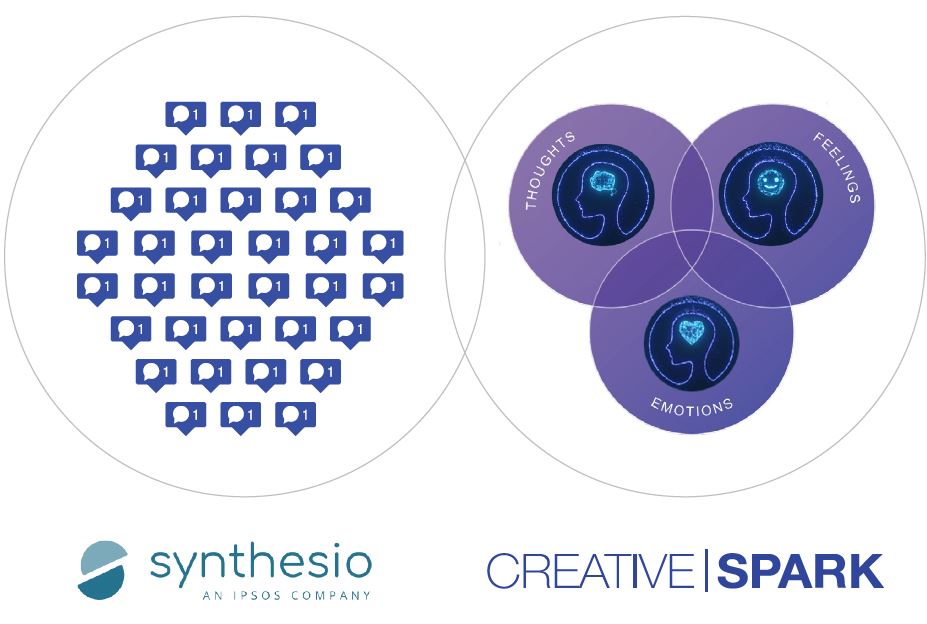
In this paper, we highlight the types of responses effective creative need to evoke to be talked about online. Using data from our social intelligence platform, Synthesio, we examine the relationship between the volume of mentions for a diverse range of online video ads, as well as the creative responses they achieved in our creative evaluation solution, Creative|Spark.
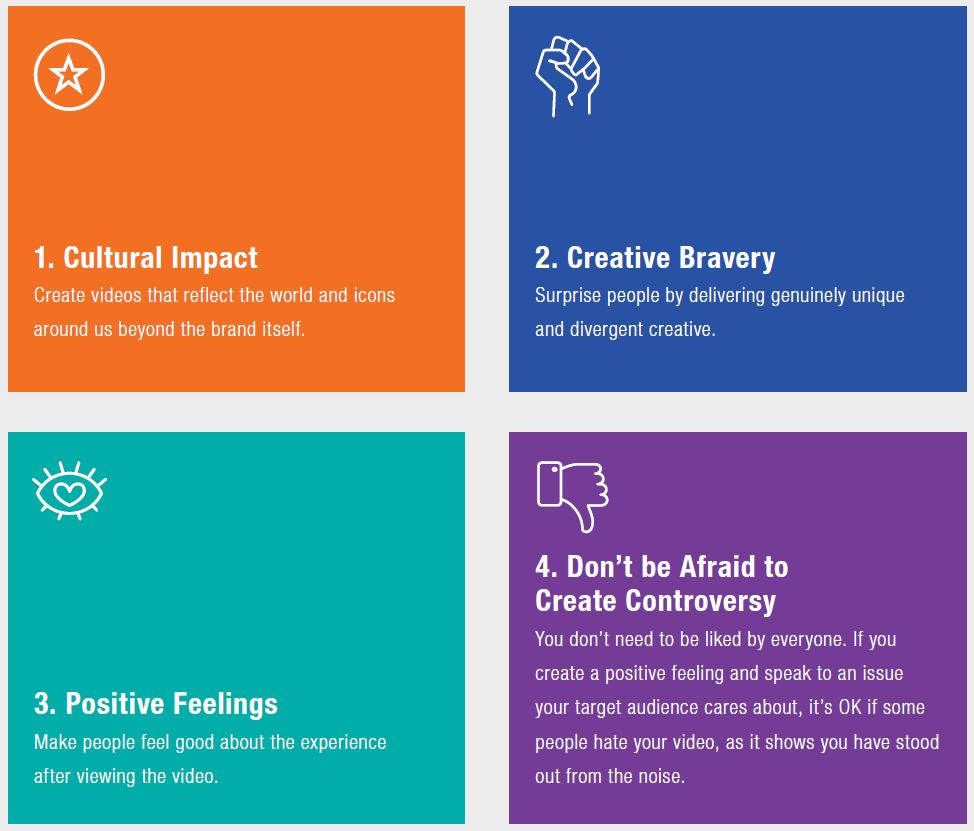
Based on our analysis, we identify four key traits that represent the types of ads that attract comments, which in turn are linked to earned media effects:
1. Cultural impact: reflect the world around us beyond the brand itself
2. Creative bravery: surprise people by delivering unique and divergent creative
3. Positive feelings: make people feel good about the experience
4. Controversy: don’t be afraid if some people hate your ad
To illustrate these four traits in action, we share some of the best examples from recent campaigns, discussing why they were talked about at significantly high levels and became famous.
"Ads generate conversation online when they reflect the broader world and culture around them, rather than just their products."
WE NEED TO TALK, JUST NOT ABOUT ADS
As people, we are social creatures and owe a lot of our success to the way we communicate. From prehistoric times we have shared stories around the campfire and later via the written word to bond socially and teach future generations the values and behaviours needed to progress in life. It is this trait of social communication and interaction that separates people from primates such as chimpanzees. While both species communicate through vocalisations and gestures, humans tend to do this to be socially helpful, by informing each other about sources of rewards or danger, whereas some observational studies have suggested chimpanzees can be less inclined to exhibit this type of behaviour1. Put simply, as people, we need to talk, both for our emotional wellbeing and success in life. So, where do brands and advertising fit into what we talk about? It turns out, very little. Even among followers of a brand's Facebook page, only 0.5% ever specifically talk about them2. And, for advertising, Ipsos Global Trends data paints a less apathetic and more negative picture, with people more than twice as likely to agree online advertising is “annoying” rather than a source of information to “share with colleagues and friends” (73% vs. 30%)3. Yet even with apathy and rare presence in our communication, there is evidence that advertising that gets talked about has the potential to deliver unpaid or “earned” reach and therefore more efficiency for marketing investments. In The Long and the Short of It, Les Binet and Peter Field observed that “Fame” campaigns, those that “inspire people to share their enthusiasm on and offline”, are four times as efficient in generating Excess Share of Voice (ESOV) than non-Fame campaigns:

With this type of evidence, we see a seductive proposition for marketers. A Fame challenge that very few achieve, with high potential, earned media rewards that the aptly-named communications and advisory company, Contagious, coins very well: "You know what's cooler than paying for advertising? Not paying for advertising."
MOVING BEYOND DANCING BABIES
With the Fame challenge set before them, many a self-respecting marketer will understandably look to famous campaigns that have been considered a success in delivering earned media results, and there is none more famous than Evian’s 2009 “Roller Babies”. A campaign that used dancing babies to convey the brand’s message of “Live Young”. Official statistics for the campaign have not been released by Danone. However, the variety of videos published have been reported to have attracted over 100 million views on YouTube and 130,000 comments5. This could certainly be considered a likely success if the business objective was to gain earned media efficiency, but how does looking at a campaign with dancing babies help to provide insight and guidance for other brands hoping to achieve similar outcomes? Herein lies the tension, that while a single campaign can inspire brands to try to achieve similar results, it’s clear that dancing babies, or indeed any distinct creative device, alone are not generalisable enough to achieve media efficiency for your brand. If we accept that looking at only one case is not enough, we need to analyse the outcomes for ads that are talked about and those that are not talked about toidentify the characteristics and types of responses the more successful campaigns attract, to inspire future campaign planning. In this paper, we summarise an Ipsos research programme that provides these generalisable findings, looking at the relationship between the volume of mentions for a diverse range of online video campaigns measured in our social intelligence platform, Synthesio, and the creative responses they achieved in our creative evaluation solution, Creative|Spark. You can find more information about Synthesio here and Creative|Spark here.
THE FOUR TRAITS THAT MATTER
Based on this analysis, we identified four key traits that increase the chances people will talk about an ad online. These are identified below. We detail the scope of our research that led to these four traits, which we hope will inspire marketers to create truly culturally worthy, brave work, knowing that it is these campaigns that meet the Fame challenge and deliver earned media efficiency.
WHAT WE DID
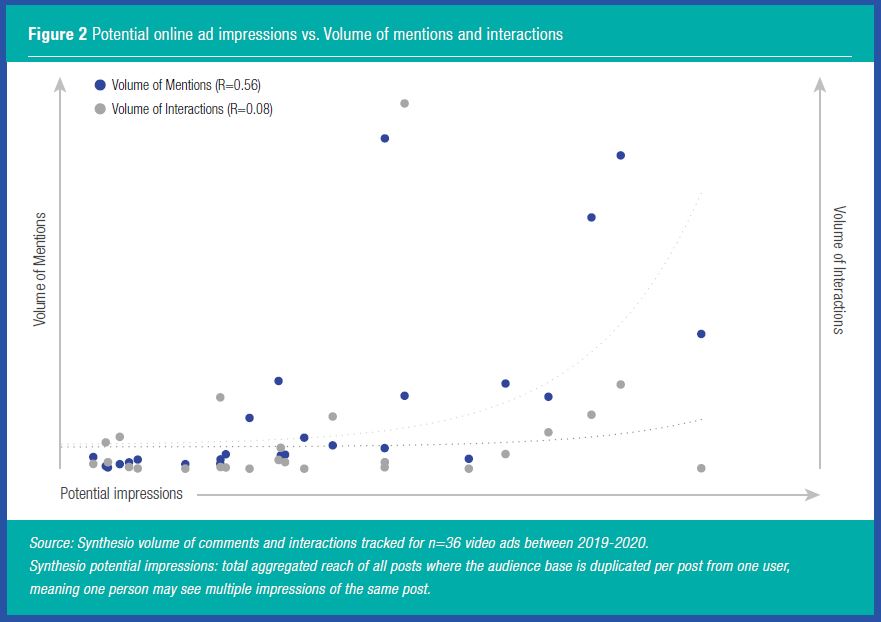
We selected a total of 36 video ads in the USA that were published online between 2019-2020, with varying levels of success in generating online comments. We measured the volume of comments in the first four weeks after the day of launch for each video in our social intelligence platform, Synthesio, enabling us to draw comments from a range of social media platforms, including YouTube, Facebook, Instagram and Twitter. Each of the videos were also evaluated in Creative|Spark, either pre-launch or within the first two days of being published online. This provided access to more than 30 measures of creative response across our Thoughts, Feelings and Emotions framework. With this unified dataset, we analysed the direct relationship between the creative measures and volume of mentions to understand the key traits that are linked to campaigns that people talk about. We selected mentions as our dependent variable, rather than other interactions such as likes and shares, because we observed they have a closer relationship with the total potential impressions achieved by the ads in a four-week period (see Figure 2).
After identifying the creative measures with the strongest relationship to mentions, we placed them into a stepwise regression model to understand which weighted combination of measures could explain the most variance of comment volume. This in turn led to the creation of the Social Power Index we now offer to clients to help them understand which creative has the most potential to get people talking and deliver earned reach for the brand.
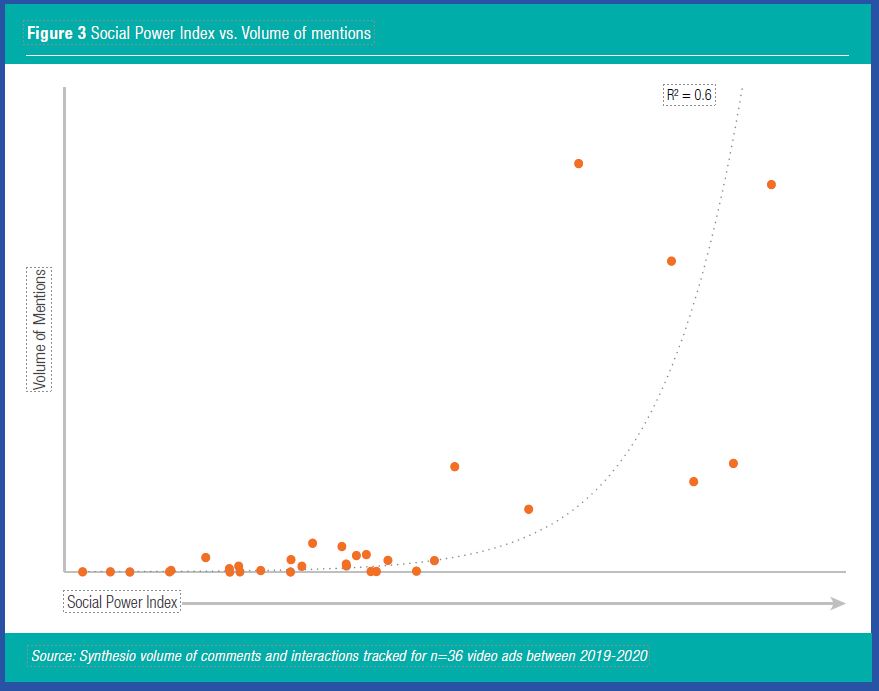
When compared to the actual volume of mentions, the Social Power Index explains 60% of the variance in mentions, confirming its value in selecting and optimising the best creative to deliver earned reach objectives (see Figure 3). Irrespective of the underlying creative response measures, this level of explained variance confirms that creative quality matters when trying to evoke conversations online and achieve fame effects for the brand. This means that while media seeding investment and placement are no doubt important in being part of the fuel of earned media value, the ad itself needs to deliver an experience of a standard that is worth talking about. In the following section we list the key traits and underlying measures in the Social Power Index that marketers can consider when developing campaigns with earned media objectives. These are not meant to act as a set of rules, but more as a list of principles that can give inspiration to create advertising that will make people engaged enough to talk about your ads.
THE FOUR TRAITS IN ACTION
When reviewing the measures available in the data, we identified seven that had the strongest individual relationship with total volume of mentions. Two of these measures related to an expectation that others would talk about the ad or an expectation that respondents themselves would talk about it online, while the other five related less to the desired outcome and more to the traits or types of responses evoked by advertising that gets talked about. Below are the four traits we identified earlier in the paper, along with their underlying measures.
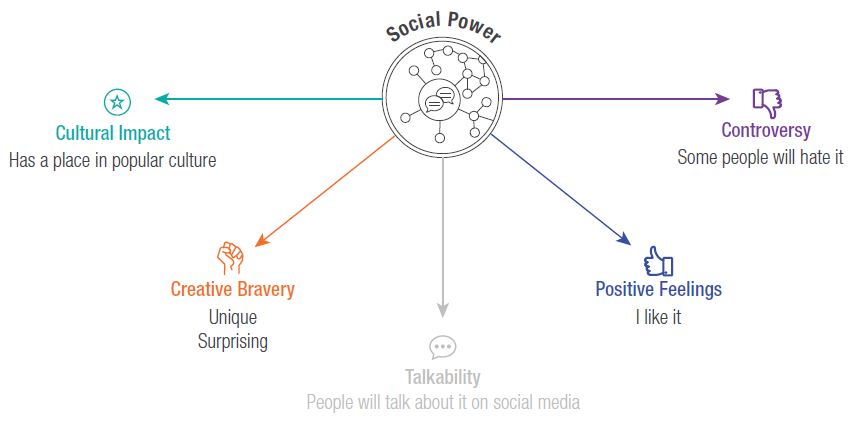
To further illustrate the traits in action and give context to these generalisable insights, we have outlined some of the best examples, explaining how these ads got talked about at significantly higher levels than other cases in the dataset.
1. CULTURAL IMPACT: REFLECT THE WORLD AND YOUR BRAND’S PLACE IN IT
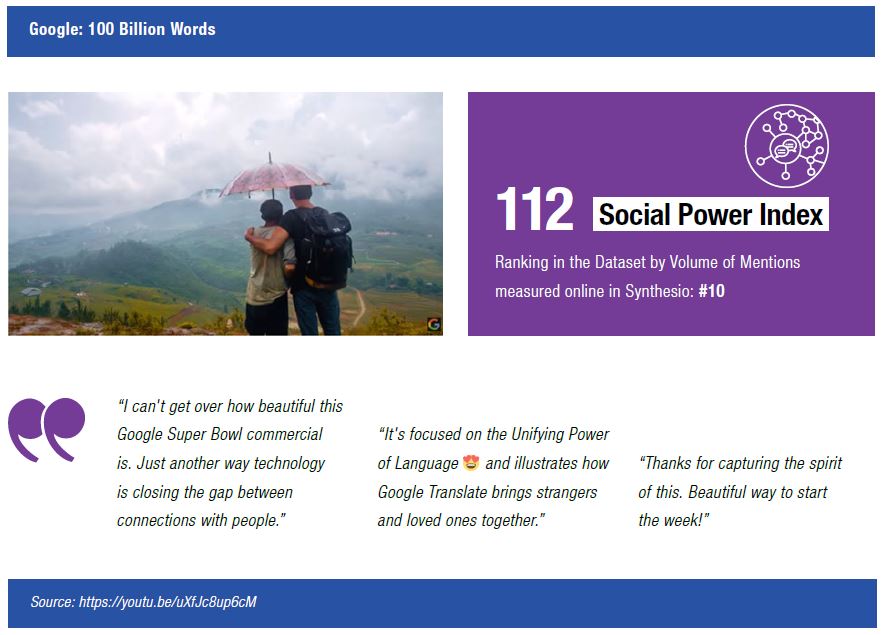
It is clear from Ipsos data already cited in this paper that people claim to not be positive about the advertising they view. Nobody likes to be sold to. So perhaps it is not surprising that one of the key variables we identified to separate the ads that generate conversation online is when they reflect the broader world and culture around them, rather than just their products. One such example is Google’s 100 Billion Words. In this video, Google show a range of cultures around the world, and the power of Google Translate in bringing people together in one common language. The ad works beautifully to weave in the functional value of the app in moments of togetherness, while highlighting the positivity of human communication by revealing that the most commonly translated words are those such as, “How are you?” and “Thank you”.
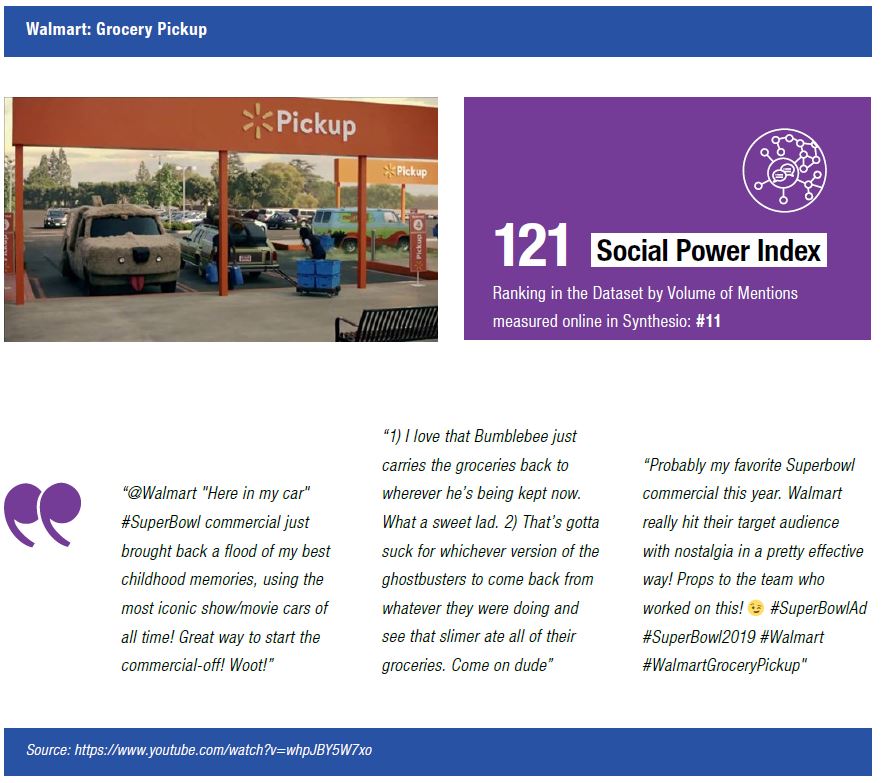
Another example that touches the cultural zeitgeist, for very different reasons, is Walmart’s Grocery Pickup. The ad features a range of popular vehicle characters from entertainment, such as ECTO-1 from Ghostbusters and KITT from Knight Rider. These vehicles are all woven into the message of home delivery from Walmart, while also clearly rekindling memories of cultural icons for audiences.
2. CREATIVE BRAVERY: AIR BRAVE AND UNIQUE WORK
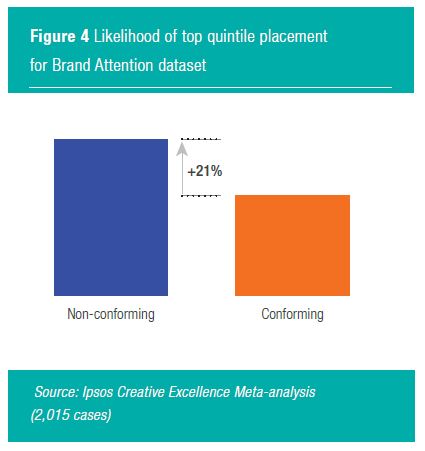
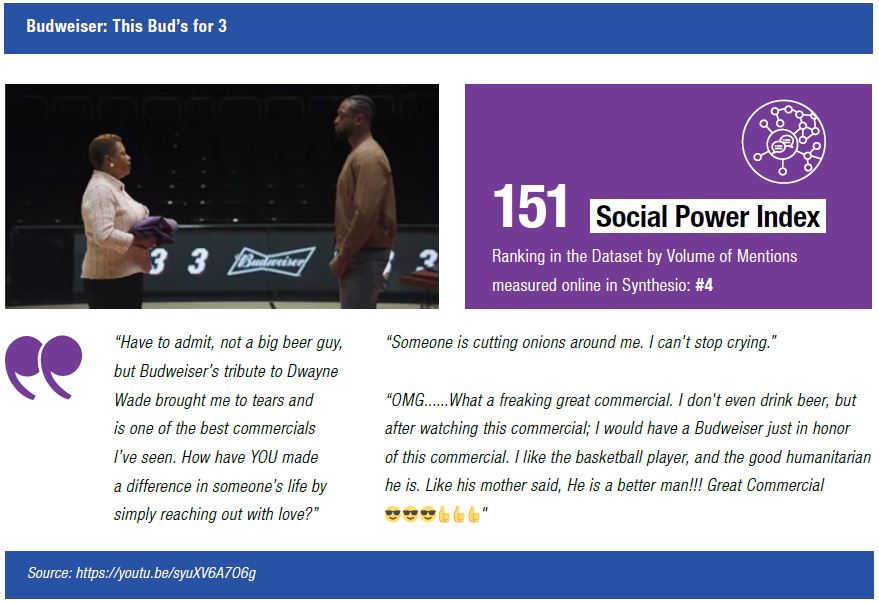
Outside of this dataset, we know that non-conventional creative considered to go outside category codes and norms is more effective at encoding branded memories, with non-conventional ads 20% more likely to feature in the top quintile of our database for Brand Attention than conventional ads. This would suggest your advertising is more likely to be remembered if it’s truly brave and unique work (see Figure 4). In this context, it is no wonder that ads described as “unique” or “surprising” were more likely to be talked about online. It is these ads that at times can cross the Rubicon by delivering a content experience rather than an “ad” and one example of this is Budweiser’s This Bud’s for 3. In this video, Budweiser filmed NBA Basketball star Dwayne Wade being surprised by people from his past and present that he had provided help and support to, and by their thanks for his selfless acts of kindness. As well as showing several emotional reactions, the ad was described as “unique” and “surprising” at high levels by pivoting from an initial expectation of being a simple sporting tribute to a retiring player.
3&4. POSITIVE FEELING AND CONTROVERSY: DELIVER A POSITIVE EXPERIENCE AND DON’T BE AFRAID IF SOME PEOPLE NOT IN YOUR TARGET HATE YOUR AD
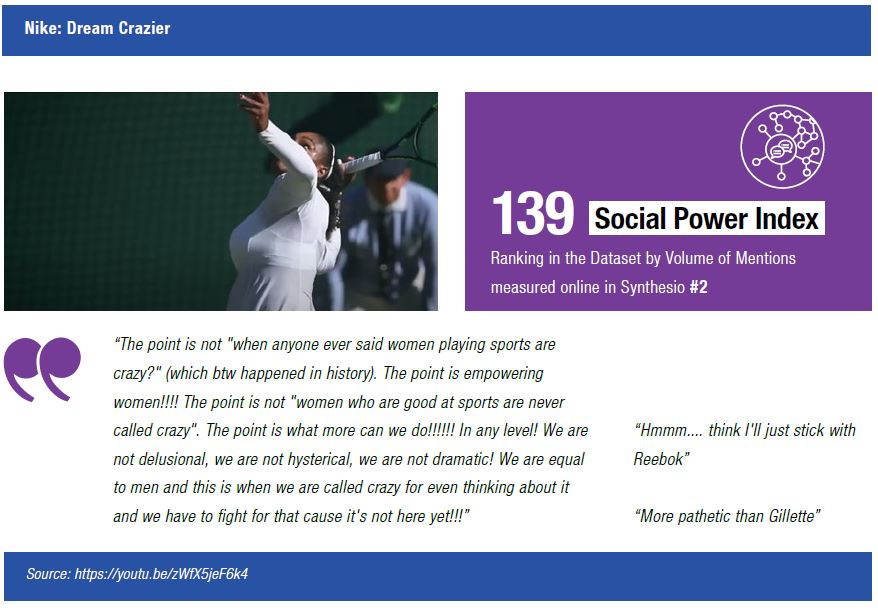
Many marketers would likely agree that if you want to influence someone it’s better they feel good about your communication than not, and Ipsos data bears this out, where we have observed that ads that build a positive immediate emotional response over time are more likely to be remembered than those that are comparatively flat6. But getting people talking is a more nuanced undertaking, where often instantly they will take an action to comment online, to voice an opinion. To facilitate these actions of commenting, we see a number of examples in the dataset that are both liked, delivering a positive experience, and carry an expectation that others will “hate them”. One stand-out example is Nike’s Dream Crazier. Building off their previous Dream Crazy campaign, the ad continues to shine a light on female inequality in sport in a direct and near confrontational way that was liked by three quarters (76%) of respondents, while a third (32%) also expected that some people would hate it.
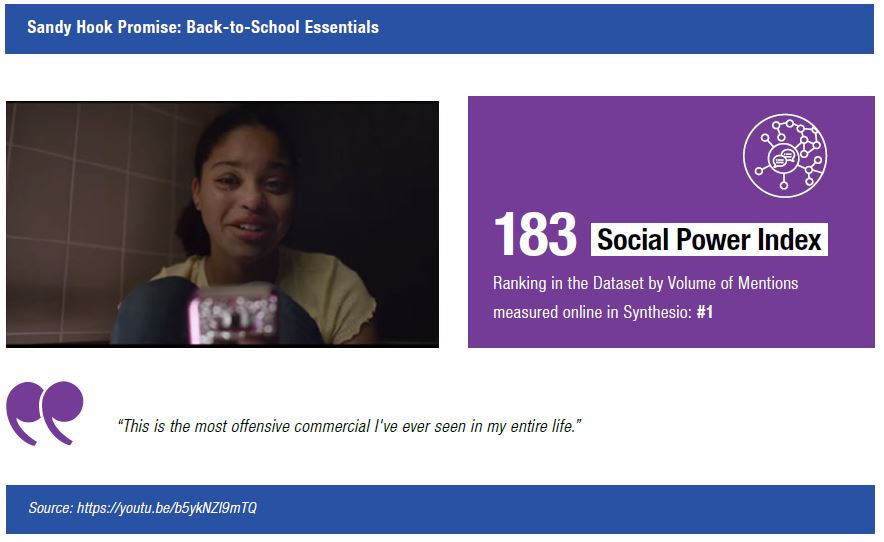
Another case in the dataset with a very different message and purpose is Sandy Hook Promise’s Back-to-School Essentials. This hard-hitting video shows children talking about the items they are taking back to school as they are being attacked by a gunman. While liked by just over half of the respondents who saw the ad (57%), we can presume due to the effectiveness of the message, a similar 54% expected some people to “hate” it. These examples, and others in the dataset, represent the value of controversy in general in getting people talking and often the expectation that some people will hate an ad can be a spark to attract discussion and comments.
BE PART OF CULTURE, BE BRAVE, BE BOLD
In this dataset, we have discovered four creative key traits that represent the types of ads that attract comments online, which in turn are linked to earned media effects.
While each of these traits can be considered in your creative strategy, they are united by a key principle worth consideration. Whether you focus on developing unique creative, speak to a wider issue in society, or represent a sense of nostalgia with cultural icons, all these traits ladder up to delivering an experience truly worthy of discussion that the brand plays a part in. Which brings us back to the reality: people need to talk, just not about ads. Instead they will talk about experiences they think will benefit themselves or others, which is why many of the campaigns that achieved the Fame challenge were experiences rather than traditional ads. Based on our observations in the data we recommend that if you want people to talk about your communication, think about delivering an experience worthy of discussion that your brand is part of, rather than an ad that simply sells your product.
![[WEBINAR] How winning brands are making themselves essential in a tight economy](/sites/default/files/styles/list_item_image/public/ct/publication/2026-09/thumbnail-templates%20demo_3.png?itok=0YmowUKN)

