
What Just Happened? America's Public Response to 2022
The last 12 months brought a series of once-in-a-generation events. Inflation hit a 40-year high, the Supreme Court overturned the right to abortion at the federal level, the war in Ukraine began in Europe, the country put the pandemic in the rearview mirror, and a significant midterm election cycle shifted the control of power in Washington.
It was also an active year in substantive policy making, with the Inflation Reduction Act, the CHIPS Act, gun reform, student loan forgiveness, federal marijuana decriminalization, and same-sex and interracial marriage comprising some of the most significant changes to U.S. law in recent memory.
Yet, public opinion around the key issues of the day remains mostly unchanged from last year. Below we unpack the biggest stories of the year to look ahead and see where the country may be headed in the new year.
#1. Can inflation be tamed without triggering a recession?
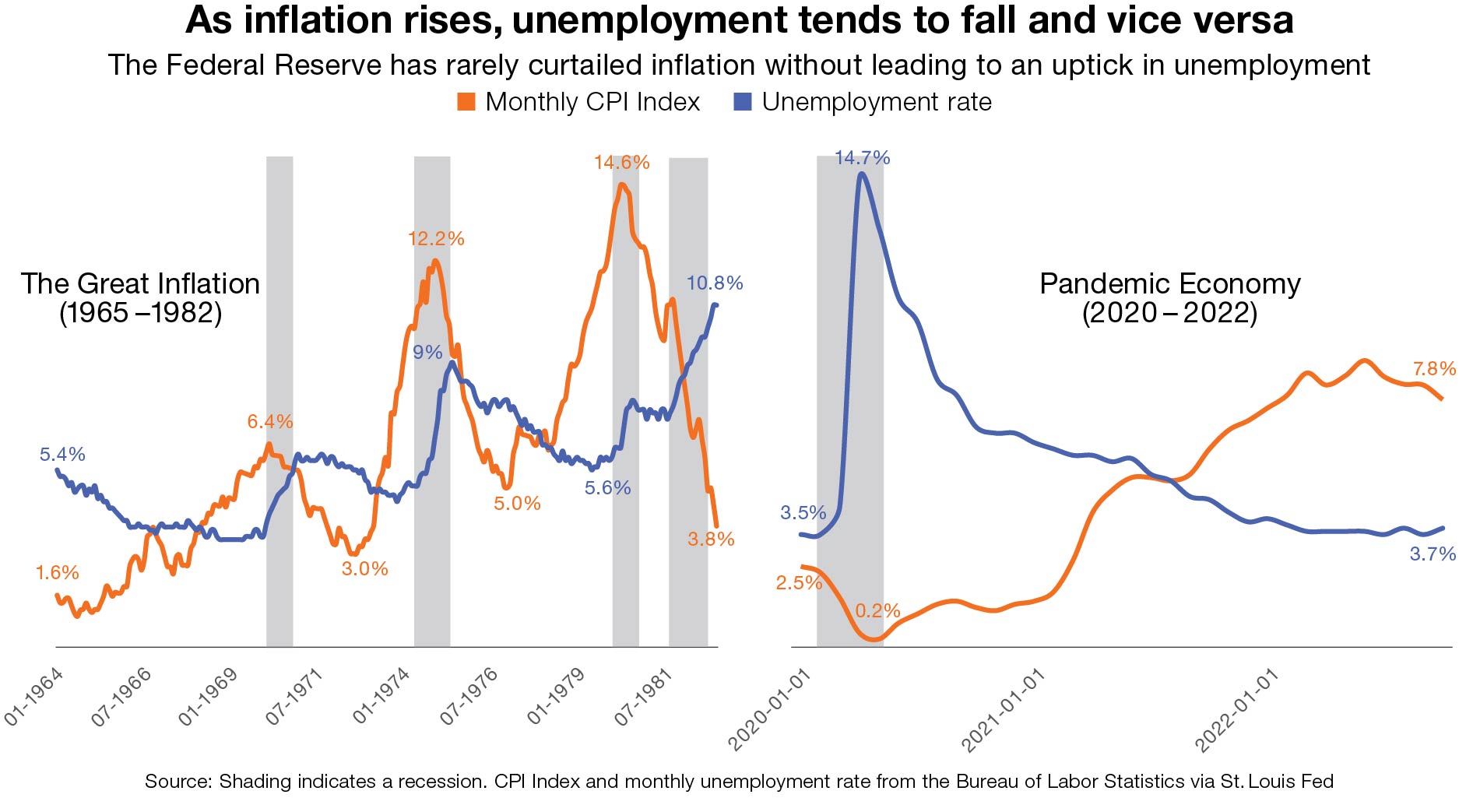
One of the biggest stories of 2022 was historically high inflation. The Consumer Price Index, the core U.S. measure of inflation, reached highs the country has not seen in decades. Groceries, gas, rents, and mortgages all climbed quickly, making the cost of living harder to afford for many.
However, during this period, American hiring has remained robust, cushioning any downturn in the economy. Will that remain the case as the Federal Reserve continues to increase interest rates to try to break inflation? Since the 1960s, unemployment has risen whenever the Fed tries to aggressively cool inflation. The Great Recession in 2008–2009 and the long recovery shows that Americans often find it harder to come back from wide-scale layoffs.
#2. Consumers going into the red to keep powering the economy
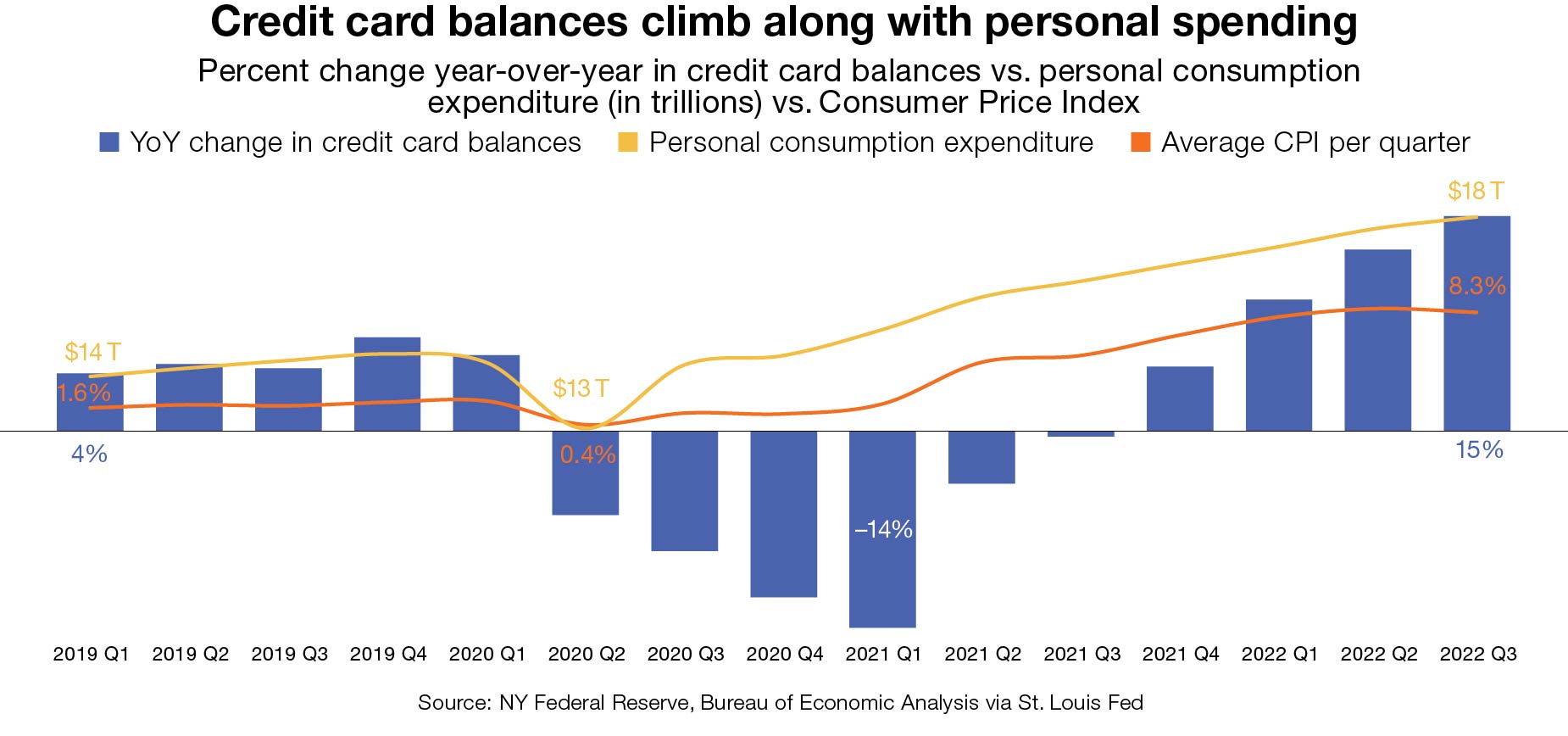
Even as inflation is a looming concern for Americans, consumer spending has not slowed down. This Black Friday and Cyber Monday hit record sales.
To explain that story, we have to look at debt. Despite falling through the first year of the pandemic, consumer debt is now rising as interest rates continue to climb. Credit card balances grew 15% compared to this time last year, marking the largest year-over-year increase in 20 years.
With higher interest rates, this new level of debt might be harder to pay off. The combination of rising prices and the rising cost of debt may put many Americans in a precarious financial place heading into the new year.
These rising expenses do not impact all Americans equally. Inflation acts as a regressive tax, meaning lower income Americans suffer the most from inflation since they have less wiggle room to account for rising prices. Rising credit card balances suggest that many Americans may be living on credit as they try and get by with higher prices.
#3. The Midterms weren’t (just) about the economy after all
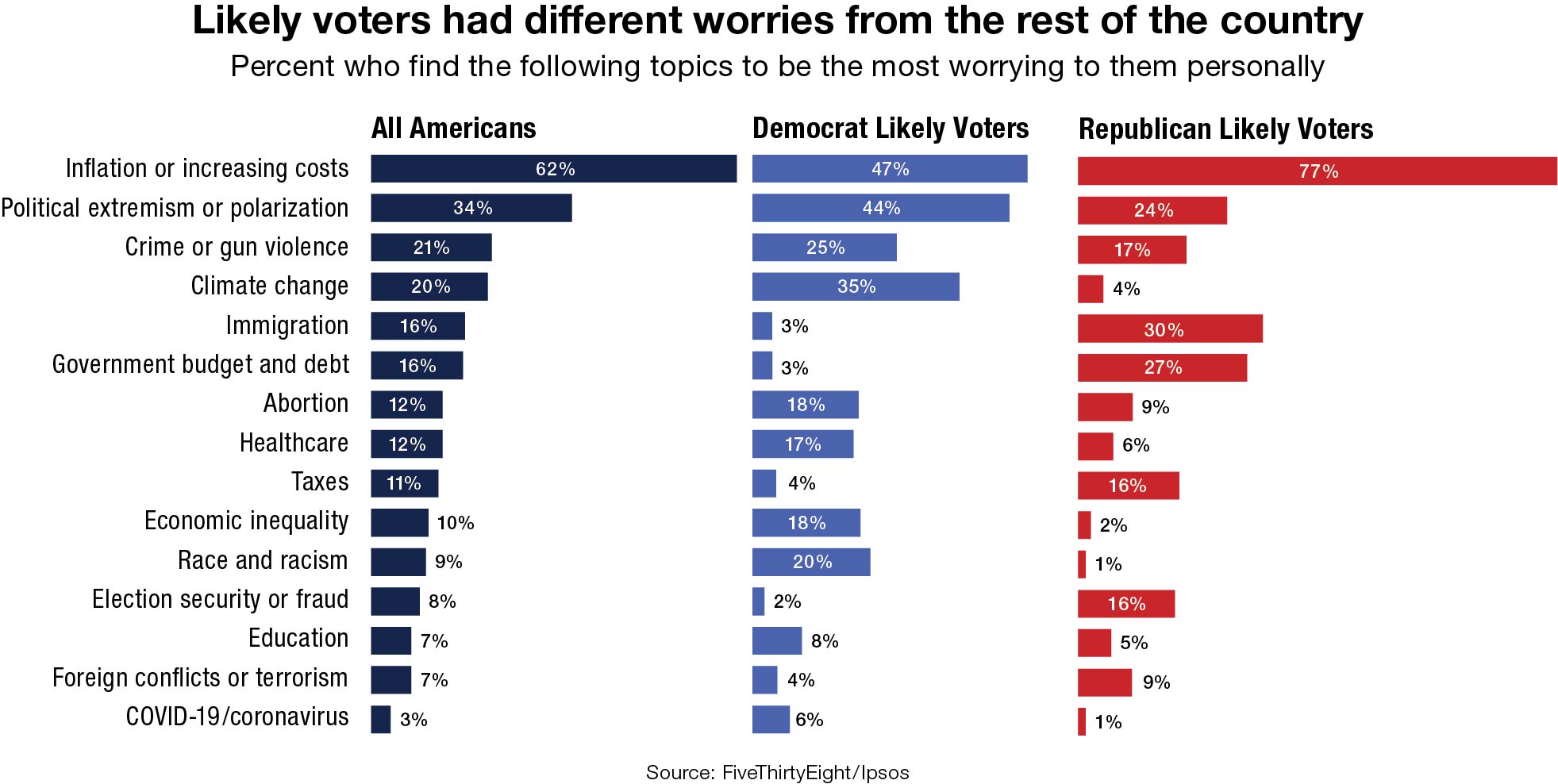
Leading up to the election, the economy was the top worry among Americans but not necessarily among the voting public. With only about half of the American public voting in the midterms, second-tier concerns for the public as a whole, like abortion or crime, are more central to these motivated minorities.
That appears to be a deciding factor in some key states this year. The Dobbs decision that overturned the federal right to abortion appears to have been a motivating wedge issue for voters this cycle. Preliminary midterm results show that turnout was higher in states where abortion was on the ballot compared to states that didn’t have abortion on the ballot. Select and motivated groups that turn out in midterms can make issues like crime or abortion key for these elections, driving turnout and nudging results. How politicians govern with these critical constituencies and issues in mind will be important to watch going forward as both parties gear up for the primaries ahead of the 2024 presidential election.
#4. Democrats (with an assist from Republicans) were able to beat Midterm odds
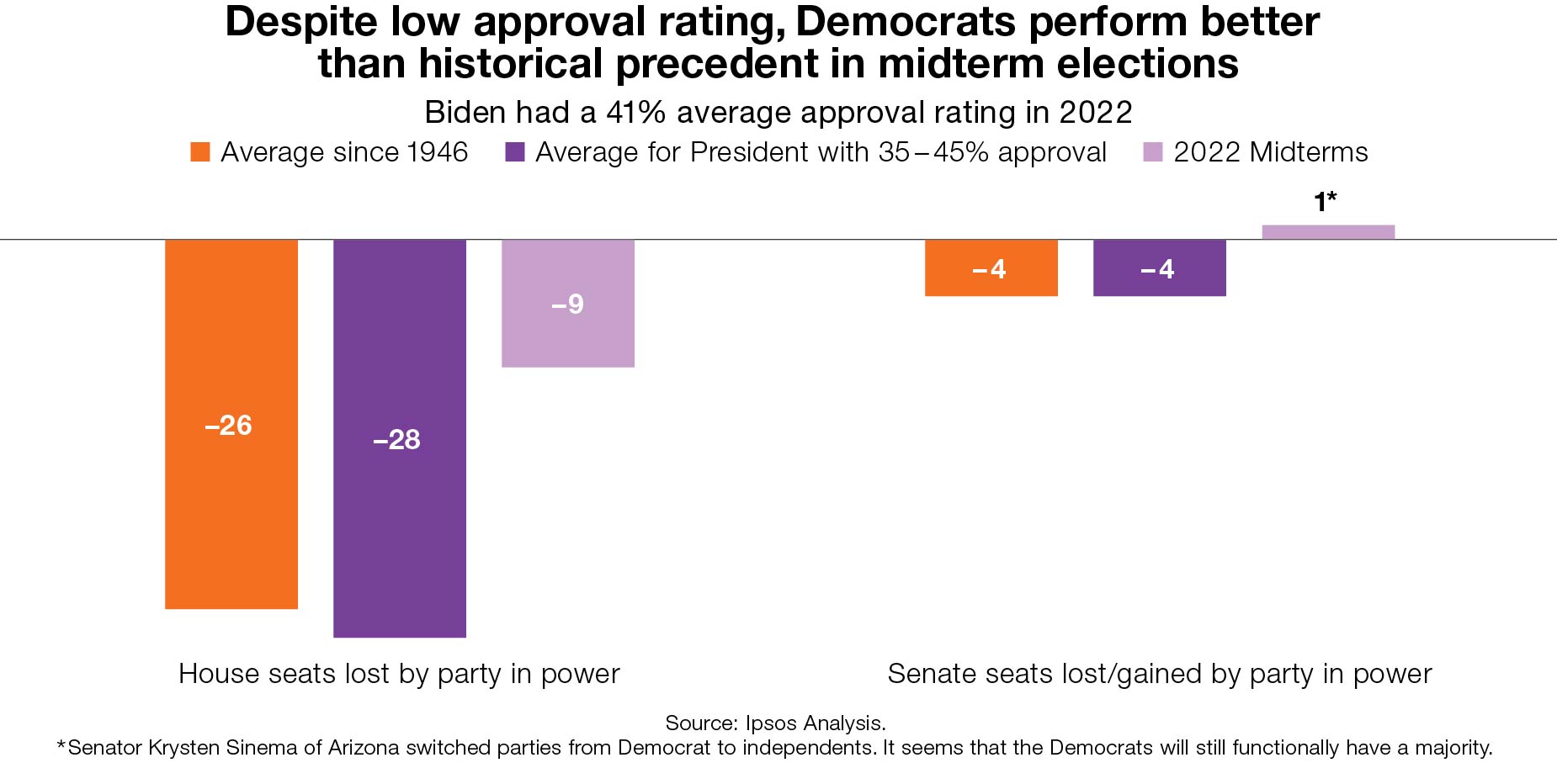
Given the challenging economic environment and President Biden’s low approval ratings, many pundits forecast a red wave, with Republicans sweeping the House and Senate in the midterms. Yet, this year proved to be a more complicated and nuanced political environment, in line with Ipsos’ predictions.
On average, the president’s party loses 26 seats in the House and four seats in the Senate in a midterm election. Presidents with Biden’s middling approval ratings have, on average, lost 28 seats in the House and four Senate seats. But this year, Democrats lost only nine seats in the House and gained one seat in the Senate, functionally giving them a majority (even as current Senator Krysten Sinema of Arizona switched from the Democrat to the independent party to ward off potential primary challenges in 2024).
A big part of this story is the relatively week showing of MAGA or Trump-aligned Republicans. Several independent analysts have found that MAGA Republicans performed 5–7 points worse than more standard Republicans, potentially tipping numerous close races towards the Democrats.
How President Biden consolidates support for a potential 2024 reelection bid and what this means for former President Trump’s reelection campaign are big questions hanging over Washington following this cycle.
#5. Despite upheaval, Americans views on issues-of-the-day mostly unchanged
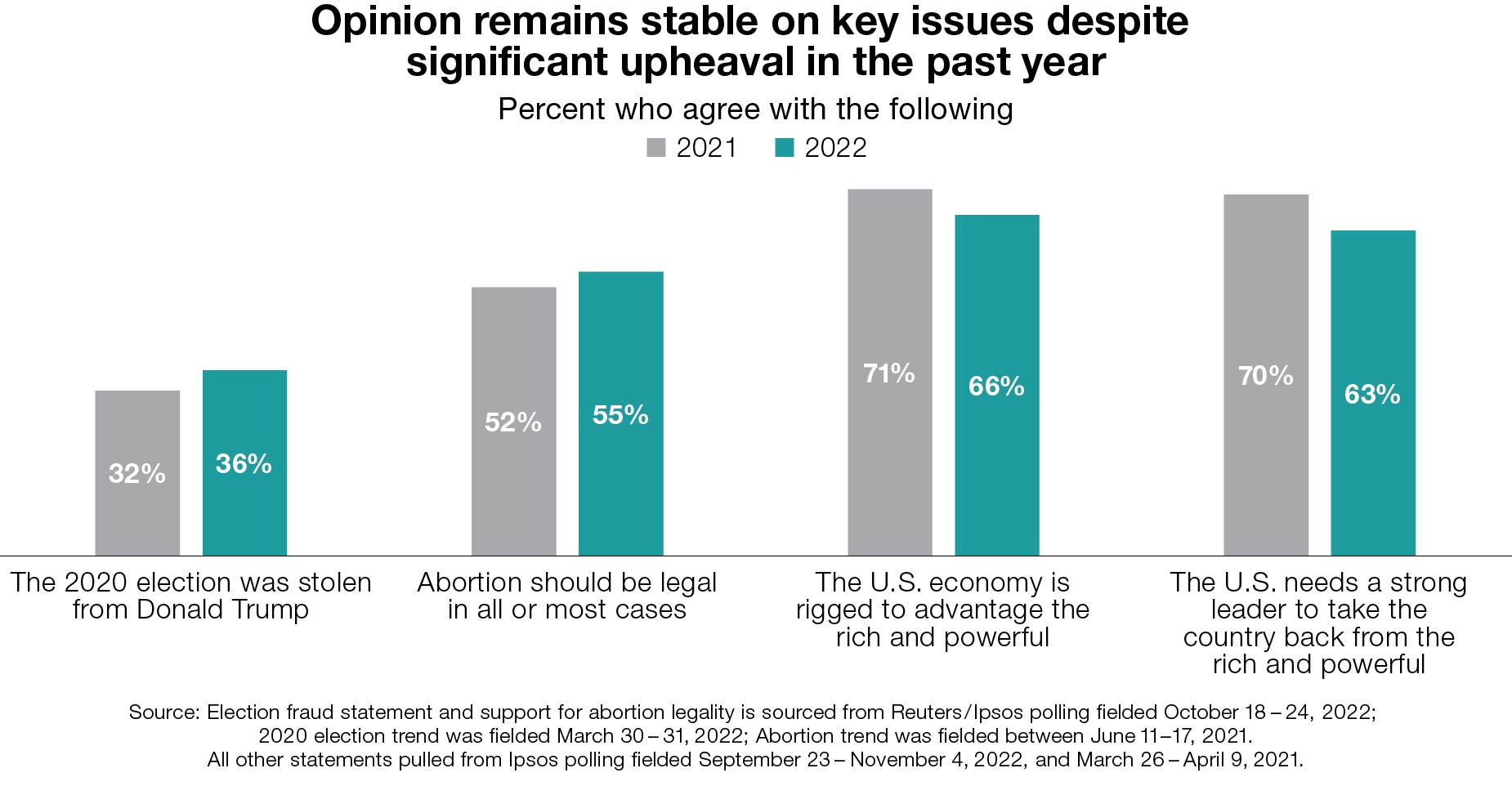
Taking a step back, despite all the disruption and change this year has brought, Americans haven’t changed their minds about some of the most pressing issues of the day, pointing to the overall stickiness of sentiment among the electorate and consumers that contextualizes these turbulent times.
Support for abortion grew slightly, as did the belief that the 2020 election was stolen from former President Trump. At the same time, the belief that the U.S. economy is rigged to the advantage of the rich and that the country needs strong leaders to take the country back from the rich and powerful both saw slight declines in support, even as many Americans still feel this way.
These beliefs will continue to frame the public discussion, acting as the political context for business and political leaders and the media for at least the short-to-mid-term future.
#6. Public priorities are the same for 2023 as 2022—get inflation under control
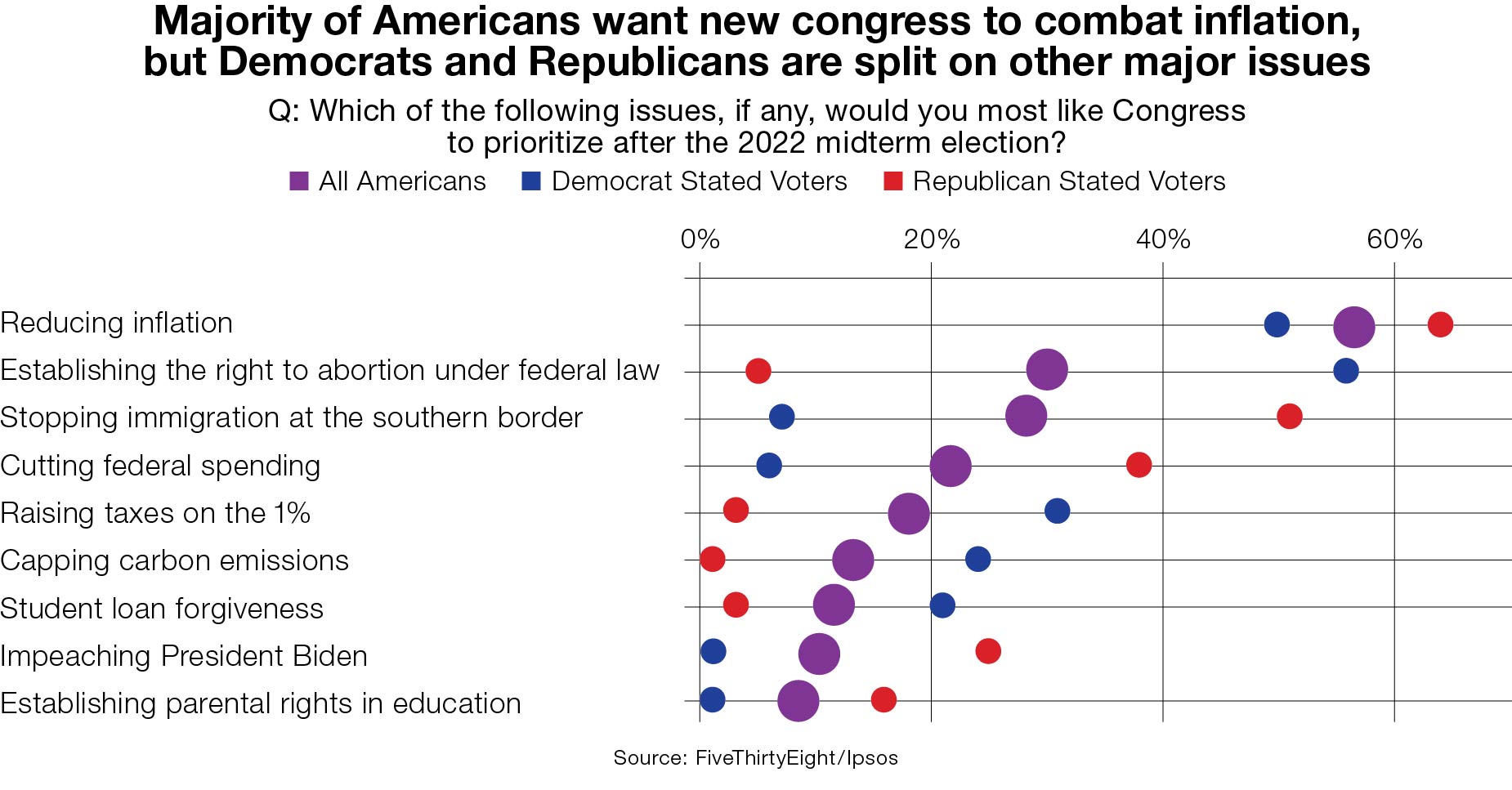
The midterms left the U.S. with a divided government. The House will be controlled by Republicans, Democrats will lead the Senate with a razor-thin margin, and the executive branch will continue to be controlled by Democrats. But Americans still have high hopes over the next two years.
Inflation is the issue both parties and most Americans would like Congress to act on in the new year. Outside of that, all other issues mirror larger political fissures. Democrats, for example, are looking to Congress to establish the federal right to abortion, while Republicans want to see action on immigration.
But given the split control of Congress, expect legislative gridlock, more executive actions, and Republican Congressional investigations over the next two years.
Things to watch in 2023
- Unemployment figures and consumer debt
- How the nation navigates the political gridlock in Washington
- The ways political leaders will be jockeying for power through touching on wedge issues that their base cares about as the country gears up for the presidential primaries
- Whether public opinion on the biggest issues of the day stays steady
![[WEBINAR] Know America at 250: Public Opinion Update](/sites/default/files/styles/list_item_image/public/ct/news_and_polls/2026-09/250_0.png?itok=7pwykKmG)
![[WEBINAR] Ipsos Global Trends 2026: The U.S. Edition](/sites/default/files/styles/list_item_image/public/ct/event/2026-09/thumbnail-gt-26.png?itok=AbsiS6xk)
![[WEBINAR] AI in Higher Education: How AI is Reshaping Teaching and Learning](/sites/default/files/styles/list_item_image/public/ct/event/2026-10/How%20AI%20Is%20Reshaping%20Teaching%20and%20Learning.png?itok=XYdLaI-4)