
Two-thirds of Americans concerned about impact of rising prices on holiday gift budgets
Washington, D.C., December 1, 2022 – A new Ipsos poll on behalf of Shutterfly finds that while many Americans plan to send holiday cards and gifts to connect with family and friends this year, a majority are concerned about the impact of rising prices on their holiday budgets. Balancing the desire to find thoughtful gifts for their loved ones with recent inflationary pressures, at least half of Americans say they are planning to send holiday cards or gifts to fewer people this year. Regardless of how many people ultimately make someone’s gift or card list, about three in five view sending cards as a way to stay close to friends and family, and two-thirds admit to spending a lot of time to find the perfect gift for a loved one.
For more information about this study, click here.
Detailed Findings
1. Many Americans say they plan to connect with friends and family through giving or receiving holiday cards this year. While most say they are likely to purchase, rather than make their own, cards or gifts, a majority say that the ability to customize a gift is an important factor in their purchasing decisions.
- More than two in five (43%) say they plan to send out holiday cards to connect with family and friends this holiday season. Of those who report planning to send out holiday cards, most say they are likely to buy or design a card including an inspiring quote (73%), followed by a funny joke or sentiment (61%), a meaningful poem (59%), and personal or family news (54%).
- Women (48%) and older Americans ages 55+ (56%) are more likely than men (37%) and younger Americans (33% of ages 18-34, 36% of ages 35-54), respectively, to report planning to send out holiday cards this year.
- When ranking what they may enjoy most about receiving holiday cards this year, about half of Americans rank either personal photos (49%) or personal/family news (47%) in their top two.
- A plurality of Americans (48%) say they are likely to purchase, rather than make their own, gifts/cards this holiday season. Two in five (39%) say they are likely to create, rather than purchase, their holiday gifts/cards.
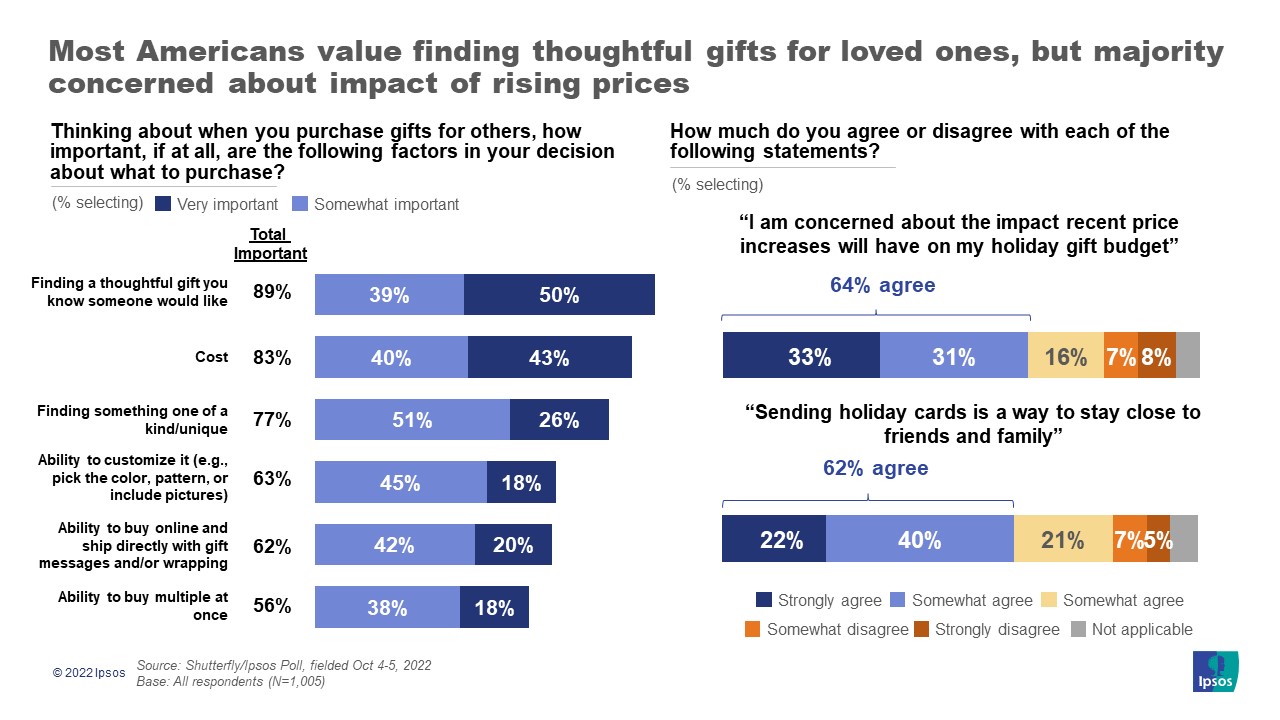
- However, three in five (63%) say that having the ability to customize a gift is an important factor when deciding what to buy for another person.
- Younger Americans ages 18-34 (73%) and people with children under 18 in the home (76%) are more likely than older Americans (62% of ages 35-54, 57% of ages 55+) and people without children (58%), respectively, to say it is important to be able to customize a gift for another person.
2. In addition to gift customization, a majority of Americans say it is important to find thoughtful gifts for others. While spending a lot of time choosing gifts that are “just right,” more than a third say they are stressed about finding a meaningful gift for their loved ones.
- Nine in ten (89%) Americans say it is important to find a thoughtful gift you know someone would like when thinking about purchasing gifts for others. Similarly, four in five (77%) say it is important to find something one of a kind or unique.
- About two-thirds (64%) agree they spend a lot of time choosing gifts that are “just right” for their loved ones.
- When it comes to sending cards, 62% say it is a way for them to stay close to friends and family; among those who actually plan to send out holiday cards, 85% agree.
- Two in five say they are somewhat or very stressed about not finding a gift that is meaningful for their loved one(s).
3. Against the backdrop of rising inflation in the past year, many Americans are balancing budgetary concerns with their desire to find meaningful gifts for their loved ones. At least half say they are likely to send holiday cards or gifts to fewer people this year.
- Nearly two-thirds (64%) report being concerned about the impact of rising prices on their holiday gift budgets. Separately, almost half (47%) report being somewhat or very stressed about being able to afford holiday gifts.
- One quarter say they plan to spend less on holiday shopping this year, an eight-percentage point jump from 2021*. This includes nearly one in three women (32%), compared to 17% of men.
- Fifty-five percent of Americans say they are likely to give holiday gifts to fewer people this year. Half (52%) say the same for holiday cards.
- Seven in ten (69%) say they plan to start holiday shopping early this year (before late November). One in five (21%) say they had already started by early October.
*Note: In the September 2021 study, the sample included U.S. adults ages 18-70. This year, the study uses a nationally representative sample of U.S. adults ages 18+. Further information about the September 2021 survey can be found here.
About the Study
These are the findings of an Ipsos poll conducted on behalf of Shutterfly between October 4-5, 2022. For this survey, a sample of 1,005 adults age 18+ from the continental U.S., Alaska, and Hawaii was interviewed online in English.
The sample was randomly drawn from Ipsos’ online panel, partner online panel sources, and “river” sampling and does not rely on a population frame in the traditional sense. Ipsos uses fixed sample targets, unique to each study, in drawing a sample. After a sample has been obtained from the Ipsos panel, Ipsos calibrates respondent characteristics to be representative of the U.S. Population using standard procedures such as raking-ratio adjustments. The source of these population targets is U.S. Census 2019 American Community Survey data. The sample drawn for this study reflects fixed sample targets on demographics. Post-hoc weights were made to the population characteristics on gender, age, race/ethnicity, region, education, and income.
Statistical margins of error are not applicable to online non-probability polls. All sample surveys and polls may be subject to other sources of error, including, but not limited to coverage error and measurement error. Where figures do not sum to 100, this is due to the effects of rounding. The precision of Ipsos online polls is measured using a credibility interval. In this case, the poll has a credibility interval of plus or minus 3.8 percentage points for all respondents. Ipsos calculates a design effect (DEFF) for each study based on the variation of the weights, following the formula of Kish (1965). This study had a credibility interval adjusted for design effect of the following (n=1,005, DEFF=1.5, adjusted Confidence Interval=+/-5.3 percentage points).
For more information on this news release, please contact:
Mallory Newall
Vice President, US
Public Affairs
+1 202 374 2613
About Ipsos
Ipsos is one of the largest market research and polling companies globally, operating in 90 markets and employing over 18,000 people.
Our passionately curious research professionals, analysts and scientists have built unique multi-specialist capabilities that provide true understanding and powerful insights into the actions, opinions and motivations of citizens, consumers, patients, customers or employees. Our 75 solutions are based on primary data from our surveys, social media monitoring, and qualitative or observational techniques.
Our tagline "Game Changers" sums up our ambition to help our 5,000 customers move confidently through a rapidly changing world.
Founded in France in 1975, Ipsos has been listed on the Euronext Paris since July 1, 1999. The company is part of the SBF 120 and Mid-60 indices and is eligible for the Deferred Settlement Service (SRD).ISIN code FR0000073298, Reuters ISOS.PA, Bloomberg IPS:FP www.ipsos.com


