Forget Politics! On US Social Media, the UK is more about Adele, soccer... and Hogwarts
Washington, D.C. - On behalf of the British Council, the Risk Analytics Division of Ipsos Public Affairs recently conducted a social media and web search analysis to explore the current relationship between the United States and the United Kingdom and its future prospects. Analysis of U.S. internet activity between 2016 and 2018 reveals that 64 per cent of U.S. social media mentions relevant to the U.K. were concerned with culture, compared with 18 per cent for politics. In the U.S., online discussions of pop star Adele surpassed those of Brexit on average over the periods analyzed, which included the month immediately following the U.K.’s EU referendum vote. Web analysis shows that the phrase "special relationship", often used to describe the bilateral relationship, has almost four times more popular traction in the U.K. than in the U.S., and not much in either. The detailed findings are reported in https://www.britishcouncil.org/organisation/policy-insight-research/a-special-relationship.
Mutual Attraction
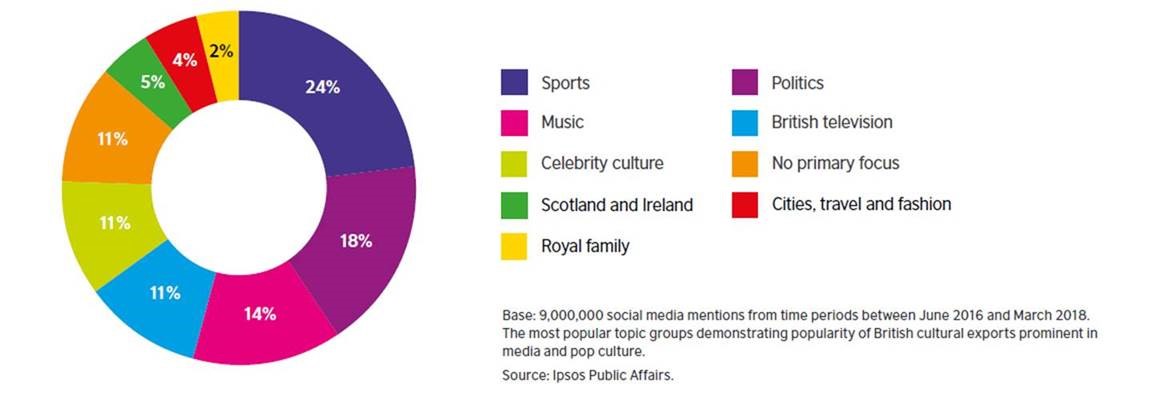
The social media analysis revealed that approximately 64 per cent of all the analyzed conversations on American social media relating to the U.K. referenced British culture (broadly defined), compared to 18 per cent referring to politics. Similarly, social media analysis revealed a large continuing interest in the U.S. in British cultural exports. Prominent among these were popular musicians like Adele and David Bowie, television shows like the Great British Bake Off and Downton Abbey, and British sports (largely soccer).
U.S. social media mentions referring to the U.K., grouped by category
 In order to identify cultural similarity between countries, Ipsos Public Affairs accordingly examined web search patterns for names of popular celebrities, politicians, and important historical figures for both the U.S. and the U.K. Ipsos then calculated search interest in these names for a number of countries around the world and ranked them accordingly. The results showed that Americans are interested in both popular and historical British figures. British people were not quite as enamored of American celebrities. Yet they rank highly when it comes to interest in American historical figures. These high rankings suggest overall similar interests both in terms of popular and historical culture. This suggests that Americans and Britons are very much interested in each other’s popular culture and history, and share an interest in similar topics and people.
The social media analysis also showed rising positive sentiments over the period in question. There were surges of interest in political events and figures in the other country, with terms such as ‘Brexit’, ‘Trump’, ‘Theresa May’, and ‘Boris Johnson’ showing spikes in the immediate aftermath of key political events, followed by returns to lower levels of interest. It is perhaps worth pointing out, however, that social media discussions of pop star Adele still surpassed those of Brexit, suggesting that British popular culture is of more interest to ordinary people in the U.S. than British politics, and that analysts of the relationship should remain aware that cultural factors often tend to have a greater impact on global views of countries than political issues.
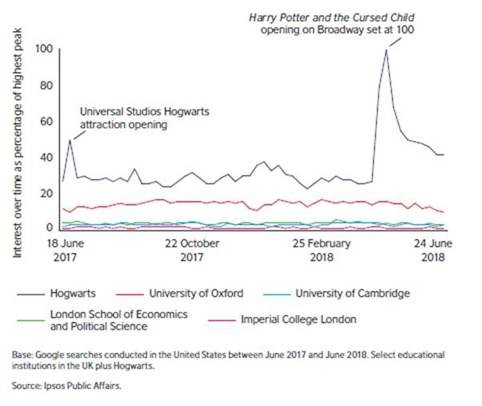
The social media analysis found that, while British education was not a particularly popular topic of discussion on American social media, leading British universities (Oxford, Cambridge, LSE, Imperial, and Edinburgh) featured relatively highly in American web search trends. However, the most-mentioned British educational establishment throughout the period analyzed was Hogwarts.
Leading British educational institutions, according to U.S. social mentions
Another finding is the steady social media discussion of joint military ties and shared international security concerns partly by the large numbers of American soldiers who served alongside British service personnel before returning to live in the U.S., often in the non-coastal ‘fly-over’ states where British cultural penetration is otherwise perhaps less obvious.
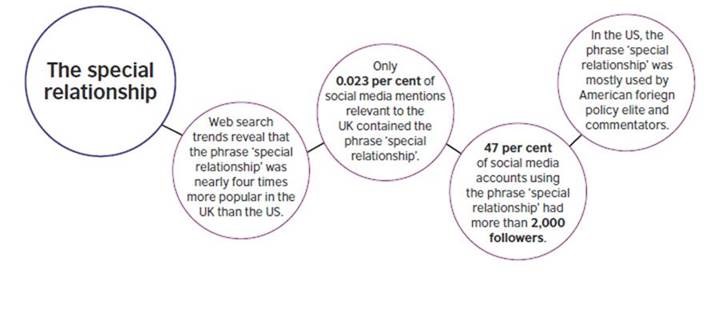
The research examined whether the phrase “special relationship” has much popular traction – particularly in the U.S. – but also whether the ties that underpin it remain strong and important. The objective was to help shed light on whether the special relationship is an aspirational theory with little underpinning in current reality – or whether it is in fact quite the reverse: a flourishing reality disguised by lack of awareness or cynicism about its theoretical label. When the term ‘special relationship’ related to the U.K. was examined through social media and search trend analytics, it was found to be largely absent from mainstream American social media. It was nearly four times less popular, per capita, as a phrase in American as opposed to British social media posts. In as much as it is used in the U.S., it is a term mostly deployed by American political and foreign policy commentators: 47 per cent of social media accounts using the phrase had more than 2,000 followers, and it had a low level of grass roots interest. There was an increase in web searches for, and conversations about, the special relationship at the time of the EU Referendum and Donald Trump’s inauguration, but in both cases they quickly subsided.
Popularity of the phrase "special relationship" in social media and web searches
Social Media and Web Trends Analysis
To conduct the research, Ipsos Public Affairs targeted three specific moments in time, consisting of a one-month period immediately following the Brexit vote (June 23, 2016), Donald Trump’s inauguration (January 20, 2017), and early 2018 (February 17, 2018). A total of nine million social media mentions were collected from across the United States (approximately three million per time period), including four million unique content mentions (i.e., not retweets or other types of content shares).
The analysis was conducted utilizing Ipsos social intelligence analytics, including proprietary machine learning algorithms applied to social media and search trends data. The analysis relied on analysis of major social media and network platforms such as Facebook, Instagram, Google, Reddit, YouTube, and Twitter among others. Methodologies applied for this study include: text analytics – author/pattern clustering and word associations, Google search trends, search similarity by country and topic modelling.
TFIDF (Term Frequency-inverse Document Frequency) was utilized to vectorize social media mentions in text analytics and topic modelling. It is a numerical statistic, which reflects the weight (importance) of words to a document. In order to identify groups of users with similar interests, Ipsos Public Affairs utilized the clustering algorithm non-negative matrix factorization (NMF). When applied to text, this technique identifies terms and phrases that pattern together across texts. As an example, the algorithm identified one cluster of users primarily concerned with the television show Sherlock and some of the most relevant terms to that group of users include: Sherlock, season, Holmes, Watson, SDCC, trailer, Cumberbatch, sdcc2016, Benedict, series, John, episode, Benedictcumberbatch, etc. Another subset of users was primarily concerned with Brexit and its economic effects. Some of the key terms include: Brexit, U.K., vote, EU, post, May, bank, mortgage, news, Britain, says, Trump, rates, IMF, economy, global, growth, etc.
Text Analysis - Word Association
To identify terms that were associated with a topic of interest, Ipsos Public Affairs separated data into groups of posts, which contained words denoting our topics, such as ‘history’, ‘politics’, or ‘diplomacy’. A technique called support vector machine (SVM) classifier was then utilized to identify vocabulary closely associated with each group of posts. For every topic Ipsos Public Affairs ranked the terms by the SVM association score multiplied by the overall frequency of the term, to identify terms that were both common and associated with the topic of interest. As a supplement to this technique Ipsos Public Affairs also identified the most common words and phrases in the subset of posts containing topic terms. As an example, in period 2 the top five phrases most associated with the terms ‘sports’ or ‘soccer’ were: Champions league, premier league, Manchester united, Rio2016 Olympics, and Manchester city. In Period 1, the top five phrases most associated with the term ‘politics’ were: Boris Johnson, David Cameron, Jeremy Corbyn, Prime Minister and Nigel Farage.
Google Search Trends
Google’s search interest score is relative and per search, meaning that the values are represented on a scale of 0 to 100. Each search interest value represents the raw number of searches for a word or phrase divided by the total number of all searches. After retrieving a set of search interest scores, each score is normalized relative to the maximum in the set, meaning that the maximum will always be 100, with other values displayed as a percentage of that maximum. This score can be restricted to a given geographic area or time period, to either rank areas or show change over time.
Search Similarity By Country
In order to identify cultural similarity between countries, Ipsos Public Affairs examined search patterns for important names. It created several dictionaries, including sets of names denoting currently popular celebrities, politicians, and important historical figures for both the U.S. and U.K.. For the list of popular modern names, the 37 most searched people in the U.S. in 2017 (politicians, actors, musicians, and athletes), and the top ten most searched people in the U.K., were used. The list of top historical figures in U.S. history was sourced from an article in the Smithsonian Magazine, and includes such individuals as Abraham Lincoln and Louis Armstrong. A 2002 BBC poll provided an equivalent list of British historical figures and contained politicians like Winston Churchill, musicians like Paul McCartney, and many others. Ipsos calculated average search interest in these names for each country and ranked them accordingly.
Topic Modelling
Ipsos Public Affairs used the NMF algorithm to identify clusters of words that patterned together across posts and shares containing the phrase ‘special relationship’. These clusters represent topics of discussion. One group of posts was centered around discussions of Theresa May. Here are some of the words most associated with that cluster: May, Theresa, Prime, Minister, British… Another cluster referred to Brexit: union, European, leave, vote, historic… The frequency of each of these topics were examined to determine the most common themes in discussions of the ‘special relationship’.
For more information on this news release, please contact:
Peter Szczesny
Director, U.S.
Ipsos Public Affairs
+1 646 267-1975
[email protected]
About Ipsos Public Affairs
Ipsos Public Affairs is a non-partisan, objective, survey-based research practice made up of seasoned professionals. We conduct strategic research initiatives for a diverse number of American and international organizations, based not only on public opinion research, but elite stakeholder, corporate, and media opinion research.
Ipsos has media partnerships with the most prestigious news organizations around the world. Through our media partnerships, Ipsos Public Affairs is a leading source of intelligent information for businesses and professionals in the U.S., Canada, the UK, and internationally. Ipsos Public Affairs is a member of the Ipsos Group, a leading global survey-based market research company. We provide boutique-style customer service and work closely with our clients, while also undertaking global research.
About Ipsos
Ipsos is an independent market research company controlled and managed by research professionals. Founded in France in 1975, Ipsos has grown into a worldwide research group with a strong presence in all key markets. Ipsos ranks fourth in the global research industry.
With offices in 89 countries, Ipsos delivers insightful expertise across five research specializations: brand, advertising and media; customer loyalty; marketing; public affairs research; and survey management.
Ipsos researchers assess market potential and interpret market trends. They develop and build brands. They help clients build long-term relationships with their customers. They test advertising and study audience responses to various media and they measure public opinion around the globe.
Ipsos has been listed on the Paris Stock Exchange since 1999 and generated global revenues of €1,780.5 million in 2017.