Despite pandemic, interest in battery electric vehicles growing in the U.S. and China
The Covid-19 pandemic has caused many things to slow down, but that can’t be said for Americans’ interest in battery electric vehicles (BEVs). Ipsos’ new 2020 Global Mobility Navigator Study, focusing on Electrification, found global interest remained on par with the numbers we saw from 2019. However, the study reveals there has been an increase in interest in the U.S. and Chinese markets.
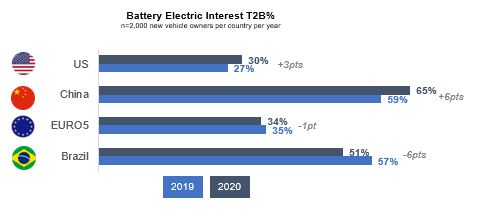
This increased interest can be attributed to the greater level of familiarity with BEVs. For instance, over the last few years we have found the highest level of knowledge about BEVs in China. Those consumers who are more familiar are more likely to consider a BEV.
Ipsos’ John Kiser, Senior Vice President, U.S. Automotive & Mobility, said the same type of correlation between greater familiarity and greater interest can be seen in America.
“In the U.S., knowing a fair amount about BEVs more than doubles consideration for them. Increasing future sales for BEVs will rely on companies improving awareness of their product. The auto industry has seen this need to improve familiarity in the past, with some advanced driver assist features such as ACC and even autonomous driving. A growing consumer awareness led to an increased desire to have them in vehicles.”
An interesting consumer insight from the Ipsos 2020 Mobility Navigator Study is that the perceived top benefits of the BEV and the top consumer drivers do not all necessarily align. Globally, vehicle owners and those considering purchasing BEV agree the top benefits of going electric are improving the environment, adding convenience and reducing ownership costs. However, what drives someone to make the purchase is beyond these benefits. Ipsos conducted a regression analysis to reveal the benefits that are most impactful for BEV consideration. The top driver focused on convenience, such as access to public transport / express lanes (carpool, HOV, etc.). After convenience, a nice-looking vehicle proved to be very important. This was followed by a BEV which uses more advanced technology.
By establishing the winning formula as greater knowledge = greater consumer interest, electric vehicle manufacturers must focus their marketing on increasing familiarity with BEVs. A critical component for messaging is tackling the key barriers preventing drivers from adopting a BEV. The Ipsos Study uncovered the top five issues: driving range, affordability, access to charging stations, overall ownership cost and battery life. It is imperative manufacturers address these barriers, because only in doing so, can they increase familiarity and remove any myths and negative perceptions about BEVs. To counteract these concerns, companies should stress the following: many new BEVs on the market do have substantial driving range and are affordable with attractive gas ownership better than gas counterparts, and there is also easy access to charging - especially with home level 2 chargers on the market. After addressing the barriers, the benefits of owning a BEV can be highlighted. These benefits can be presented as a best of both worlds for potential owners. Drivers will not only have the functional benefit of going green, they will also have the emotional benefit of owning a great looking vehicle with advanced technology.
Adopting new technology is a challenge for most consumers, and the bigger the purchase the bigger the challenge for manufacturers. There are few bigger purchases that a consumer will make than that of a vehicle. In order to overcome the unknown of BEVs, consumers need to be educated on the product so they will feel comfortable and confident. Companies should focus on what truly matters to potential buyers and present that information in a consumer-friendly manner. Things like how many miles per charge do you get, how quickly can it charge, how many charge stations are there in my city and how much would the average driver save on gas in one year. This is all relevant information consumers want to know upfront, before considering getting behind the wheel of their very own BEV.
For more insights from Ipsos’ 2020 Global Mobility Navigator Study, please contact:
John Kiser
Senior Vice President, U.S. Automotive & Mobility
[email protected]
+1 925 577 3743
Our Ipsos Mobility Navigator study provides further insights on what is required such as range limits, charging speeding requirements and what is needed to be competitive in the market. The next 10 years in the automotive industry will see a significant number of new BEVs launched across key vehicle segments and regions. Ipsos can help navigate this highly competitive marketplace to maximize the opportunity for new BEVs coming out.
Look for our next installment in December 2020, which will focus on Shared Mobility. We will measure the impact of COVID-19 on vehicle and mobility usage, as we know ride hailing/public transportation usage has been reduced during this pandemic. Will it increase by December?
About the Study
For this survey, Ipsos interviewed a total of 22,003 new vehicle owners aged 18-74 in the United States of America, China, Japan, Brazil, France, Germany, Italy, Spain, Great Britain, Russia and India.
Data collected are weighted so that each country’s sample composition best reflects the demographic profile of the adult population according to the country’s most recent census data. Data are also weighted to give each country an equal weight in the total “global” sample. Online surveys can be taken as representative of the general working age population in France, Germany, Great Britain, Italy, Japan, Spain, and the United States. Online samples in Brazil, mainland China and India are more urban, educated, and/or affluent than the general population and the results should be viewed as reflecting the views of a more “connected” population.
Additional data is available through a subscription to the offering. See the link below for more information.
About Ipsos
Ipsos is the world’s third largest market research company, present in 90 markets and employing more than 18,000 people.
Our passionately curious research professionals, analysts and scientists have built unique multi-specialist capabilities that provide true understanding and powerful insights into the actions, opinions and motivations of citizens, consumers, patients, customers or employees. We serve more than 5,000 clients across the world with 75 business solutions.
Founded in France in 1975, Ipsos has been listed on the Euronext Paris since July 1st, 1999. The company is part of the SBF 120 and the Mid-60 index and is eligible for the Deferred Settlement Service (SRD).
ISIN code FR0000073298, Reuters ISOS.PA, Bloomberg IPS:FP