US and global public attitudes to the 2022 Beijing Winter Olympics
New York, NY, February 2, 2022 — Ahead of the 2022 Winter Olympics set to begin on February 4 in Beijing, China, Ipsos asked more than 20,000 individuals across 28 countries for their views on the Games. The poll covers attitudes towards the rules and conventions of the Games, the most popular sports, and awareness of the Paralympics.
Key findings
- 42% of U.S. adults say that they are interested in the upcoming Beijing Winter Olympics, a level somewhat lower than for last summer’s Tokyo Olympics and the previous Winter Olympics in PyeongChang, South Korea.
- Interest in the upcoming Winter Olympics is also slightly lower in the U.S. than it is on average globally.
- Figure skating is the most popular event both in the U.S. and globally. Ice hockey and snowboarding are the next two sports Americans are most interested in, while globally, hockey and ski jumping follow figure skating in popularity.
- Public opinion is divided over whether the Olympics should go ahead as planned even if the Covid-19 pandemic isn’t over yet.
- Awareness about the disciplines featured in the Paralympic Games is low. A majority of Americans feel the Paralympics don’t get a fair amount of coverage by the news and sports media.
Interest
Ahead of the event, an average of 46% of adults surveyed across all 28 countries say they are interested in the Beijing Winter Olympics. This is level with the public mood in the lead-up to last year’s Tokyo Summer Olympics and slightly lower than for the 2018 Winter Olympics in PyeongChang, South Korea when 51% said they were interested.
- Interest in this year’s Winter Olympics is highest in host country China (84%) and lowest in Germany (30%).
- In the U.S., interest for the upcoming games is four points lower than it was for the Tokyo Olympics (42% interest for Beijing vs. 46% interest for Tokyo) and 13 points lower than for the 2018 Winter Olympics (55%).
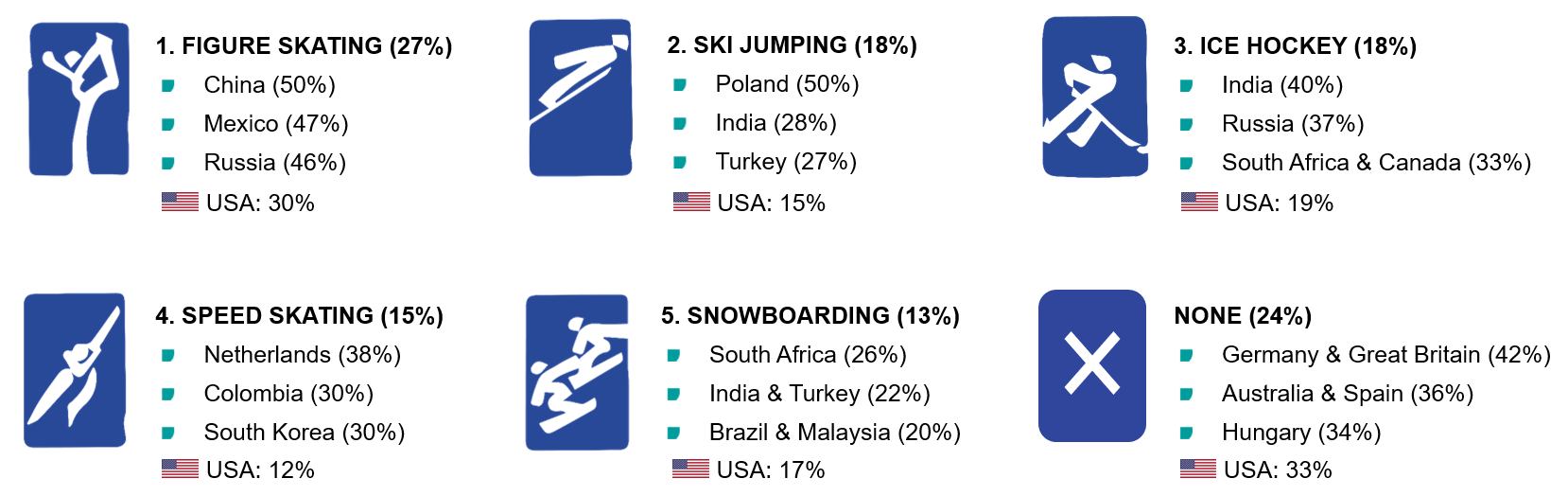
Looking at the 15 different events at this year’s Winter Olympics, figure skating comes out on top in terms of public interest globally. The five sports that people around the world say they are most interested in following are:
- Figure skating (27%) – also #1 in the U.S. (30%)
- Ski jumping (18%) – #4 in the U.S. (15%)
- Ice Hockey (18%) – #2 in the U.S. (19%)
- Speed skating (15%) – #6 in the U.S. (12%)
- Snowboarding (13%) – #3 in the U.S. (17%)
However, when presented the full list of winter sports, 24% worldwide and 33% in the U.S. say they are not interested in any of the 15 events.
Another Pandemic Olympics
It seems that people remain cautious about big international sporting events going ahead in a pandemic context. Only slightly more than half (52% both in the U.S. and on average globally) agree that the Beijing Winter Olympics should go ahead as planned, regardless of the Covid-19 situation.
- Host nation China is where popular support for Beijing 2022 going ahead is highest (80%) while South Korea, the 2018 host, is where it is lowest (30%).
The Paralympics
The survey shows a widespread lack of awareness around the sports that will be part of the 2022 Winter Paralympics in Beijing. When asked to identify the six Winter Paralympics sports from a list that also includes 15 disciplines (the six correct ones and nine that are incorrect), most do not know (50% on average globally, 57% in the U.S.) or say “none” (10% globally and 17% in the U.S.).
- None of the six Winter Paralympics disciplines is correctly identified by more than one in five adults globally and by more than one in seven in the U.S. (from 13% for hockey to just 3% for biathlon).
On average globally, 60% agree that their country’s news and sports media give a fair amount of coverage to the Paralympic Games. However, this is not the case in the U.S. where a majority (53%) disagree.
Attitudes toward controversial issues
The survey also explored public views on some more controversial issues related to the Olympics:
- The global public is divided on whether it is appropriate for athletes to take a public stand on social or political issues when performing at the Olympics -- 55% on average across all 28 countries agree, but only 47% in the U.S. do.
- A majority in every country, including the U.S. (65%) agree that athletes from countries that have been officially barred for doping should still be allowed to compete under their country’s Olympic banner – if they are not implicated in the doping.
- While an average of 57% globally agree that there is “too much nationalism on display” at the Olympics, it is the case of only 42% of Americans.
About the Study
These are the results of a 28-country survey conducted by Ipsos on its Global Advisor online platform. Ipsos interviewed a total of 20,025 adults aged 18-74 in the United States, Canada, Malaysia, South Africa, and Turkey, and 16- 74 in 23 other markets between December 23, 2021 – January 7, 2022.
The samples consist of approximately 1,000 individuals in each of Australia, Belgium, Brazil, Canada, mainland China, France, Germany, Great Britain, Italy, Japan, Spain, and the U.S., and 500 individuals in each of Argentina, Chile, Colombia, Hungary, India, Malaysia, Mexico, the Netherlands, Peru, Poland, Russia, Saudi Arabia, South Africa, South Korea, Sweden, and Turkey.
The samples in Argentina, Australia, Belgium, Canada, France, Germany, Great Britain, Hungary, Italy, Japan, the Netherlands, Poland, South Korea, Spain, Sweden, and the U.S. can be taken as representative of their general adult population under the age of 75.
The samples in Brazil, mainland China, Chile, Colombia, India, Malaysia, Mexico, Peru, Russia, Saudi Arabia, South Africa, and Turkey are more urban, more educated, and/or more affluent than the general population. The survey results for these countries should be viewed as reflecting the views of the more “connected” segment of their population.
The data is weighted so that each market’s sample composition best reflects the demographic profile of the adult population according to the most recent census data.
“The Global Country Average” reflects the average result for all the countries and markets where the survey was conducted. It has not been adjusted to the population size of each country or market and is not intended to suggest a total result.
Where results do not sum to 100 or the ‘difference’ appears to be +/-1 more/less than the actual, this may be due to rounding, multiple responses, or the exclusion of “don't know” or not stated responses.
The precision of Ipsos online polls is calculated using a credibility interval with a poll of 1,000 accurate to +/- 3.5 percentage points and of 500 accurate to +/- 5.0 percentage points. For more information on the Ipsos use of credibility intervals, please visit the Ipsos website. The publication of these findings abides by local rules and regulations.
For more information on this news release, please contact:
Nicolas Boyon
Senior Vice President, Public Affairs, U.S.
About Ipsos
Ipsos is the world's third-largest Insights and Analytics company, present in 90 markets and employing more than 18,000 people.
Our passionately curious research professionals, analysts, and scientists have built unique multi-specialist capabilities that provide true understanding and powerful insights into the actions, opinions, and motivations of citizens, consumers, patients, customers, or employees. We serve more than 5000 clients across the world with 75 business solutions.
Founded in France in 1975, Ipsos is listed on the Euronext Paris since July 1st, 1999. The company is part of the SBF 120 and the Mid-60 index and is eligible for the Deferred Settlement Service (SRD).
ISIN code FR0000073298, Reuters ISOS.PA, Bloomberg IPS:FP www.ipsos.com