
Understanding Choice & Consumption
What Else Are We Missing?
Where we often fall short is in our efforts to understand how the full context in which a product is used impacts product choices (i.e., situational influencers). Situational influencers include the physical environment that the product will be used in (e.g., home, work, gym, car), the social context (e.g., presence of others, who specifically), temporal factors (e.g., time of day, time constraints) and how the products will be used (e.g., carried around, held in one hand).
Situational influencers are important because we don't use products in a vacuum. We use them within a certain physical, social, temporal and usage context. Take time of day for example. Thinking of meal occasions, we have been brought up to expect only certain foods in the morning. Considerations for "breakfast" food include, among others, eggs, waffles, pancakes, toast, cereal, and oatmeal. Our mental construct of what breakfast is instantly limits the food options we would consider at breakfast. But other situational factors can also often influence food choices. For example, recent news reports that cereal consumption is on the decline as people no longer have time to eat cereal in the morning. So, even though cereal is considered a breakfast food, it seems that time (or the lack thereof) is a powerful situational influencer of what is consumed at breakfast. When choosing a product, consumers often start with the situation they are in (or will be in the near future) and then determine the products that would solve their needs in that particular situation.
How Important are Situational Influencers on Product Choice?
We may all agree that situational variables should be considered when trying to understand choice or consumption of a product or service but recently we observed the magnitude of their impact. In a recent study, we conducted a driver analysis with the specific intent to understand the impact of situational variables relative to product benefits on product choice. In the chart below, it is clear that situational variables (e.g., meal occasion type, time constraints, place of consumption) have an impact on product choice that far exceeds that of the benefits offered by products.
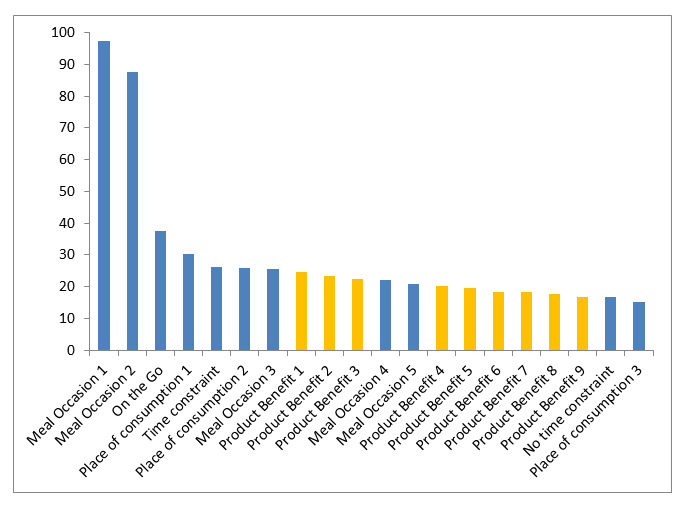
While the relative impact of situational to product specific drivers will vary from category to category, these results strongly suggest we need to give greater consideration to situational variables. Situational variables cannot be manipulated like product variables, but we can certainly use the insights gained from situational variables for product design. Knowing the common benefits of products used in a particular meal, social or temporal occasion, for example, can help provide insights into product design. Understanding product usage context is especially important for multi-national manufacturers that operate in a global marketplace where situational variables can vary widely from country to country.
Next Steps
So, what should manufacturers do? There are many opportunities in research to measure situational influencers. At a very basic level, it may start by simply asking consumers how they use a product. In the food example provided above, respondents were asked to report on two recent food occasions, what they ate, when they ate, where they ate, who they ate with, the benefits they were seeking during the occasion, etc. Such questions can be easily incorporated in an Attitude and Usage, or Habits and Practices study. In product testing specifically, we can ask respondents to evaluate products at, for example, different times of day and to describe the context at a particular point in time (e.g., who was around, where they were, what they were doing). When capturing "in the moment" situational factors is critical, mobile research would be particularly effective. These efforts can all result in getting a bigger picture of what influences product choice.

![[WEBINAR] TOAST 2026: Under Pressure - Fewer, Fragmented, Fought-For](/sites/default/files/styles/list_item_image/public/ct/event/2026-07/thumbnail-templates_1_0.png?itok=MxL-wPJW)
