Americans Going in Different Directions After One Year of Trump
Reader Note: This survey was conducted before the federal government shutdown which may impact attitudes.
Washington, DC - Polarization continues to dominate the American political landscape one year into Donald Trump’s presidency, according to a new Ipsos poll of 1,007 U.S. adults. Overall, just a third of Americans (32%) say America’s position as a world leader has improved since Trump’s inauguration, yet this measure is driven entirely by partisanship: 58% of Republicans agree compared to only 15% of Democrats and 33% of Independents.
Similarly, 71% of Republicans say the happiness of people in their community has improved in the past year, while just 31% of Democrats and 40% of Independents agree. The chasm between Republicans and Democrats extends to views on the health of the U.S. economy (79% of Republicans say it has gotten better versus 46% of Democrats), personal happiness (80% versus 59%), and Americans’ willingness to support each other (47% versus 26%).
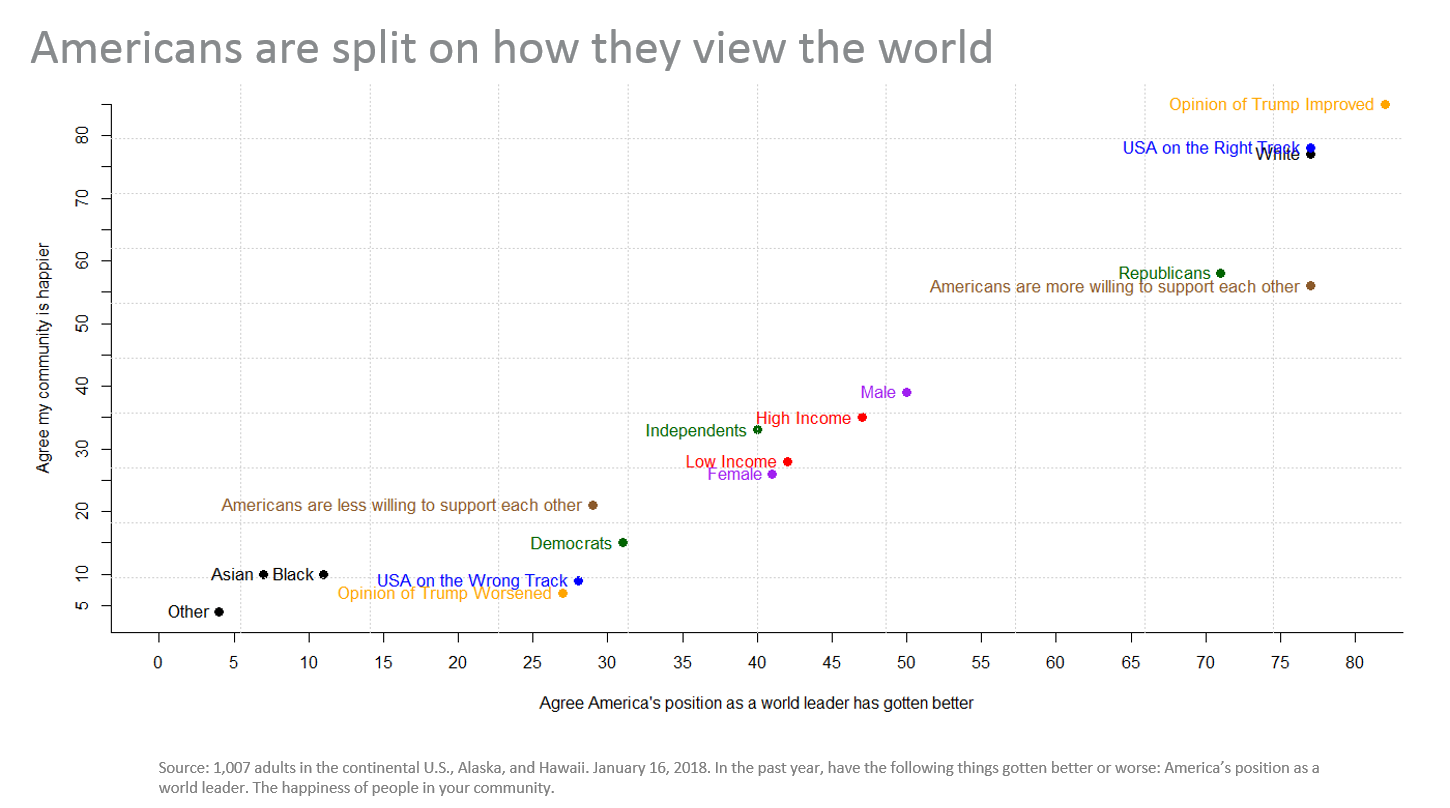
These polarized attitudes along party lines have transmitted over to Trump’s approval rating, with 73% of Republicans approving of his job performance, compared to just 10% of Democrats and 36% of Independents. A majority of the American public (55%) says their opinion of Trump has worsened in the past year, including more than 8 in 10 Democrats (82%) and a majority (56%) of Independents.
One area where there is some degree of bipartisan agreement are the expectations of Trump’s first year in office: 76% of Republicans, 69% of Democrats, and 63% of Independents say that his first year as president was as expected. Additionally, a majority of Republicans (76%), Democrats (68%), and Independents (75%) agree with each other that traditional political parties and politicians don’t care about people like them.
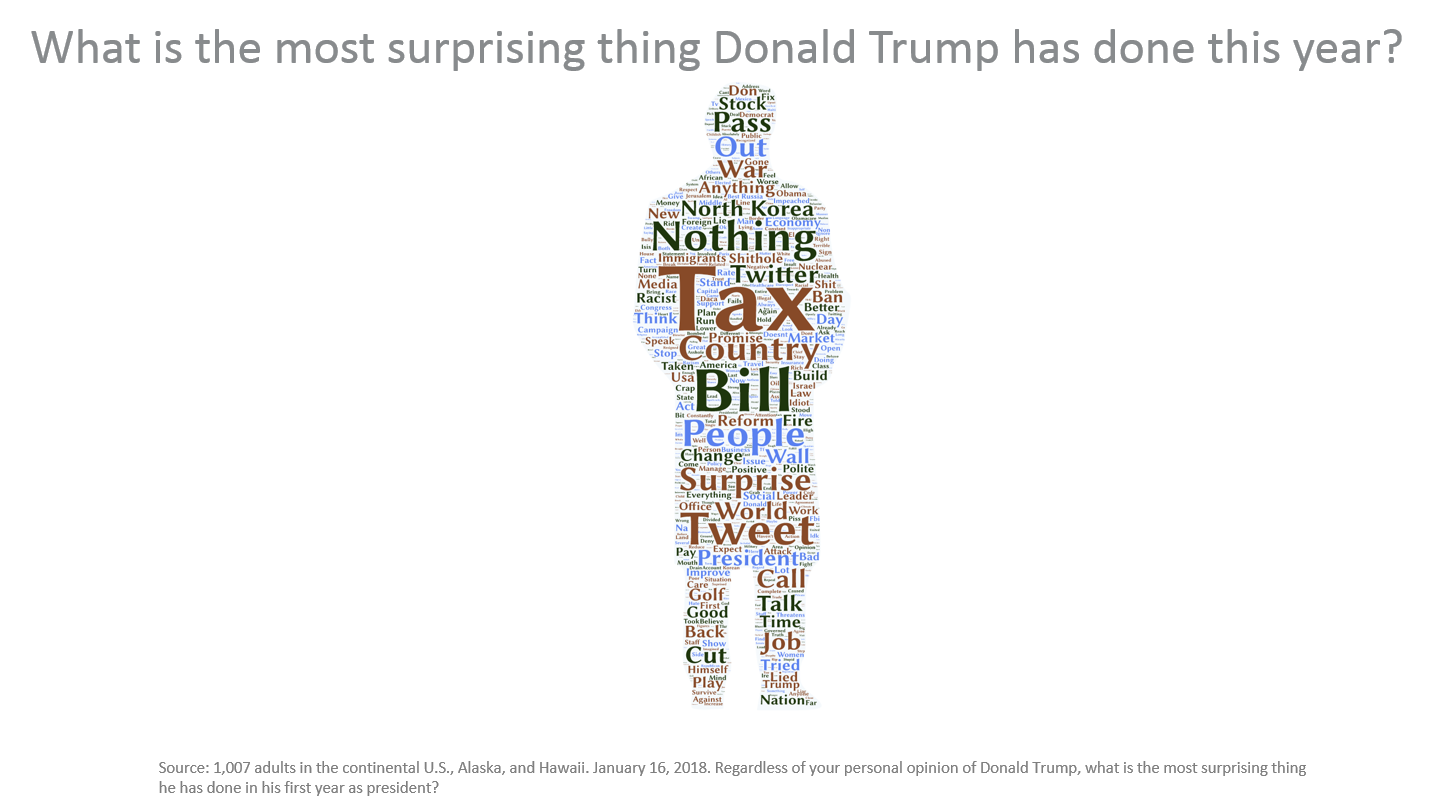
Democrats and Independents also find common ground on the most surprising thing President Trump has done in his first year – threatening military action against North Korea. On the other hand, Republicans believe passing the largest tax cut in decades, closely followed by moving Israel’s capital city to Jerusalem, is the most surprising.
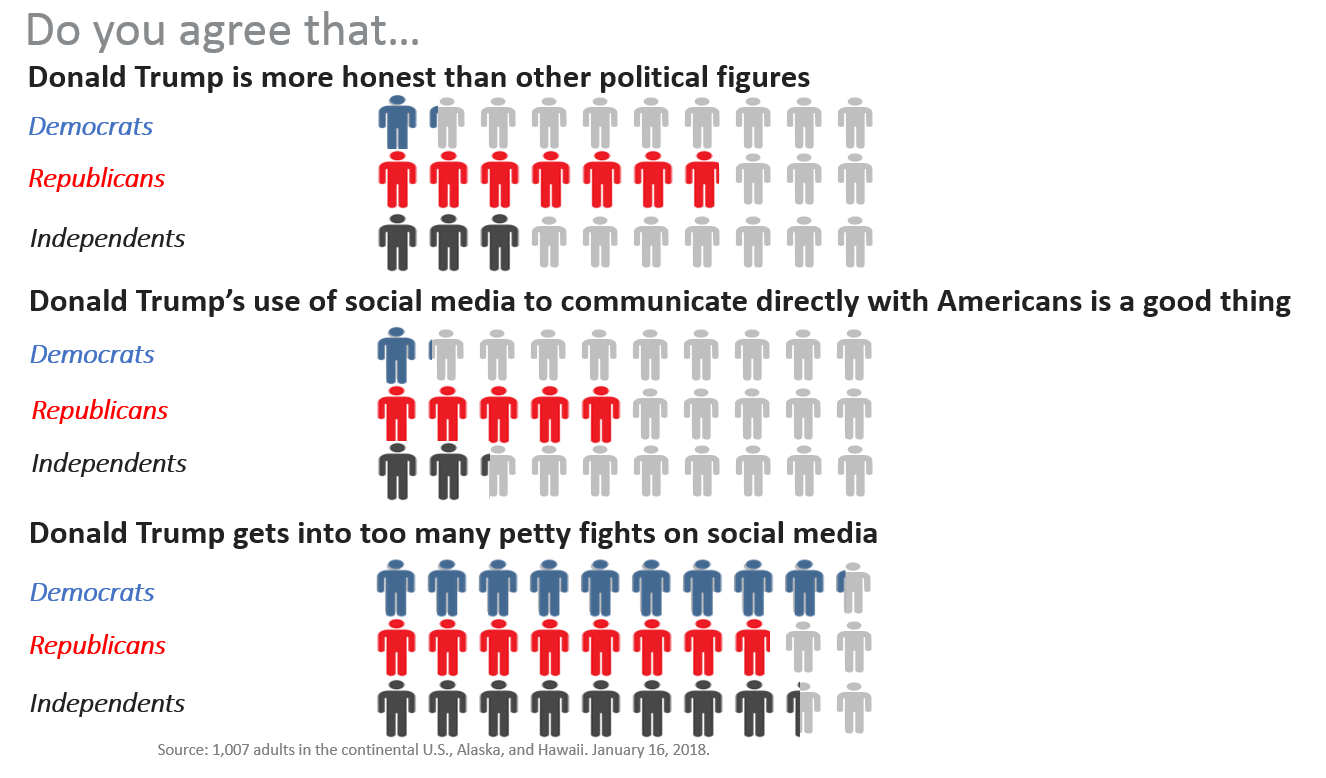
While opinions of Trump remain strong overall among Republicans, there are underlying signs his position may have weakened among some rank and file Republican supporters, with a quarter (26%) voicing that their opinion of the President has worsened over the past year. This may be in part due to his use of Twitter and social media: 78% of Republicans believe that Donald Trump gets into too many petty fights on social media, and they are split on whether his use of social media to communicate with Americans is a good thing. Conversely, he is buoyed by two-thirds of Republicans (68%) who believe that he is more honest than other political figures, compared to 13% of Democrats and 30% of Independents who feel the same way.
Trump’s low approval among Democrats and Independents and worsening views among 1 in 4 Republicans could potentially hurt Trump and the Republicans’ ability to hold onto their congressional majorities in the upcoming November 2018 midterm elections, which typically see an incumbent president’s party lose seats. If these elections were held today, 38% of Americans say they would choose the generic congressional Democratic candidate in their home district, compared to 30% choosing a generic congressional Republican. However, one in five (19%) Americans remain undecided, and Republicans could also be bolstered by positive economic outlooks. When respondents were asked whether their personal finances had improved over the past year, 67% of Republicans, 56% of Democrats, and 68% of Independents stated that they have. Likewise, when asked about their local economies, 77% of Republicans, 50% of Democrats, and 55% of Independents say they’ve seen improvement over the same period.
About this Study
These are findings from an Ipsos poll conducted January 16, 2018. For the survey, a sample of roughly 1,007 adults age 18+ from the continental U.S., Alaska and Hawaii was interviewed online in English. The sample includes 368 Democrats, 303 Republicans, and 230 Independents.
The sample for this study was randomly drawn from Ipsos’s online panel (see link below for more info on “Access Panels and Recruitment”), partner online panel sources, and “river” sampling (see link below for more info on the Ipsos “Ampario Overview” sample method) and does not rely on a population frame in the traditional sense. Ipsos uses fixed sample targets, unique to each study, in drawing sample. After a sample has been obtained from the Ipsos panel, Ipsos calibrates respondent characteristics to be representative of the U.S. Population using standard procedures such as raking-ratio adjustments. The source of these population targets is U.S. Census 2013 American Community Survey data. The sample drawn for this study reflects fixed sample targets on demographics. Post-hoc weights were made to the population characteristics on gender, age, race/ethnicity, region, and education.
Statistical margins of error are not applicable to online polls. All sample surveys and polls may be subject to other sources of error, including, but not limited to coverage error and measurement error. Where figures do not sum to 100, this is due to the effects of rounding. The precision of Ipsos online polls is measured using a credibility interval. In this case, the poll has a credibility interval of plus or minus 3.5 percentage points for all respondents. The credibility interval is 5.8% for Democrats, 6.4% for Republicans, and 7.4% for Independents. Ipsos calculates a design effect (DEFF) for each study based on the variation of the weights, following the formula of Kish (1965). This study had a credibility interval adjusted for design effect of the following (n=1,007, DEFF=1.5, adjusted Confidence Interval=5).
For more information about conducting research intended for public release or Ipsos’ online polling methodology, please visit our Public Opinion Polling and Communication page where you can download our brochure, see our public release protocol, or contact us.