
Americans’ Trust in Doctors Offers Path Forward for an Effective Vaccine Rollout
The COVID-19 pandemic had an immediate and positive impact on issues of trust in healthcare providers in the U.S. There were spontaneous and planned demonstrations in support of first responders and healthcare workers, indicating a surge of trust emerging from the crisis.
Several surveys Ipsos conducted over the last few months show how enduring this trust is, even as faith in other core institutions wavered over the course of the pandemic. According to a December NPR/Ipsos survey, 85% of Americans say that they hold a “great deal” or “a fair amount” of trust in their personal doctors. This puts healthcare providers at the top of a list that includes faith and spiritual leaders, Dr. Anthony Fauci, President Biden and former President Donald Trump.
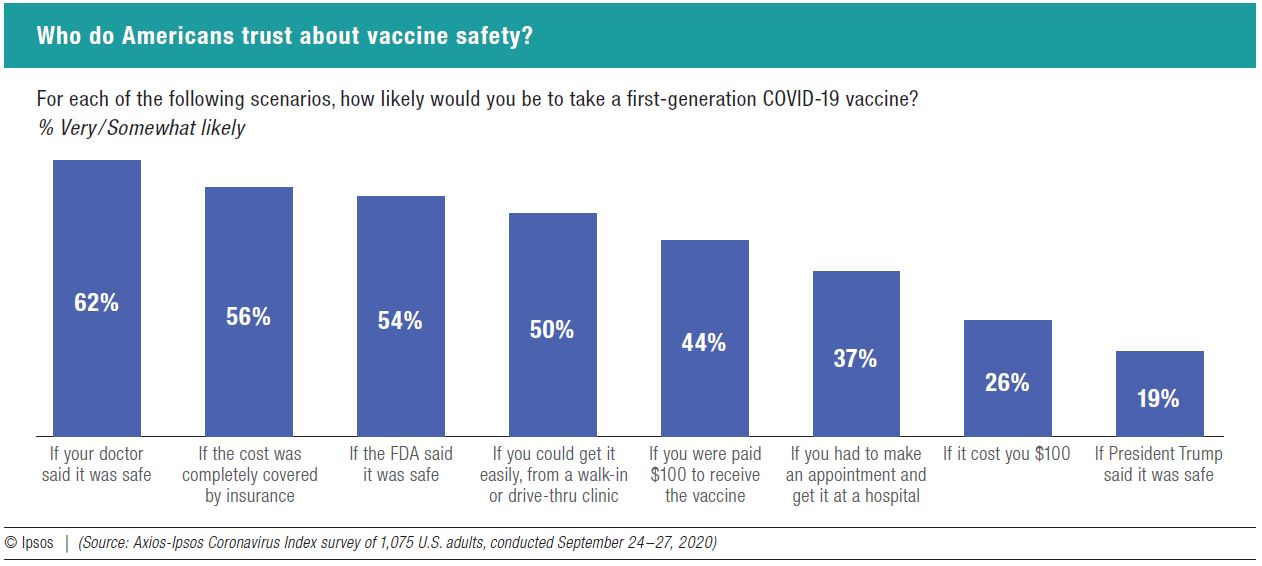
Just as telling about Americans’ trust in medical professionals is how likely Americans were to say they would take a COVID-19 vaccine prior to it becoming available. In September 2020, before the vaccines officially came online, just 37% of Americans said they were likely to get a shot as soon as it became available. However, if their doctors told them to, it was another matter entirely. Six in ten (62%) Americans said they would be likely to take the vaccine if their own doctors told them it was safe, compared to 54% who said they would get the vaccine if the FDA endorsed it, and 56% who said they would get it if the cost was covered by insurance.
Americans have grown less wary of the vaccine now that the early versions have received FDA authorizations and as the vaccine rollout picks up pace. However, while 53% now say they either have received the vaccine or would get it as soon as it became available to them, 18% say they would not get it at all. The importance of leveraging trust to defeat the virus cannot be overstated. Experts put the exact percentage who need to be vaccinated to achieve herd immunity at anywhere from 70% to 90% of the population. At least some of the skeptics will need to be reassured that the vaccine is safe before herd immunity is possible.
Given the severity of the current wave of the COVID-19 pandemic in the U.S., and the troubles in rolling out the available vaccines, healthcare providers and professionals are at risk of experiencing lowered trust from the communities they serve. Despite these challenges, there are still opportunities for healthcare providers and professionals to build back trust with the public, namely by cultivating effective communication at all levels of the industry with patients and caregivers.
Download our latest paper for research and insights to inform your communications strategies.
AMERICANS’ TRUST IN DOCTORS OFFERS PATH FORWARD FOR AN EFFECTIVE VACCINE ROLLOUT
Doctors emerged as some of the most trusted figures nationally from the pandemic. What are the implications for the healthcare industry at large? Trust in healthcare in the United States has been declining since the 1960s, reflecting a broader erosion of trust in public institutions. Paradoxically, while faith in the healthcare industry as a whole may have diminished, Americans place high levels of trust in their doctors and rate their own experience of healthcare positively. And while the coronavirus pandemic may have had a corrosive effect on trust in major public institutions, like the federal government and the CDC, doctors have emerged as among the most trusted figures nationally. The great amount of trust Americans have in their doctors speaks to the power of individualized, personal connection and offers lessons for the healthcare industry to cultivate trust with the public. Building on this trust will be essential to corralling the pandemic. Saving lives comes down to persuading the public to follow the relevant public health guidance and to adopt precautions like wearing a mask in public, social distancing and getting vaccinated against the virus. Despite all the noise in mainstream and digital media, the most critical determining factor of beliefs about COVID and willingness to get the vaccine is information source. On that point, there is relatively little ambiguity. Most Americans trust the same experts they turn to for day-to-day healthcare: personal physicians.
AMERICANS ARE RELYING ON THEIR PERSONAL DOCTORS TO GUIDE THEM THROUGH THE PANDEMIC AND VACCINES
The COVID-19 pandemic had an immediate and positive impact on issues of trust in healthcare providers in the U.S. There were spontaneous and planned demonstrations in support of first responders and healthcare workers, indicating a surge of trust emerging from the crisis. Several surveys Ipsos conducted over the last few months show how enduring this trust is, even as faith in other core institutions wavered over the course of the pandemic. According to a December NPR/Ipsos survey, 85% of Americans say that they hold a “great deal” or “a fair amount” of trust in their personal doctors. This puts healthcare providers at the top of a list that includes faith and spiritual leaders, Dr. Anthony Fauci, President Biden and former President Donald Trump. Just as telling about Americans’ trust in medical professionals is how likely Americans were to say they would take a COVID-19 vaccine prior to it becoming available. In September 2020, before the vaccines officially came online, just 37% of Americans said they were likely to get a shot as soon as it became available. However, if their doctors told them to, it was another matter entirely. Six in ten (62%) Americans said they would be likely to take the vaccine if their own doctors told them it was safe, compared to 54% who said they would get the vaccine if the FDA endorsed it, and 56% who said they would get it if the cost was covered by insurance.
Americans have grown less wary of the vaccine now that the early versions have received FDA authorizations and as the vaccine rollout picks up pace. However, while 53% now say they either have received the vaccine or would get it as soon as it became available to them, 18% say they would not get it at all. The importance of leveraging trust to defeat the virus cannot be overstated. Experts put the exact percentage who need to be vaccinated to achieve herd immunity at anywhere from 70% to 90% of the population. At least some of the skeptics will need to be reassured that the vaccine is safe before herd immunity is possible. Given the severity of the current wave of the COVID-19 pandemic in the U.S., and the troubles in rolling out the available vaccines, healthcare providers and professionals are at risk of experiencing lowered trust from the communities they serve. Despite these challenges, there are still opportunities for healthcare providers and professionals to build back trust with the public, namely by cultivating effective communication at all levels of the industry with patients and caregivers. Successful communication requires that all parties produce statements that are grounded in truth, are appropriate to the context and come from an intentional space built on an emotional truthfulness. This will be an incredibly important consideration in response to the pandemic, especially when it comes to encouraging widespread acceptance of a coronavirus vaccine.
Utilizing research to illuminate the path forward
Clear communication between patients and healthcare providers is an essential component of cultivating trust. Another key component involves determining a means to capture the presence of trust and to be able to continually measure and monitor it. One such example is the CAHPS suite of patient experience surveys, which include questions that can provide insight about trust in healthcare providers and facilities. These questions ask respondents to rate communication, respect and their healthcare decision-making autonomy. The CAHPS surveys also include questions about the respondent’s experience with appointment schedulers and other support staff, which contextualize patients’ overall experience with the provided care. Finally, respondents are asked whether they would recommend the healthcare facility. Utilizing such survey methodology, healthcare leaders at hospitals and systems can directly assess—and address—questions of trust. A composite measure could be created from the items listed above, encompassing individual components that, when combined, serve as a measure of trust in providers or facilities. With either approach, scores of “trust” measures can be linked to open-ended questions to develop deeper insights into drivers of trust in providers and facilities. This can help administrators, providers and leaders create programs to broaden and deepen the trust relationships they are working to grow and sustain with their patients. Increasingly, trust is recognized as a key factor in building relationships with patients at both the provider and the institutional level. Strengthened trust between patients, providers and institutions offers many tangible and intangible benefits for all involved. For patients, trust in their providers and the institutions where they seek care can enhance their loyalty and satisfaction, translating into better communication with providers, better adherence to their clinical plans and better outcomes. For providers, communication benefits are significant, as are the possibilities of recruiting patients into being collaborators around their own care. For institutions, enhanced trust can lead to elevated patient experience scores, loyalty and revenue through improved outcomes. Building trust is a multifaceted process. Sustaining it can strengthen the health of patients, providers, hospitals and healthcare systems. In the face of a resurgent coronavirus epidemic and the complexities of the vaccine rollout, the importance of trust must not be underestimated. Mahak Kumari is a Research Analyst with Ipsos Public Affairs. Seth Messinger, Ph.D., is a Research Scientist with Ipsos Public Affairs. Catherine Morris is a Data Journalist with Ipsos Public Affairs.

![[WEBINAR] What the Future: Success](/sites/default/files/styles/list_item_image/public/ct/event/2026-07/thumbnail-wtf-success-.png?itok=3mnYDE70)