
Consumer Consciousness
 As the world has become more volatile, it’s more important than ever for brands to be able to react to changing consumer behavior.
Companies with a high level of consumer consciousness are more aware and attuned to consumer needs and more agile to developing needs or market disruptions.
Consumer centricity is a term often used to describe a strategy to use consumer insights to drive the business. Companies are using different strategies to get closer to the consumer. However, these strategies will not result in a true consumer-centric organization.
In this paper we outline a more holistic strategy, based on recent developments in neuroscience and data science/analytics to build a kind of consumer consciousness in an organization. An integrated, learning system that puts the consumer at the heart of the business.
There are three elements of a consumer conscious company:
- The availability and connectivity of consumer data.
- The ability of a connected consumer data platform to create fresh, new consumer insights with appropriate analytical capabilities.
- The level of activation of these consumer insights and feedback of learnings to the consumer data platform.
Watch the video
For companies looking to get consumer consciousness right, we identified five critical success factors. These are:
- First, we believe that insights generation is a specific skill and its responsibility and curation should be under a single command. This ensures consistency of quality and the ease in which insights can be activated in profitable marketing interventions.
- Second, the insights should be holistic and ‘de-siloed’ to make sure we build on the integration of various data sources. It is increasingly important that companies develop strong links between insight generation and digital analysts, computer scientists, and marketers.
- Thirdly, manual, qualitative, curation will always be a key skill in the creation of consumer insights. But in an automated data world, insights can also be generated through digital analytics and data science.
- Fourth, consumer data collection and insights generation are not ad-hoc activities. It should be an ‘always-on’ capability where data collection and insights generation is a 24-7 automated activity. What’s important is to consider a smart data strategy and architecture to be able to manage large amounts of consumer data from various sources in an integrated platform.
- And fifth, to reduce complexity, we believe that a conscious consumer data ecosystem should be built and maintained with a small number of external partners.
INTRODUCTION
In an increasingly volatile world, where market developments and consumer behaviors have become harder to predict, more companies are turning to consumer-centric strategy frameworks.
Consumer centricity is a term often used to describe a strategy to use consumer insights to drive the business. Companies are using different strategies to get closer to the consumer. Some companies focus on acquiring vast amounts of consumer data like sales data, social media feeds and market research reports. Other companies focus on IT systems to integrate available data on one platform. A third strategy is to use market research to find interesting insights to help drive innovation, communication or in-store activation. And another strategy is to use digital one-on-one marketing to give consumers personalized offers.
But none of these strategies separately will result in a true consumer-centric organization. In this paper we will outline a more holistic strategy, based on recent developments in neuroscience and data science/analytics to build a kind of consumer consciousness in an organization. An integrated, learning system that puts the consumer at the heart of the business.
Based on the integrated information theory developed by Dr. Tononi, a world-renowned neuroscientist, we developed a Corporate Consumer Consciousness Framework to help improve the level of a company’s consumer consciousness. Companies with a high level of consumer consciousness are more aware and attuned to consumer needs and more agile to changing consumer needs or market disruptions. Especially in today’s volatile world, deeply embedded Consumer Consciousness in any organization is critically important for companies to survive.
In this paper we will discuss:
- The building blocks of consumer consciousness
- Critical success factors to get consumer consciousness right
THE BUILDING BLOCKS OF CONSUMER CONSCIOUSNESS
Dr. Tononi has worked for many years on the understanding of the sense of self on human consciousness. When is a brain conscious and what determines consciousness? He developed a new integrated information theory and a mathematical formula to determine the level of consciousness based on the degree of a system’s connectivity and feedback.
Simplified, the three drivers in this mathematical formula are:
- The number of neurons and the level of connectivity between these neurons.
- The network’s ability to create new information.
- The level of feedback to the network (Dr. Tononi calls a network that does not use feedback, a ‘zombie’ network).
This formula is a great metaphor for the level of consumer consciousness within a company. Translated to consumercentricity, a consumer conscious company has three critical elements:
- The availability and connectivity of consumer data.
- The ability of a connected consumer data platform to create fresh, new consumer insights with appropriate analytical capabilities.
- The level of activation of these consumer insights and feedback of learnings to the consumer data platform.
1. THE AVAILABILITY AND CONNECTIVITY OF CONSUMER DATA
There is no consumer consciousness without data about consumers, competitors, the market, trends, sales, digital and offline shopping behavior, CRM data and brand data. Consumer data availability and new developments in Neuroscience and Behavioral Science can help companies to get closer to consumers than ever before. Consumergenerated data on social media and qualitative communities are other examples of the new research tools available to marketers to acquire deep consumer insights. With a consumer conscious data grid, companies are able to link consumer data with sales data, brand data, shopping behavioral data and much more in one connected data management system.
It is important to consider a smart data strategy and architecture to be able to manage AND integrate large amounts of consumer data from various sources in an integrated data platform. Advanced conscious consumer data management platforms can store and integrate high volume data and different types of consumer, brand, market and competitive data from various sources. The right data management frameworks will help to ensure data veracity. Ipsos has developed various types of platforms that companies can use to integrate and manage different consumer data sources, qualitative as well as quantitative. Ipsos MMA’s digital data platform is one example of an integrated data platform. Traditionally market research and consumer insights firms such as Ipsos have established strong data management frameworks that produce high levels of trustworthy data.
As an illustration, Nike has transformed its consumer data strategy with its Nike Direct Consumer Data Strategy. And Datorama has unified its marketing data in its Salesforce platform.
2. THE ABILITY OF A CONNECTED CONSUMER DATA PLATFORM TO CREATE FRESH, NEW CONSUMER INSIGHTS WITH APPROPRIATE ANALYTICAL CAPABILITIES
Integrated consumer data is not enough to create consumer consciousness. According to the Integrated Information Theory, a conscious network creates new information. That means that a conscious consumer system needs to use big data analytics, data science, smart curation, and advanced marketing modelling to find new, fresh consumer insights.
But first, what is an insight? A useful definition is that an insight is a fresh fundamental human truth about brands, products or services, which applies to specific consumers and can be used as a competitive advantage. It should show a tension and it should trigger new marketing intervention ideas.
Strong insights therefore are directly linked to business opportunities and should help to strengthen and grow the brand’s positioning and/or penetration. These fresh insights can come from human intelligence through meta-analysis of existing data. But they can also come from machine intelligence by incorporating secondary data streams (sales data, distribution, in-store merchandising, social data on shopping journeys) and use advanced data analytics to find new consumer insights.
For this to work, it is increasingly important that companies develop strong links between digital analysts, computer and data scientists, consumer insights experts and marketers.
Ipsos has both the qualitative expertise and the quant data analytical/data science/marketing modeling capabilities to help you develop these insight generation capabilities.
3. THE LEVEL OF ACTIVATION OF THESE CONSUMER INSIGHTS AND FEEDBACK OF LEARNINGS TO THE CONSUMER DATA PLATFORM
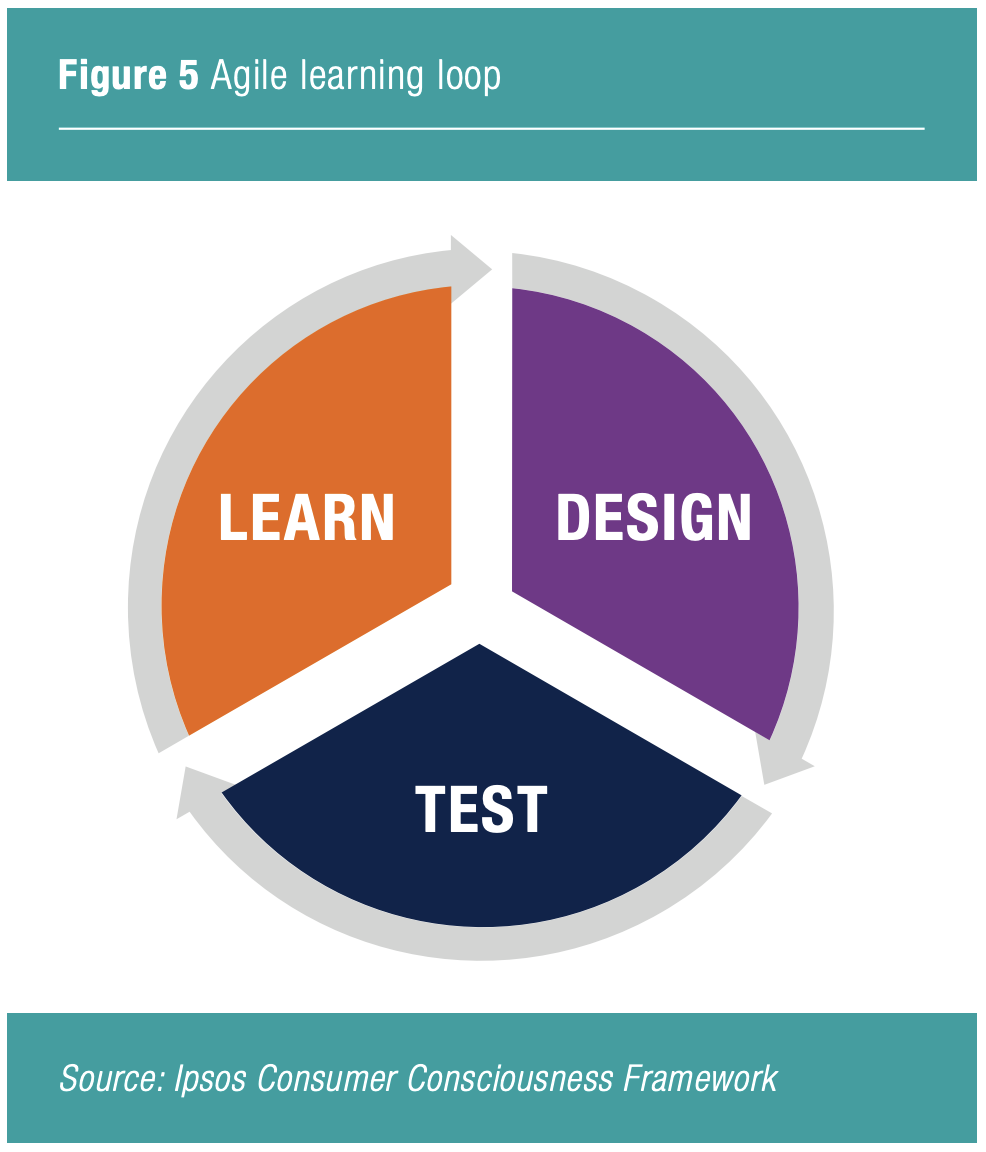
Having an integrated data strategy and finding fresh consumer insights is still not enough. To be a truly consumer conscious company, these insights need to be activated amongst other creative marketing interventions and the impact of these interventions need to be fed back into the system to create a learning loop.
This requires agile and fast feedback loops of designing marketing interventions, testing these interventions, and learning from these tests (design, test and learn). If done well, it will increase the level of organizational learning.
For example, a telecom company in the Netherlands started to enrich their consumer database with attitudinal data and data on consumer emotional needs based on advanced behavioral science principles. It is now automating the process of finding consumer insights to help reduce churn, deciding on a marketing campaign based on this insight and for these specific consumers. Then relevant consumers in their enriched database are targeted with this specific, personalized, marketing campaigns. The impact of the campaign is then fed back to the database to improve iterative campaigns to similar consumers. With this data driven consumer personalization, the company is getting close to a Conscious Consumer system.
CRITICAL SUCCESS FACTORS TO GET CONSUMER CONSCIOUSNESS RIGHT
We have identified that some companies and industries are more mature in their consumer consciousness. Those who are further up the maturity ladder benefit more from their investments in consumer consciousness. We have identified a small number of critical success factors but by no means believe there are collectively exhaustive.
- First, we believe that insights generation is a specific skill and its responsibility and curation should be under a single command. This ensures consistency of quality and the ease in which insights can be activated in profitable marketing interventions.
- Second, the insights should be holistic and ‘de-siloed’ to make sure we build on the integration of various data sources. It is increasingly important that companies develop strong links between insight generation and digital analysts, computer scientists, and marketers.
- Thirdly, manual, qualitative, curation will always be a key skill in the creation of consumer insights. But in an automated data world, insights can also be generated through digital analytics and data science.
- Fourth, consumer data collection and insights generation are not ad-hoc activities. It should be an ‘always-on’ capability where data collection and insights generation is a 24-7 automated activity. What’s important is to consider a smart data strategy and architecture to be able to manage large amounts of consumer data from various sources in an integrated platform.
- And fifth, to reduce complexity, we believe that a conscious consumer data ecosystem should be built and maintained with a small number of external partners.
IN SUMMARY
In this paper, we have discussed the importance of a Consumer Conscious Company in today’s volatile world. We have also discussed the three elements of a Consumer Consciousness based on the Integrated Information Theory from Dr. Tononi: (1) Availability and connectivity / integration of consumer data; (2) the ability of the company to develop fresh consumer insights from these consumer data and (3) the ability to automatically activate these insights into marketing interventions and a feedback loop to make it a learning system.
This framework is not only able to compare your performance in each of these three areas, but also helps you to start to think about how to improve. Building Consumer Consciousness will give your company a competitive advancement and help you find improvement opportunities to be more successful in this volatile world.
Please reach out to Ipsos and the two writers of this article if you are interested in a conversation on what this framework can mean for your organization.

![[WEBINAR] TOAST 2026: Under Pressure - Fewer, Fragmented, Fought-For](/sites/default/files/styles/list_item_image/public/ct/event/2026-07/thumbnail-templates_1_0.png?itok=MxL-wPJW)
